
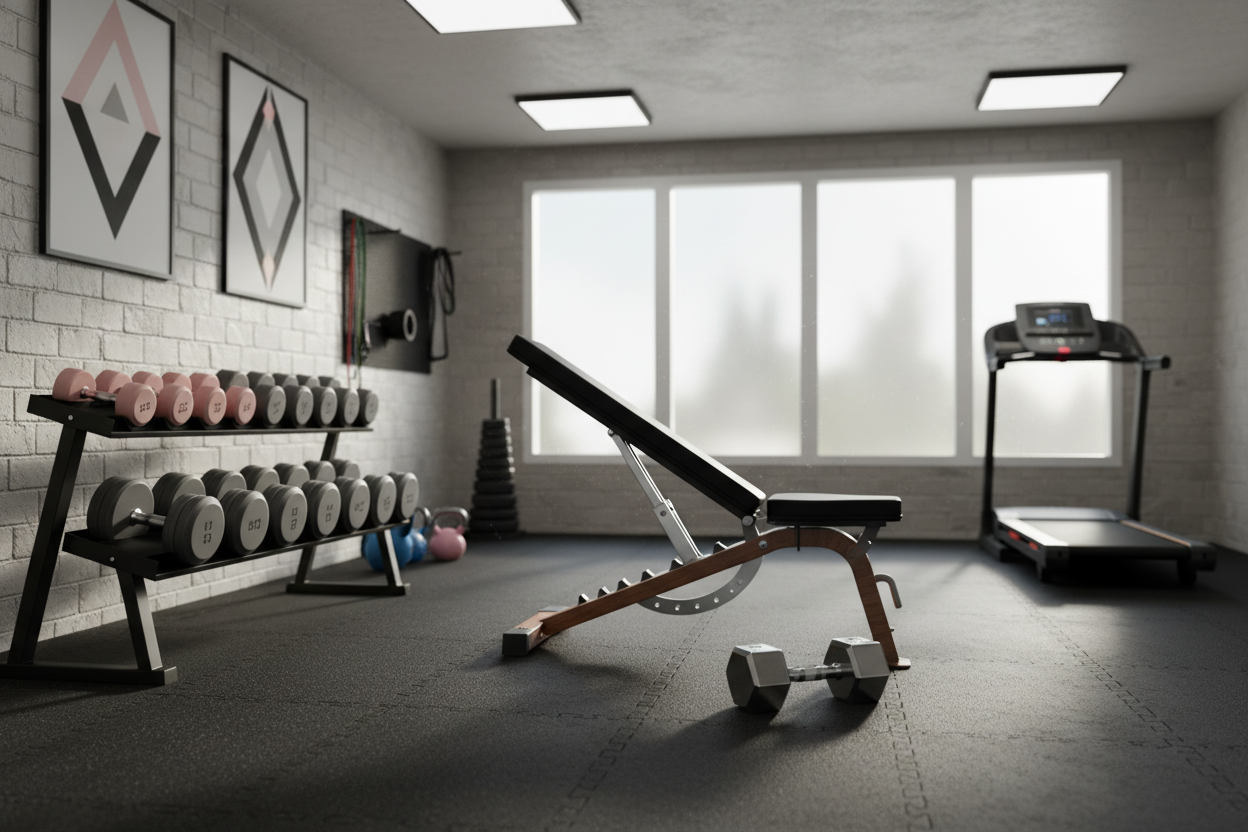
I used to walk into my local big-box gym and stare at that 40-foot wall of urethane with pure envy. I wanted that for my garage. I even spent a week measuring my wall, convinced I could fit a full dumbbell set gym in a single-car space. I was wrong, and I almost went broke trying to prove myself right.
The reality of training at home is that square footage is your most valuable currency. Trying to replicate a commercial gym dumbbells set is a fast track to a cluttered, unusable workspace where you spend more time navigating around racks than actually lifting. I learned the hard way that a curated selection beats a massive collection every single time.
Quick Takeaways
- Full sets from 5-100 lbs waste about 40% of your budget on weights you will rarely touch.
- A standard 3-tier rack eats up nearly 15 square feet of floor space once you account for the 'clearance' needed to lift safely.
- High-quality adjustables solve 90% of your training needs in the footprint of a shoebox.
- Strategic 'gap-filling' with fixed hex weights is the smartest way to scale.
Why We Are Obsessed With the Massive Commercial Rack
It is pure ego. We see that long row of chrome handles and perfectly aligned numbers and think 'progress.' We have been conditioned by years of commercial gym memberships to believe that a 5-to-100 pound run is the gold standard of a serious lifting environment.
But a commercial gym caters to hundreds of people with different strength levels. You are just one person. In a typical gym dumbbells set, those 7.5-pounders and 95-pounders serve a purpose for a wide demographic, but for a solo trainee, half of those increments are just expensive paperweights gathering dust.
I realized I was chasing an aesthetic rather than a functional training goal. I wanted my garage to look like a Pro-Performance center, but I was sacrificing the space I needed for a proper deadlift platform just to house a rack of weights I only used twice a month.
The Brutal Math of Floor Space vs. Usable Training Area
Let’s talk dimensions. A standard 3-tier dumbbell rack is roughly 5 feet wide and 2 feet deep. That sounds manageable until you realize you cannot tuck it flush into a corner and still reach the heavy weights on the bottom tier without blowing out your back. You need a 3-foot buffer in front of that rack just to operate.
That is 25 square feet of prime real estate gone. In a 200-square-foot garage gym, you just gave up 12% of your floor to storage. I started with a basic 10/15/20 set and quickly realized those three pairs did more for my accessory work than a full rack of 5-pound increments ever could.
When you are cramped, every inch counts. If your rack is blocking your ability to swing a kettlebell or step back for a lunge, your equipment is actually hindering your fitness rather than helping it. Professional athletes train in focused environments, not museums of iron.
Adjustables vs. Curating a Hand-Picked Fixed Rack
If you are tight on space, heavy-duty adjustable dumbbells are the only logical choice. Modern selectorized sets are fast, durable, and replace 15 pairs of weights in the space of two. I have dropped mine (moderately) for years and they still click into place perfectly.
However, I get the appeal of fixed weights. There is no 'clinking' sound, and they feel more balanced in the hand. If you hate adjustables, the smart move is a small rubber hex dumbbell set in your most-used increments. Most people only really need five or six specific pairs to cover 90% of their accessory volume.
I personally use a hybrid approach. I keep a pair of 50s and 70s on the floor for heavy rows and presses because I like the stability of a fixed head, but I use adjustables for everything else. It is the best of both worlds without the massive footprint.
How to Pick the Exact Pairs You Actually Need
Stop buying the 5-pound increments you never use. Nobody training at home actually needs 27.5s and 32.5s. You can bridge those gaps with rep ranges and tempo work. Identify your 'Core Four': a light pair for lateral raises, a medium pair for curls, a heavy pair for presses, and a 'goal' pair for heavy rows.
By building your own custom rack, you save enough cash to invest in a higher-quality barbell or a bench that doesn't wobble. I recommend starting with 15s, 30s, 50s, and 80s. That spread covers almost every movement pattern from high-rep isolation to heavy compound lifts.
Don't let the 'set' mentality trap you. Retailers love selling 5-50lb bundles because it clears inventory, but you are better off buying individual pairs that match your specific strength levels. Your garage will feel bigger, and your bank account will definitely look better.
Personal Experience: My $600 Mistake
I once scored a 'deal' on a full set of 5-50lb hex dumbbells on Craigslist. I felt like a king for exactly two days. Then I realized I spent $600 on weights I only used for three specific movements. I had six pairs of weights under 20 pounds that were literally just taking up space where my squat rack should have been. I ended up selling the 'dead weight' six months later at a loss just to get my floor space back.
FAQ
Are hex dumbbells better than round?
For a home gym, hex is superior. They won't roll away on an uneven garage floor, and they provide a stable base for movements like renegade rows or 'man-makers.'
Do I really need 5lb jumps?
No. For most people, 10lb jumps are perfectly fine. You can easily bridge the gap by increasing your reps by 2-3 per set before moving up to the next weight increment.
Should I get urethane or rubber?
Rubber is much cheaper and perfectly fine for home use. Urethane is more durable and doesn't smell, but unless you are training 20 people a day, the price premium usually isn't worth it.
Share:
Why Your Flimsy Bench for Work Out Is Killing Your Gains
I Bought $2K of Gymnasium and Exercise Equipment Online (And Got Burned)