
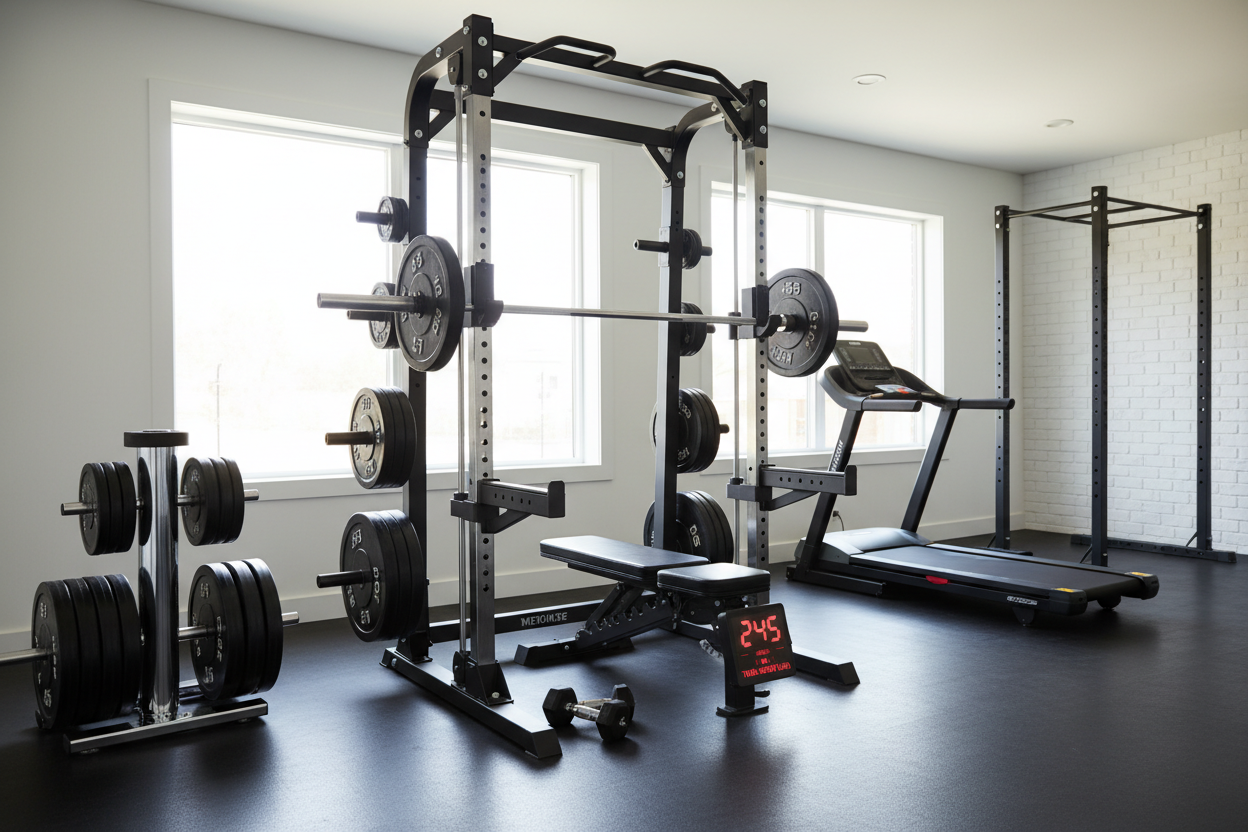
I am standing there, sweat dripping onto the rubber flooring, holding my phone like a nerd trying to figure out if I just hit a PR or if the machine is lying to me. You have seen those apps—the ones that promise to be the ultimate smith machine weight calculator. They are garbage. They ask for the machine brand, the rail angle, and probably your blood type just to tell you what you already know: you are moving heavy metal.
Quick Takeaways
- Forget the apps; they kill your training momentum.
- Identify your machine's starting weight (usually 15-25 lbs) once and move on.
- Consistency in your logbook matters more than free-weight equivalence.
- Friction and counterweights mean Smith math will never perfectly match a barbell.
Why Gym Math Apps Are Ruining Your Workout
Pulling your phone out between sets of heavy shrugs or incline presses is a total vibe-killer. You are in the zone, your heart rate is up, and then you stop to navigate a clunky UI just to see how to calculate weight on smith machine loads. It is a distraction that shifts your focus from intensity to data entry.
Most of these calculators overcomplicate things. They try to factor in the sine of the rail angle or the drag coefficient of the bushings. In the real world, that does not matter. If you are chasing progressive overload, the only thing that matters is that you are lifting more than you did last Tuesday. Stop being a mathematician and start being a lifter.
The Mechanics: Why Fixed-Path Bars Defy Normal Barbell Math
A standard Olympic bar is 45 lbs. It is a universal constant. But Smith machines are the Wild West of gym equipment. Some use massive counterweights hidden in the frame that make the bar feel like it is floating, while others are just heavy steel carriages sliding on grease. This is why you need to know how much weight does a smith machine take off before you start stacking plates.
Then there is the friction. No matter how well-lubricated those rails are, there is mechanical drag. This makes the weight feel slightly heavier on the concentric (the way up) and lighter on the eccentric (the way down). It is a physics mess that no basic app can actually account for across different brands like Hammer Strength or Life Fitness.
The 'Base Plus Plates' Mental Framework
I use a dead-simple mental framework: Base Plus Plates. First, look for a sticker on the machine frame. Most manufacturers list the 'starting weight' or 'effective bar weight.' It is usually 15, 20, or 25 lbs. That is your 'Base.' If there is no sticker, give the bar a lift; if it feels like a toy, assume 15 lbs. If it has some meat to it, assume 25 lbs.
Once you have that number, you just add your standard weight plates to the total. If your base is 20 lbs and you have a 45 and a 25 on each side, that is 140 lbs of plates plus the 20-lb base. Total: 160 lbs. Write it down, hit your reps, and stop worrying about the decimals.
Real-World Example: Doing the Math on Two Plates
Let's look at the most common question I get in the DMs: how much is 2 45 plates on smith machine? On a standard barbell, that is the classic 225 lbs. But on a Smith machine, you are almost never actually moving 225. If the machine has a 20-lb starting weight, you are looking at 180 lbs of plates plus the 20-lb bar for a total of 200 lbs.
The ego hit is real when you realize you are 25 lbs short of a 'two-plate' milestone. I actually wrote a deep dive on how much is 2 plates on smith machine because lifters get so heated about it. The bottom line? It does not matter if the number is 'lower' than a free-weight bench as long as that number is going up over time.
Stop Obsessing Over the Exact Free-Weight Conversion
The biggest mistake you can make is trying to calculate your 'Free Weight Max' based on your Smith machine numbers. They are different movements. The Smith machine removes the need for stabilizer muscles, allowing you to isolate the prime movers. It is a tool for hypertrophy and safety, not a direct 1:1 proxy for a powerlifting meet.
Pick one machine at your gym, find its base weight, and use that as your consistent baseline. If you switch gyms, just recalibrate. Your logbook should be a record of effort, not a scientific white paper. Focus on beating your last session's reps or adding five pounds to the sleeves. That is how you actually get big.
Personal Experience: The Luggage Scale Incident
I once got so annoyed by a generic Smith machine at a hotel gym that I actually pulled a luggage scale out of my bag to weigh the carriage. The gym staff thought I was insane. It weighed exactly 11 lbs. I spent twenty minutes doing 'accuracy' checks instead of training. I realized later that I wasted a perfectly good chest pump on math that didn't change my results one bit. Don't be that guy.
FAQ
Is a Smith machine bar always 45 lbs?
Almost never. Most commercial Smith machine bars weigh between 15 and 25 lbs because of the counterweights and the hollow design of the carriage.
How do I know if my Smith machine is counterbalanced?
If you unrack the bar and it stays in place or moves upward slightly without effort, it is counterbalanced. These usually have a very low starting weight, often 0 to 15 lbs.
Should I count the bar weight at all?
Yes, you should count it to keep your logbook consistent, but don't stress if your '225' on the Smith feels different than '225' on a rack. They are different lifts.
Share:
Is That Sam's Club Smith Machine Actually Worth the Hassle?
I Learned How to Properly Squat on a Smith Machine the Hard Way