
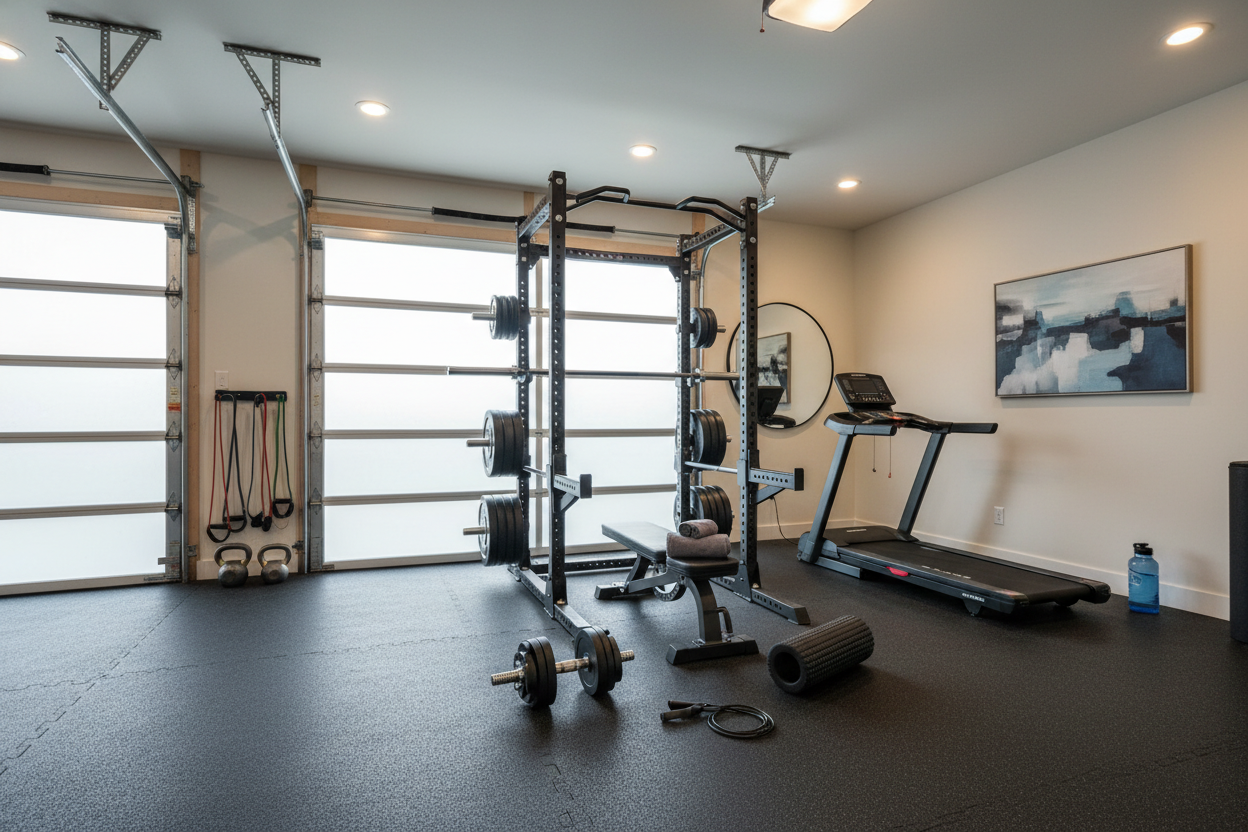
I remember staring at my garage floor two years ago, realizing I couldn't even fit a lawnmower in there anymore. I had three different machines for legs alone, and half of them felt like shaky junk. I finally realized that the secret to a pro-level feel isn't another $2,000 unit; it's the gyms accessories you choose to bolt onto what you already own.
- High-quality metal handles beat nylon straps every single time.
- Roller J-cups save your barbell knurling and your sanity.
- Spotter arms are non-negotiable for solo lifters.
- Measure your rack uprights (2x2, 2x3, or 3x3) before buying anything.
Why I Stopped Buying Giant Single-Use Machines
Floor space is the most valuable currency in a garage gym. When I was first building a home gym, I thought more was better. I bought a dedicated leg extension machine, a standalone lat pulldown, and a bulky seated row. Within six months, I was shuffling around like I was in a crowded storage unit just to change plates.
I had a realization: my power rack was basically a skeleton waiting for better organs. Instead of buying a new machine for every muscle group, I started looking for accessories for gym equipment that could expand my rack's utility. I sold the standalone units and reclaimed 40 square feet. Now, I use a high-low pulley system attached to my rack. It takes up zero extra floor space but does 90% of what those big machines did.
The real 'cheat code' is realizing that a $500 rack with $500 worth of premium attachments feels better than a $2,000 machine that only does one thing. You get the same resistance, better ergonomics, and you can actually park your car in the garage when you're done.
The Problem With Stock Cable Handles (And What to Buy)
Most pulley systems come with those cheap, flimsy nylon D-handles. They’re fine for a week, but once you start pulling anything over 100 lbs, they flex, the plastic digs into your palms, and the webbing starts to fray. They are the weakest link in your setup.
I swapped mine for heavy-duty, knurled stainless steel handles. The difference in mind-muscle connection is massive. When you aren't worried about a piece of plastic snapping, you can actually focus on squeezing your lats or triceps. Investing in quality home gym equipment accessories like a solid lat bar or a multi-grip row attachment makes a $300 pulley feel like a $3,000 commercial cable crossover.
Don't stop at just handles. Look for gym machine accessories like aluminum pulleys to replace the stock plastic ones. They spin smoother, last longer, and eliminate that 'choppy' feeling during slow eccentrics. It’s a small swap that makes every rep feel like it’s happening on a high-end gym floor.
Upgrading Your Rack: J-Cups, Spotter Arms, and Monolifts
If you're lifting heavy in a garage, safety is your primary concern. I used to dread max-effort bench days because my standard J-cups made it hard to get a clean handoff. I eventually upgraded to roller J-cups. Being able to nudge the bar left or right to center it perfectly before a lift is a luxury you didn't know you needed until you have it.
Then there are spotter arms. If you don't have a full cage, these are mandatory. I’ve dropped 315 lbs on my spotter arms more than once, and they didn't flinch. They give you the confidence to push to failure without needing a neighbor to stand over you. In many ways, a rack with high-end spotters is safer than a Smith machine home gym station because you aren't locked into a fixed, unnatural bar path, yet you still have that safety net.
For the squatters, a bolt-on monolift attachment is the ultimate luxury. It eliminates the walk-out entirely. You unrack, the hooks swing back, and you just squat. It’s better for your joints and allows you to focus 100% of your energy on the movement itself rather than the setup.
Bands and Chains: The Cheapest Way to Change Resistance Curve
You don't need a fancy variable-resistance machine to get world-class results. A set of latex resistance bands and some heavy zinc-plated chains are the most effective weight equipment accessories you can own. They change the resistance curve of your lifts, making the top of the movement harder than the bottom.
I drape chains over the ends of my barbell for 'dynamic effort' days. As the bar goes up, more links leave the floor, and the weight gets heavier. It’s a brutal way to build explosive power. Bands work similarly; loop them around the bottom of your rack and over the bar. It’ll make a 225-lb bench feel like it's trying to pinned you to the floor. For less than $100, these workout equipment accessories provide more utility than a dozen cheap dumbbells.
How to Match Attachments to Your Current Hardware
Before you go on a shopping spree for exercise equipment accessories, you need to know your rack’s 'DNA.' There is nothing worse than waiting a week for a new dip station only to find out the pins are too big for your holes. Most modern racks fall into three categories: 2x2-inch, 2x3-inch, or 3x3-inch uprights.
Check your pin size too. They are usually either 5/8-inch or 1-inch. If you have 3x3-inch uprights with 1-inch holes, you have the most options, but those accessories are also the heaviest and most expensive. Even if you only have basic home gym fitness equipment, you can usually find compatible attachments if you measure the external dimensions and hole spacing accurately.
My mistake? I once bought a 1-inch pin landmine attachment for my 5/8-inch hole rack. I spent two hours trying to 'make it work' before realizing I just had to pay for return shipping. Don't be me. Get the calipers out first.
FAQ
Do I need to buy the same brand of accessories as my rack?
Not necessarily. As long as the upright dimensions (like 3x3) and the pin sizes (like 5/8-inch) match, many brands are cross-compatible. Just check the hole spacing to ensure they line up.
Are metal handles better than rubber-coated ones?
Metal handles with good knurling provide the best grip when your hands are sweaty. Rubber is okay for light work, but for heavy rows or pulldowns, knurled steel is the gold standard.
How do I maintain my gym accessories?
Wipe down metal handles and bars with a light coat of 3-in-1 oil every few months to prevent rust, especially if your gym is in a humid garage. Check your bands for small tears or 'nicks'—if you see one, throw it away before it snaps on you mid-set.
Share:
I Squatted 315 on a Cheap Shopee Barbell (Here's What Happened)
The 4 Hidden Differences Between Cheap Iron and Pro Dumbbells