
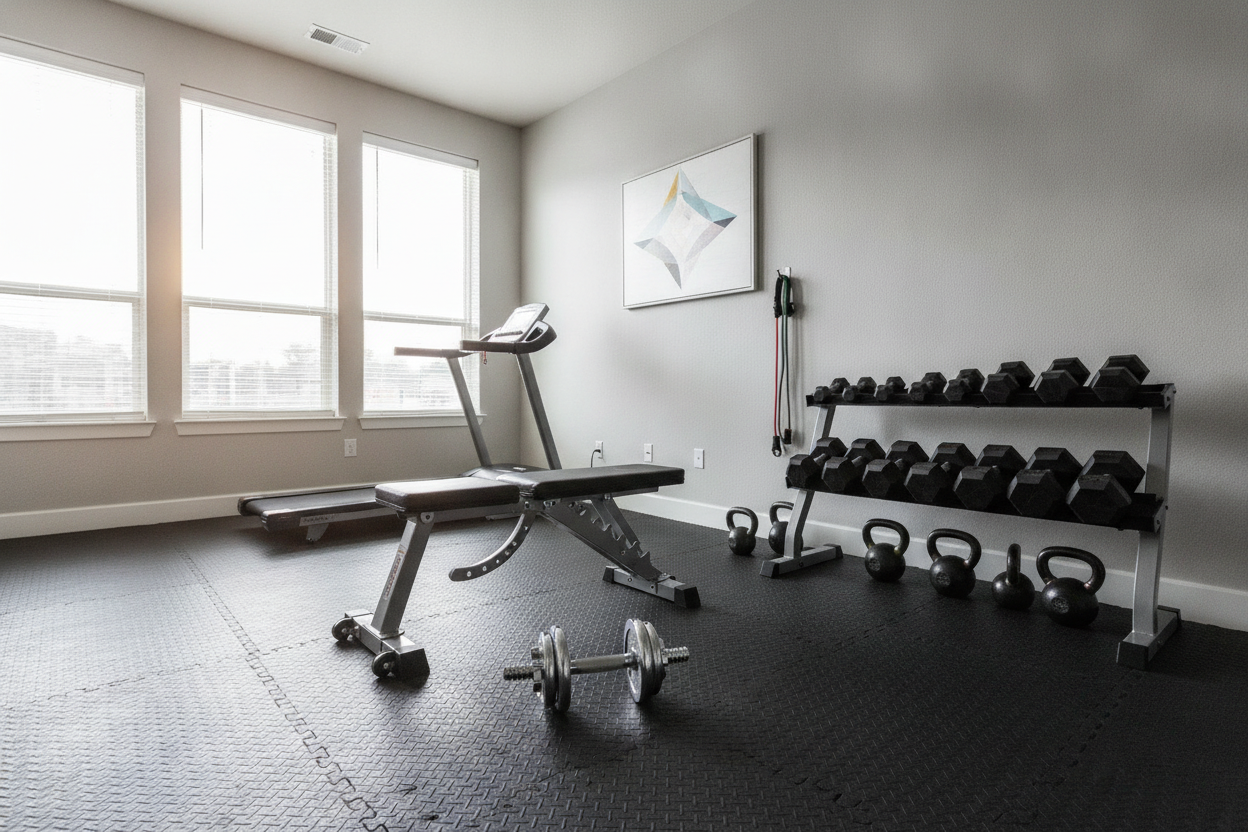
I recently moved my entire training setup from a three-car garage into a 10x10 spare bedroom. It was a reality check. I had to ditch the monster rack and find a weight bench small enough to slide into a closet when the room needed to look like a guest space again.
But here is the truth: most 'mini' equipment is garbage. Manufacturers think that because you have a small apartment, you are only lifting ten-pound dumbbells. They skimp on the steel, narrow the base, and suddenly you are one heavy set away from a hospital bill. Physics does not care about your limited square footage.
- A narrow base (under 16 inches) is a tipping hazard for heavy presses.
- 11-gauge steel is the gold standard; avoid anything that feels like a soda can.
- Flat benches are easier to store but less versatile than inclines.
- Foot placement is your 'kickstand' when the bench frame is short.
Why Shrinking a Bench Ruins Its Center of Gravity
Physics is a jerk. When you take a standard weight bench and chop six inches off the length to make it 'compact,' you are messing with the center of gravity. A full-sized bench usually has a footprint of about 48 to 52 inches. That length provides a lever that keeps the bench from flipping forward or backward when you sit on the very edge to prep for a set.
When you look for a small bench press, you will notice the 'mini' versions often shorten the stabilizer bars to save space. If those bars are too narrow, the bench loses lateral stability. I have seen benches that look great in photos but feel like a seesaw the moment you try to unrack anything over 135 pounds. If the base is not at least 50% wider than the pad, you are asking for a tip-over during a heavy rep.
3 Specs That Keep a Small Bench Press from Tipping Over
If you are tight on space, you cannot afford a massive footprint, but you cannot compromise on the 'tripod' effect. First, look at the steel gauge. A light, 14-gauge steel frame might be easy to carry, but it does not have the heft to stay planted. I look for 11-gauge or at least 12-gauge steel. Weight equals stability in the home gym world.
Second, check the rear stabilizer width. A mini workout bench needs a wide 'T' or 'H' shaped base at the back. If the feet are barely wider than the cushion, pass on it. Third, look for rubber end caps that actually grip. Plastic caps slide on hardwood or thin gym mats, which is how you end up sliding across the room during a leg drive. Remember, a compact weight lifting bench doesn't have to feel like a toy if the materials are dense enough.
Don't Trust Flimsy Hinges on a Small Incline Bench
The biggest fail point on a small incline bench is the adjustment mechanism. Cheap brands use a thin 'ladder' system with shallow notches. On a shortened frame, those notches are closer together, meaning the support bar has less surface area to bite into. I prefer a bolt-through or a heavy-duty pop-pin. If you want a space-saver that won't collapse under a 200-pound load, a high-quality adjustable weight bench is worth the extra fifty bucks. It is better than having the spine of the bench snap while you are mid-set.
Small Flat Weight Bench vs. Adjustable: What Fits Your Space?
If you are truly cramped, a small flat bench is the ultimate space-saver. Most of them are only 17 inches high, meaning they slide under a standard bed frame or can be hung on a heavy-duty wall hook. A small flat weight bench also tends to be more stable because there are no moving parts. No hinges means no wobble.
However, if you want to hit upper chest or do seated overhead presses, you need the incline. The trade-off is height. Most adjustable benches have a thicker 'stack' because of the hinge mechanism, making them harder to hide. If you have a 2x4 foot corner, go adjustable. If you literally only have the space under your bed, stick to the flat bench and use blocks to create a temporary incline if you are desperate.
How to Lift Heavy on a Mini Workout Bench Without Dying
When the equipment is small, your form has to be perfect. On a standard bench, the frame does the work. On a mini workout bench, your legs are the outriggers. I keep my feet wider than I usually would, creating a wide tripod with my body. This compensates for a narrower bench base and keeps the center of mass over the steel.
Also, know how to bail. In a cramped room, you cannot just dump the weights. You need to practice the roll of shame or have a clear path to drop dumbbells without hitting your TV. Even a heavy-duty portable weight lifting bench handle heavy dumbbells safely only if you are not boxed in by furniture. Give yourself at least two feet of 'dead zone' around the bench.
Personal Experience: The 3:00 AM Amazon Mistake
I once bought a sixty-dollar 'foldable' bench because it promised to fit in a suitcase. The first time I tried to do Bulgarian split squats on it, the locking pin sheared and the thing folded while my foot was on it. I ended up face-planting into my drywall. It was a lesson learned: if it is light enough to carry with one finger, it is not heavy enough to support your body weight plus iron. Now, I stick to benches that weigh at least 40 pounds, even for my small setup.
FAQ
Can I use a small bench for barbell presses?
Only if the weight capacity exceeds your body weight plus your max lift by at least 100 pounds. Most small benches are better suited for dumbbell work due to their narrower footprint and lack of integrated racks.
How do I stop my bench from sliding on hardwood?
Get a single 3x4 rubber stall mat. It protects your floor and creates the friction necessary to keep a lightweight bench from walking across the room during your set.
Is a folding bench safe?
Yes, but only if it uses locking pins rather than just gravity to stay open. If you cannot lock the frame into place with a steel pin, do not put your back on it.
Share:
Where to Draw the Line With Inexpensive Exercise Equipment
I Lift Heavy, But a Dumbbell Set 5 8 10 Saved My Shoulders