
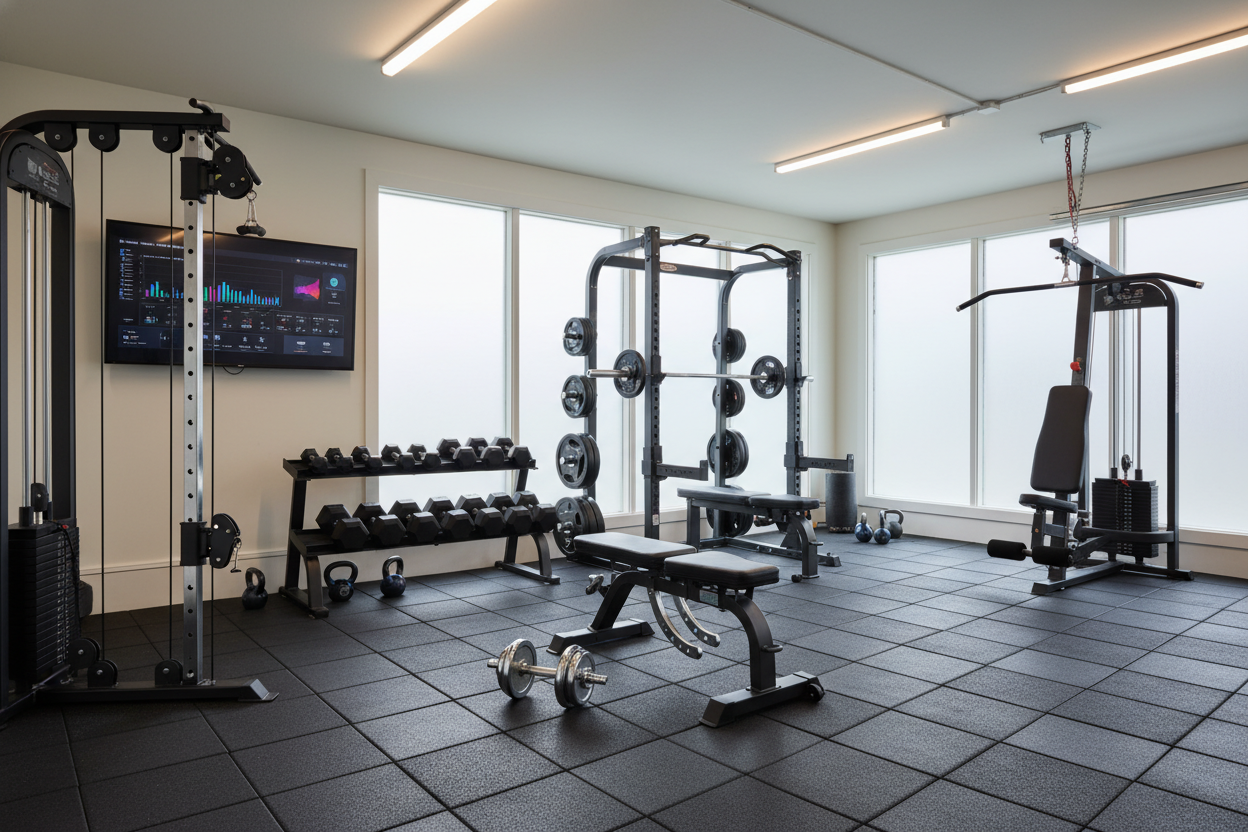
I spent my first three years in a commercial gym logging 'the chest thing with the red handles' in a battered notebook. When I finally switched to a digital tracking app, my data was a mess because I couldn't tell if I was getting stronger or just switching between a plate-loaded incline press and a selectorized flat press. If you aren't using the correct upper body workout machines names, you are essentially guessing at your progress. You can't manage what you don't measure, and you can't measure what you can't name.
Quick Takeaways
- Accuracy in naming allows for precise progressive overload tracking across different gym visits.
- Selectorized machines (pin-loaded) and plate-loaded machines have different resistance curves.
- The angle of the handle often dictates the specific muscle target, such as incline vs. flat.
- Cables provide constant tension, while leverage machines often have a 'drop-off' at the top of the movement.
Why You Need to Stop Calling It 'The Chest Thing'
Vagueness is the enemy of gains. If your log says 'Chest Press - 150 lbs,' but one week you used the Hammer Strength plate-loaded machine and the next you used the Life Fitness cable-driven unit, your data is useless. The friction in a cable system and the leverage ratio of a pivot-based machine are not the same. 150 lbs on one might feel like 120 lbs on the other. By learning the actual upper body machine names, you ensure that you are comparing apples to apples every time you step into the rack.
Beyond the data, knowing the terminology makes you a more competent trainee. When a program calls for a 'Neutral Grip Lat Pulldown' and you're staring at the equipment like it's a foreign language, you waste time and intensity. Most people stall in their training not because they aren't working hard, but because they are inconsistent with their movement selection. Identifying the exact rig you're using allows you to own that specific piece of floor space and track every pound of progress with surgical precision.
Pushing Power: Chest and Shoulder Rigs
The pushing category is where most people get tripped up because the machines often look similar. You have the standard Chest Press, but you need to distinguish between the Flat, Incline, and Decline versions. A Flat Chest Press simulates a bench press, while an Incline Press shifts the load to the clavicular head of the pec and the front delts. Then there is the Pec Deck, often confused with a Chest Fly machine. A Pec Deck usually has pads for your elbows, whereas a Chest Fly machine has handles for your hands. It sounds like a small distinction, but the internal rotation of the shoulder changes significantly between the two.
Shoulder machines are equally specific. You have the Overhead Press (or Shoulder Press) machine, which is your primary mass builder. But don't overlook the Lateral Raise machine—this is a specialized piece of upper body gym equipment designed to isolate the medial delt without the 'cheating' momentum often found in dumbbell raises. If your gym has a plate-loaded version, grab it. The pivot point is usually fixed to keep the tension exactly where you want it throughout the entire arc of the movement.
Pulling Movements: Nailing Your Back Training
Back training is where the upper body gym equipment names get really granular. The king is the Lat Pulldown, but the name changes based on the attachment. A 'Wide Grip Lat Pulldown' is not the same as a 'Close Grip V-Bar Pulldown.' One targets the outer lats for width, the other brings in more of the mid-back and biceps. Then you have the Seated Row. If the cable comes from a low pulley, it's a Low Row. If it's a fixed-path machine where you sit and pull handles toward your chest, it's a Seated Lever Row.
The T-Bar Row is another one that confuses people. In many gyms, this is a landmine attachment where you stand over a bar. In others, it's a chest-supported machine that saves your lower back from fatigue. Understanding these differences is vital for programming. If your lower back is fried from deadlifts, you want the 'Chest Supported T-Bar Row,' not the 'Standing T-Bar Row.' Slight changes in the angle of the pull—whether it's high-to-low or strictly horizontal—completely alter which muscles in the posterior chain are doing the heavy lifting.
Decoding Upper Body Workout Arm Machines at the Gym Names
Arms are usually the 'fun' part of the workout, but people still mess up the tracking. For biceps, the Preacher Curl machine is the gold standard for isolation. It fixes your elbows in place so you can't use your shoulders to swing the weight. If you see a machine where you are standing and curling a bar attached to a pivot, that's often just called a Bicep Curl Machine. The resistance curve on these is usually heaviest at the bottom, which is why your form usually breaks down right at the start of the rep.
Triceps have even more variety. You have the Triceps Pushdown station (part of the cable crossover), but you also have dedicated rigs like the seated dip machine for upper body workouts. This machine is a beast for hitting the triceps and lower chest without the shoulder instability issues some people get from bodyweight dips. When you're looking for upper body workout arm machines at the gym names, look for the 'Triceps Extension' machine—this usually involves an overhead movement that stretches the long head of the triceps, something you can't easily replicate on a standard pushdown station.
Cables vs. Leverage: Sorting Out Upper Body Gym Equipment Names
One of the biggest mistakes I see is people treating 'Selectorized' and 'Plate-Loaded' machines as interchangeable. A selectorized machine uses a pin and a weight stack. These are great for drop sets because you can change the weight in two seconds. However, they often use pulleys and cables that introduce friction. A 100-lb stack might only feel like 80 lbs of actual resistance. This is why it's helpful to occasionally check upper body equipment manuals if you're a gear nerd like me; they often list the weight ratio (2:1 or 1:1) so you know what you're actually lifting.
Plate-loaded machines, like those from Hammer Strength, are leverage-based. You're moving a physical arm on a pivot. These tend to feel more 'raw' and closer to free weights. They also allow for unilateral training (moving one arm at a time), which is crucial for fixing muscle imbalances. When you're logging these in your app, make sure to specify. 'Plate-Loaded ISO-Lateral Row' tells you a lot more than just 'Back Machine.' It tells you the mechanic of the lift and that you worked each side independently.
Are These Dedicated Rigs Actually Worth Your Floor Space?
As a garage gym owner, I have a love-hate relationship with these machines. In a commercial gym, they are great for isolation. At home, they are space hogs. Before you go out and buy a dedicated chest press, ask yourself if you've maxed out what a power rack and a good set of dumbbells can do. Most of these upper body machine names we've discussed are single-use. They do one thing well, but they take up a 4x6 foot footprint that could be used for a functional trainer or a half-rack.
If you're wondering are dedicated upper body workout machines for home worth the space, the answer is usually 'only if you have a massive pole barn.' For the average lifter, a high-quality cable tower or a functional trainer can replicate about 80% of the machines we've listed. You can do your chest presses, lat pulldowns, and triceps extensions all in one spot. However, if you have a specific injury or a stubborn muscle group that won't grow, a dedicated isolation machine like a Pec Deck or a Seated Row can be the 'secret sauce' that finally triggers growth.
Personal Experience: The 'Mystery Row' Mistake
A few years back, I bought a used 'Row Machine' from a local high school. I didn't check the specs or the brand—I just saw a seat and some handles. It turned out to be an old leverage row with a terrible 3:1 ratio. I was stacking five 45-lb plates on each side just to feel a burn, and the pivot point was so high that it felt like it was trying to rip my shoulders out of their sockets. I eventually sold it for half what I paid. The lesson? Learn the names, check the mechanics, and don't buy a piece of gear just because it looks like it belongs in a gym. If it doesn't fit your biomechanics, it's just a very heavy clothes rack.
FAQ
What is the difference between a Pec Deck and a Chest Fly machine?
The Pec Deck uses elbow pads to drive the weight, which removes the biceps from the movement. A Chest Fly machine uses handles, requiring your arms to stay slightly bent, which engages more of the stabilizing muscles in the arms and shoulders.
Why does 100 lbs feel heavier on some machines than others?
This is due to the pulley ratio and friction. A 2:1 ratio machine means you are only moving 50 lbs of actual weight for every 100 lbs on the stack. Leverage-based machines also have 'cams' that change the difficulty of the lift at different points in the range of motion.
Should I use machines or free weights for my upper body?
Both. Free weights are better for overall stability and functional strength, but machines allow you to push a muscle to absolute failure without worrying about dropping a bar on your neck. Use free weights for your heavy compounds and machines for your high-volume isolation work.
Share:
A No-BS Translation for the Names of Weight Lifting Machines
How to Actually Do Every Major Gym Exercise at Home