
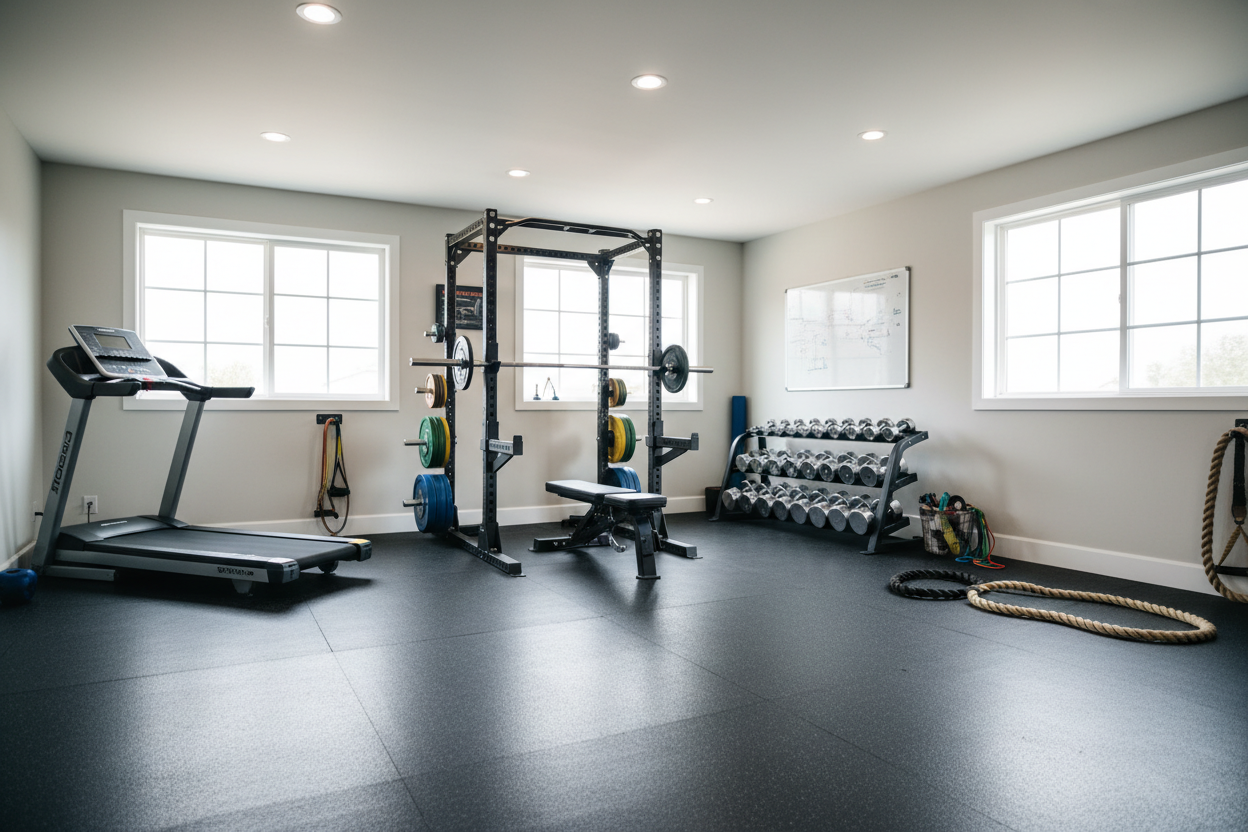
I remember the day I handed over my last rent check to a big-box gym owner. It felt like a massive weight off my chest, but the panic set in about five minutes later. I was officially starting a personal trainer home gym, and my 'setup' at the time was a rusty barbell, some mismatched plates, and a floor that smelled like wet concrete.
Ditching the commercial studio is the best career move I ever made, but it is not as simple as throwing a bench in your garage. You are moving from a controlled environment to one where you are the janitor, the technician, and the CEO. If your equipment fails, your income stops. Period.
Quick Takeaways
- Commercial rent is a profit killer; your garage is a tax-deductible goldmine.
- Liability is real—never use 'residential-only' gear for paying clients.
- Flooring is the foundation of your professional image (no puzzle mats).
- Versatility wins in small spaces; look for multi-functional cable stations.
The Reality Check of Ditching Commercial Rent
The financial freedom of personal training in your home is intoxicating. No more 40% commissions to the gym or $1,200 monthly 'rent' for a single squat rack. But here is the catch: a solo setup only has to survive you. A professional setup has to survive back-to-back sessions, eight hours a day, five days a week.
When you are running a home gym personal trainer business, your overhead drops, but your responsibility spikes. You need gear that doesn't just work, but feels 'premium.' If a client feels like they are training in a storage unit, they won't pay premium rates. If they feel like they are in an exclusive private club, they will stay forever.
You Can't Just Use Cheap Big-Box Store Gear Anymore
I learned this the hard way when a 'budget' adjustable bench started creaking under a 220-lb client. It’s embarrassing and dangerous. When you transition to a professional setup, you must invest in commercial-grade home gym equipment. You need steel that doesn't flex and upholstery that doesn't crack after three months of sweat.
Professionalism is also about perception. If a client sees a brand they recognize from a high-end studio, their trust in your coaching goes up. Cheap gear screams 'hobbyist.' Heavy-duty gear screams 'expert.'
Upgrading Your Flooring (Seriously, Don't Skip This)
Stop looking at those foam puzzle mats. They are meant for playrooms, not deadlifts. They slide, they compress under heavy loads, and they look cheap. For a professional space, you need high-density rubber. It protects your concrete, dampens the noise for your neighbors, and saves your clients' joints.
I always tell trainers that Why The 4X8 Gym Mat Is The Gold Standard For Home Training isn't just about the rubber—it is about the stability. A client shouldn't feel the floor shifting during a split squat. Thick rubber mats give your garage that 'real gym' feel the second they walk in.
The 'Big Three' Equipment Investments for Client Results
You have limited square footage, so every piece of gear must earn its keep. You need a bomb-proof power rack, a set of dumbbells (ideally 5 to 50 lbs), and a way to do cable work. This is the core of personal training home gym success. You can't waste space on single-use machines like a dedicated leg extension.
I’m a huge advocate for the Full Body Multifunctional Training Station M1. It combines a rack with a functional trainer, which is a lifesaver when you’re trying to program for a 65-year-old grandmother and a 20-year-old athlete in the same four-hour block. It handles the heavy squats and the high-rep face pulls without taking up the whole garage.
Squeezing Cable Work Into a Tight Space
Clients love cables. They are intuitive, they provide constant tension, and they are generally 'scarier' than a heavy barbell for beginners. The problem is that traditional cable crossovers are 10 feet wide. You don't have that kind of room.
If you're struggling with a narrow layout, read up on How I Fit a Real Functional Trainer for Home Gym in a 1-Car Garage. Wall-mounted units or compact dual-pulley systems are the secret to offering a 'big gym' menu in a residential footprint.
Layout and Flow: Don't Make It Feel Like a Dungeon
The psychology of personal training at home gym spaces is often overlooked. If your garage is dark, dusty, and full of Christmas decorations, your clients will feel like an afterthought. You need to clear the clutter. If it doesn't help someone get stronger or leaner, it doesn't belong in the gym.
Invest in bright LED shop lights—ditch those dim yellow bulbs. Paint the walls a light color. Get a high-powered floor fan to keep the air moving. These small touches transform a 'garage' into a 'private training studio.' Cleanliness is your best marketing tool.
Is a Garage Setup Actually Better for Your Clients?
Most of my clients actually prefer my garage to the commercial club. Why? Total privacy. They can pick the music, they never have to wait for a rack, and they don't feel judged by a room full of strangers. You are selling an experience that the local 24-hour fitness simply cannot match.
Running your own space gives you total control over the environment. You can program exactly what the client needs without compromising because the leg press is busy. It is the ultimate way to deliver results while keeping your sanity and your profits.
Personal Experience: My $400 Mistake
When I first started, I bought a cheap set of cast iron plates from a local classified ad. I thought I was being smart. Two weeks in, I realized they were 'off' by about 3 to 4 pounds each. I had a client struggling with a '135-lb' bench press that was actually closer to 142 lbs because of the poor casting. It messed with his confidence and my programming. I sold them at a loss and bought calibrated plates immediately. Accuracy matters when someone is paying you for progress.
FAQ
Is a 1-car garage big enough for a training business?
Absolutely. You can fit a full rack, a bench, and a set of dumbbells in about 150 square feet. Use wall-mounted storage for your plates and bands to keep the floor clear for movement.
How do I handle the temperature in a garage?
Insulate your garage door first—it makes a 10-15 degree difference. Use a powerful drum fan for summer and a propane or electric space heater for winter. Just make sure to turn the heater on 30 minutes before your first client arrives.
Do I need special insurance?
Yes. Your standard homeowner's insurance will almost certainly NOT cover a business-related injury. Get a specific professional liability policy that includes your home address as the primary training location.
Share:
I Mapped a Weight Lifting Equipment Store (Here's the Trap)
Who Actually Needs an Adjustable Height Exercise Bench Anyway?