
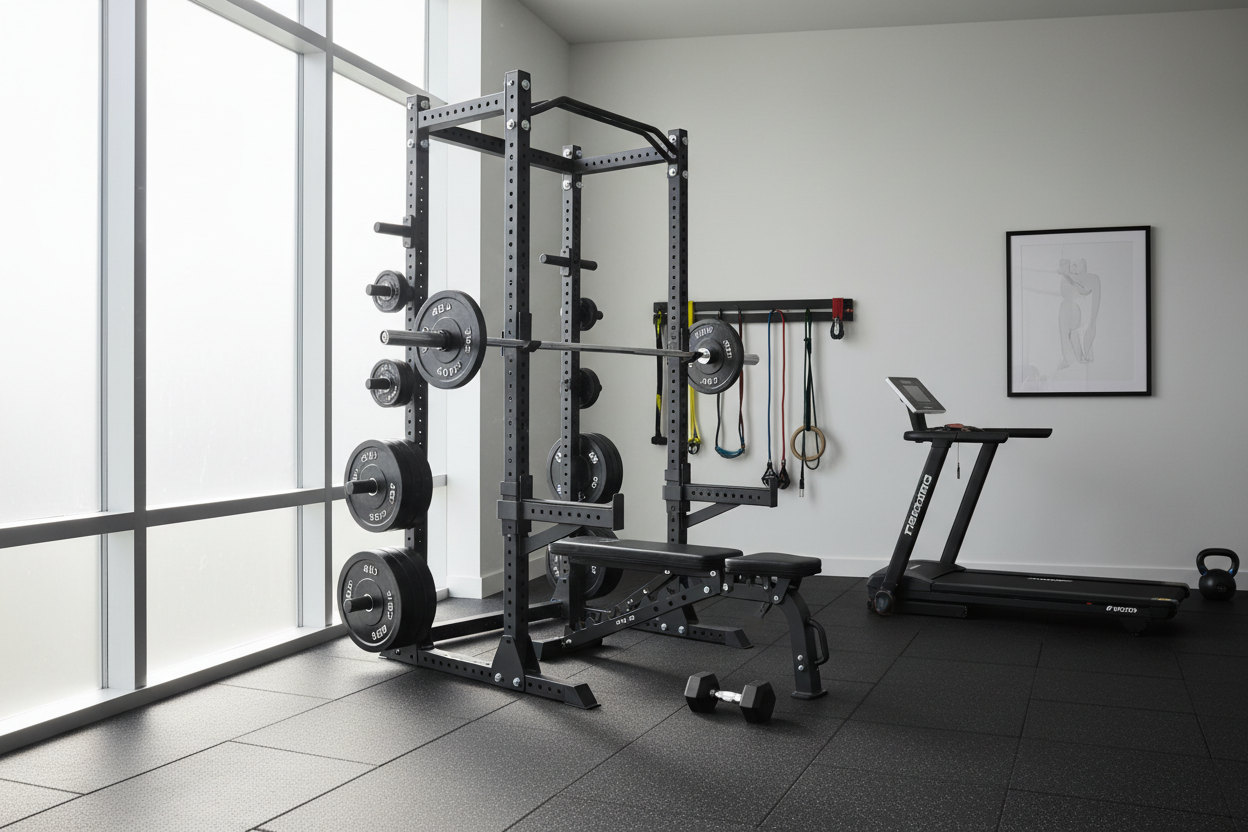
My garage used to look like a graveyard for fitness fads. I had a leg extension machine that took up four square feet but only trained one muscle, and a treadmill that eventually became a very expensive place to hang my damp hoodies. After moving three times and realizing I didn't want to haul 4,000 pounds of mediocre steel again, I purged. I kept only the essential home gym items that actually made me stronger.
Quick Takeaways
- Prioritize 3x3 11-gauge steel for your rack to ensure lifetime durability.
- Standard iron plates save massive amounts of sleeve space compared to bulky bumpers.
- A high-quality cable system replaces a dozen individual accessory machines.
- Avoid 'novelty' bars and cardio ergs until your foundation is bulletproof.
The Great Garage Purge: Why I Sold 80% of My Equipment
About three years ago, I realized I couldn't actually park a car in my two-car garage. Not because of the cars, but because I had accumulated four different types of pull-up bars and a collection of kettlebells that I hadn't touched since the 2016 CrossFit craze. We all fall into the trap of buying gear that looks cool on Instagram. You see a pro athlete using a specialized belt squat machine and suddenly you're convinced your quads won't grow without it.
The reality hit me during a heavy squat session. I was using a cheap, bolt-together rack I bought on sale. As I walked 315 pounds out, the uprights swayed. That moment of genuine fear is a great clarifier. I sold off the fluff—the ab rollers, the cheap adjustable dumbbells that felt like plastic toys, and the bulky cardio equipment. I focused back on the core pieces that allow for the highest intensity with the lowest amount of maintenance. What every home gym needs isn't more variety; it's more quality.
Figuring Out What Every Home Gym Needs (And What It Doesn't)
When you are building a functional home gym, you have to be ruthless. You are the owner, the janitor, and the head coach. If a piece of equipment requires a proprietary tool to tighten every month, or if it has a footprint that prevents you from deadlifting safely, it has to go. My criteria for the 'survivors' were simple: versatility, footprint efficiency, and durability.
I stopped looking at equipment as a 'workout' and started looking at it as an investment in floor space. A power rack is a 4x4 foot square of prime real estate. It needs to do more than just hold a barbell. It needs to be the anchor for your entire training life. If you can't attach a dip bar, a landmine, or a cable pulley to it, it’s wasting your space. I also stopped buying anything made with 14-gauge steel. If I can dent the upright by accidentally dropping a 25-pound plate against it, it doesn't belong in a serious lifting environment.
The Essential Home Gym Items That Made the Cut
The list of what survived the purge is shorter than you’d think. It’s not about having a tool for every possible angle; it’s about having the best tool for the most important movements. These are the pieces that have seen 5:00 AM sessions in the winter and 100-degree workouts in the summer without flinching.
1. A Power Rack That Actually Handles 400+ Pounds
If you buy a rack with 2x2 tubing and thin walls, you’ll be looking for an upgrade within twelve months. I moved to a 3x3 11-gauge steel rack with 5/8-inch hardware. The difference is night and day. When you rack a heavy triple, the rack doesn't move. It doesn't groan. It feels like part of the foundation of the house. I opted for a rack with 2-inch hole spacing through the bench zone, which is critical for getting your safety pins at the exact right height. No more 'almost' hitting the safeties or pinning yourself to the bench because the holes were four inches apart.
2. High-Density Iron (Because Bumpers Hog Space)
I know, everyone loves the look of colorful bumper plates. But unless you are training for the Olympics and dropping snatches from overhead, bumpers are a massive waste of sleeve space. A standard 45-pound bumper is about 3.25 inches thick. A machined iron plate is barely 1.25 inches. If you’re getting strong, you’ll run out of room on a standard barbell sleeve very quickly with bumpers. I switched back to deep-dish iron. They sound better, they take up half the space on the storage pegs, and they don't bounce into your drywall when you set a deadlift down a little too fast.
3. A Multi-Station Cable System You Can Trust
For a long time, I was a 'barbell only' purist. I was wrong. Accessory work like face pulls, lat pulldowns, and tricep extensions are what keep your joints healthy when the heavy lifting gets taxing. Instead of five different machines, I invested in a high-end Smith machine home gym station that integrates a dual-pulley system. The 2:1 ratio on the cables allows for smooth, constant tension that you just can't replicate with bands. It replaced my need for a standalone lat tower and a functional trainer, saving me about 15 square feet of floor space.
The 'Nice-to-Haves' I Regret Buying First
I wasted a lot of money on 'finishing touches' before I had the basics covered. I bought a specialized rowing ergometer that I used twice a month because, frankly, I'd rather just go for a run or do hill sprints. I also fell for the 'specialty bar' trap. I had a Swiss bar, a safety squat bar, and a cambered bar all leaning in a corner. Unless you have a specific injury or you're a competitive powerlifter, a single high-quality 20kg multi-purpose bar with decent knurling is all you need for the first five years.
Another budget killer? Fancy flooring. I spent too much on 'interlocking' foam tiles that ended up tearing and smelling like a tire fire. Spend the money once on 3/4-inch recycled rubber stall mats. They are heavy, they are ugly, and they will outlive you. Everything else is just aesthetic fluff that doesn't add a single pound to your total.
Where To Spend Your Money Next
The best advice I can give is to let your training dictate your purchases, not your wishlist. If you find yourself skipping leg day because you hate back squats, maybe then you look at a leg press. But don't buy the leg press first. Start with the heavy steel and the iron. If you’re working with a razor-thin budget, there are absolutely essential for home gym training lists that can get you started for under five hundred bucks. Focus on the big rocks, and stop worrying about the pebbles.
FAQ
Is 11-gauge steel really necessary?
If you plan on lifting for more than a year, yes. 14-gauge is fine for a clothes rack, but for a squat rack, the stability and safety of 11-gauge steel are worth every extra penny. It’s the difference between a rack that lasts a lifetime and one that ends up on Facebook Marketplace in six months.
Can I use iron plates on a platform?
Absolutely. As long as you have decent rubber flooring (3/4-inch mats), iron plates are perfectly fine for deadlifts. Just don't drop them from overhead. If you're doing cleans or snatches, keep two 45-pound bumpers for the inner part of the bar and load the rest with iron.
Do I need a 1:1 or 2:1 cable ratio?
For most home lifters, 2:1 is better. It feels smoother and gives you more travel length for exercises like cable crossovers or lunges. A 1:1 ratio is 'heavier,' but it often feels 'choppy' on cheaper home units.
Share:
Can You Actually Build Big Delts With a Shoulder Press on Smith Machine?
Your Smith Machine Bench Press Conversion Math Is Probably Wrong