
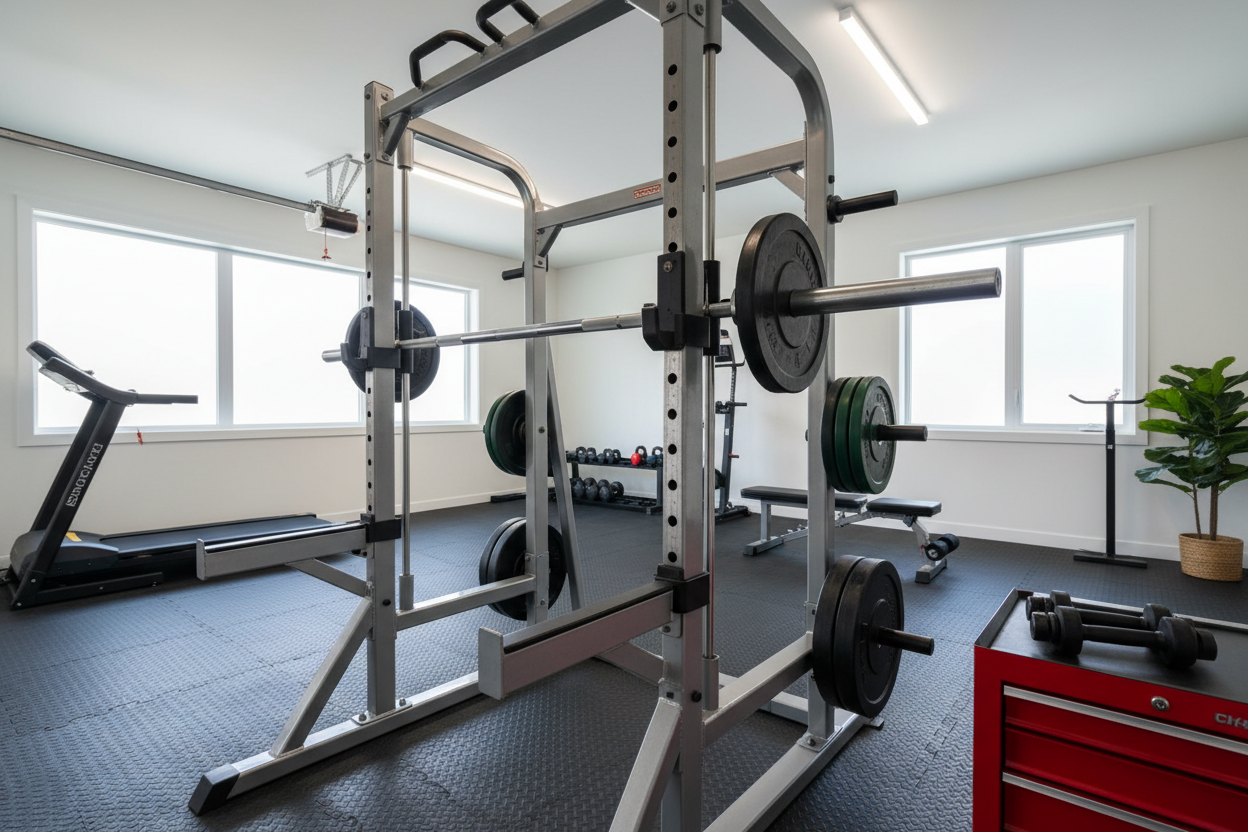
I have spent the last decade in garage gyms and commercial dungeons, and if there is one thing that still makes me twitch, it is watching someone wrestle with rusted spring collars for three minutes just to do a set of shrugs. It is a ritual that makes zero sense once you understand the mechanics of the equipment you are standing in. Using clips on smith machine bars is often more about habit than actual safety, and frankly, it is a waste of your training energy.
I used to be that guy. I clamped every plate like my life depended on it. But after thousands of sets, I realized that the Smith machine is not a barbell, and treating it like one is just inefficient. If you are training in a home gym, every second saved on plate changes is an extra second of recovery or a faster workout. Let’s talk about why those clips on the smith machine are usually just taking up space on your floor.
Quick Takeaways
- The fixed track eliminates the bar tilt that causes plates to slide off standard barbells.
- High-quality linear bearings provide a smooth ride that keeps plates seated via gravity.
- You only need smith machine clips for explosive movements, resistance bands, or unilateral loading.
- Skipping collars saves time and frustration during drop sets or pyramid training.
The Great Gym Floor Debate
Walk into any powerhouse gym and you will see two camps. There is the safety-first crew who meticulously slides a collar onto the sleeve even if there is only a single 25-pound plate loaded. Then there is the veteran crowd that lets the plates jingle and move as they please. It is a polarizing topic because we are taught from day one that an unsecured bar is a dangerous bar. On a free-weight bench press, that is 100% true. If you lose your line and the bar tilts five degrees, those plates are going for a ride, and your wrists are going to snap.
But the Smith machine changes the rules of engagement. Because the bar is locked into a steel track, the 'tilt' factor is removed from the equation. You can't tip the bar even if you tried. This leads many lifters to realize that the friction of the plate against the sleeve, combined with the vertical orientation, is more than enough to keep things stable. It is a debate about perceived safety versus mechanical reality.
The Physics of a Bar That Can't Tilt
On a standard Olympic barbell, collars serve one primary purpose: preventing lateral movement caused by uneven force production. If your left tricep is stronger than your right, the bar tilts, gravity takes over, and the plates slide toward the floor. In a Smith machine, the bar is mounted on guide rods. It can only move up and down (and sometimes on a slight incline). The physics of the machine ensures the bar stays perfectly horizontal at all times.
This means the force of gravity is always pulling the plates directly down onto the sleeve, not toward the ends of the bar. Because the bar doesnt equal a barbell in terms of freedom of movement, the danger of a plate 'escaping' during a standard press or squat is virtually zero. The internal diameter of a 45-pound plate has just enough tolerance to sit snugly on a 2-inch sleeve, and without a tilt to encourage sliding, those plates aren't going anywhere.
3 Scenarios Where Clips on the Smith Machine Are Mandatory
I am not saying you should throw your collars in the trash. There are three specific times where I will still reach for them. First: resistance bands. If you loop a heavy monster band around the end of the bar, the tension doesn't just pull down; it pulls inward or outward depending on your anchor point. That tension can easily wiggle a plate off the end of the sleeve during the eccentric phase.
Second: explosive 'throw' movements. If you are doing Smith machine bench throws—where you actually release the bar at the top for power development—the sudden impact of catching that bar can create enough vibration to shift the plates. You don't want a 45-pounder sliding off while the bar is mid-air. Third: unilateral loading. If you are intentionally loading only one side for a specific rehab movement or offset carry, the imbalance can create weird harmonics in the machine. While it won't tilt, the vibration can be unpredictable.
For a controlled, heavy movement like a bent over row on smith machine, you are moving the weight in a smooth, predictable arc. In these cases, the plates stay seated purely by the grace of vertical alignment. I have never had a plate move more than half an inch during a heavy rowing session.
Does Track Vibration Rattle Plates Loose?
The quality of your machine matters here. If you are using a cheap, bolt-together unit with nylon bushings, the movement is going to feel 'crunchy.' That friction creates vibration. Over a 12-rep set, that micro-shaking can actually cause plates to walk toward the end of the sleeve. It is the same principle as a washing machine moving across a laundry room floor during the spin cycle.
However, if you are using a smith machine with cable crossover that utilizes high-end linear bearings, the travel is buttery smooth. There is almost zero lateral vibration. I have tested 405-pound squats on premium machines without clips, and the plates didn't budge a millimeter. If your machine feels like it is vibrating your teeth loose, use the clips. If it feels like it is sliding on ice, you are fine without them.
The Final Verdict: To Clip or Not to Clip?
For 90% of your lifting, skipping the clips is a smart move. It makes weight changes faster and keeps your focus on the set rather than the hardware. If you are doing standard bodybuilding work—presses, squats, lunges—gravity is the only collar you need. Save the clips for the days you are getting fancy with bands or trying to set a world record for the most explosive bench press throw ever recorded.
When setting up quality smith machine setups in a home gym, I always recommend having a pair of quick-release plastic collars nearby just in case. They are easier to slap on than the old-school metal springs and provide that extra peace of mind for high-intensity sets. But don't feel like a rebel for leaving them off; feel like an efficient lifter who knows his gear.
Personal Experience: The 'Walking' Plate
I learned my lesson about vibration the hard way. I was training at a hotel gym on a Smith machine that clearly hadn't been greased since the 90s. The guide rods were sticky, and the bar jumped every few inches. I was doing high-rep calf raises and didn't bother with clips. By rep 20, the outer 25-pound plate had vibrated so far out it was hanging halfway off the sleeve. I had to stop the set mid-burn to kick it back on. Now, if I’m on a machine that sounds like a freight train, I clip up. If it’s a smooth, commercial-grade rig, I leave them in the bucket.
FAQ
Is it safe to use a Smith machine without clips?
Yes, for most standard lifts. Because the bar is on a fixed vertical or slightly angled track, it cannot tilt. Without tilt, gravity keeps the plates firmly on the sleeves unless you are doing explosive movements that cause heavy vibration.
Do Smith machines need special collars?
No, they use standard 2-inch Olympic collars. However, since Smith machine sleeves are often shorter than those on a standard barbell, slim-profile plastic collars are usually better than bulky metal ones if you are maxing out the plate capacity.
Should I use clips for Smith machine squats?
Unless you are doing jump squats or using resistance bands, you don't need them. The bar path is stable, and the plates won't slide off during a standard squatting motion.
Share:
Why I Finally Bought the Best Workout Gym Machines for My Garage
Why Your Sitting Exercise Machine Feels Like a Flimsy Footrest