
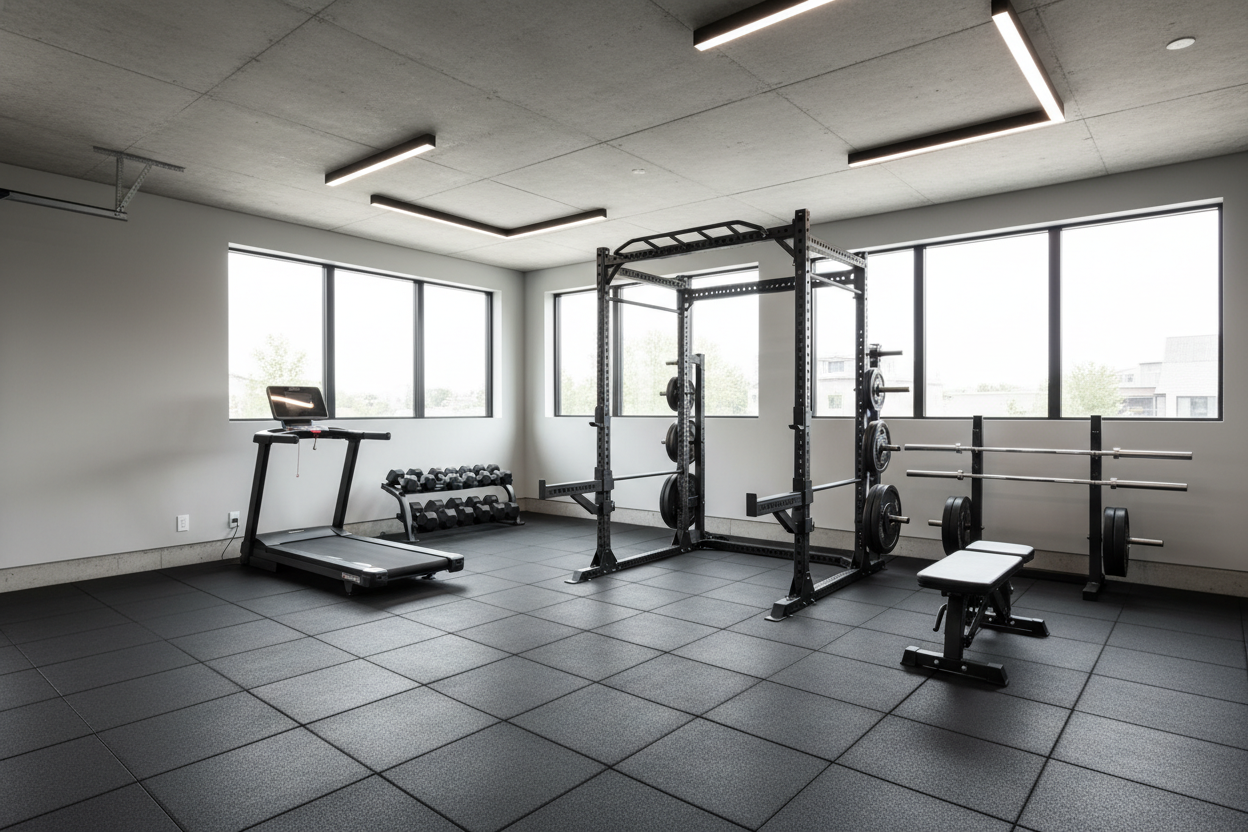
I remember the first time I set up a power rack in a spare bedroom. I was so focused on the knurling of my new Ohio Bar and the shiny finish on my plates that I completely ignored the floor beneath me. Three weeks into a heavy squat cycle, I noticed a hairline crack spider-webbing across the ceiling of the kitchen directly below. I hadn't built a gym; I'd built a structural hazard.
Most of the best home gym ideas you see on social media are aesthetic lies. They show heavy iron on thin laminate flooring without a hint of reinforcement. If you want a space that survives more than a year of heavy triples, you have to stop looking at the gear and start looking at the bones of your house. Your gym structure is the most expensive piece of equipment you own.
Quick Takeaways
- Standard residential floors are rated for 'live loads' (people and furniture), not 500-lb 'dynamic loads' (dropping a barbell).
- A home gym addition requires specific concrete PSI and vapor barriers to prevent equipment rust.
- Soundproofing is about mass and decoupling, not just sticking foam wedges on the wall.
- Budget at least 20% of your total spend on 'invisible' upgrades like electrical and subfloor beefing.
Stop Ignoring Your Floor Joists
Standard American residential code usually calls for a 40-psf (pounds per square foot) live load capacity. That sounds like a lot until you realize a 300-lb rack with 500 lbs of plates sitting on a 4x4 footprint is already pushing that limit. Now, imagine yourself at the bottom of a heavy squat. You aren't just sitting there; you are exerting downward force. If you miss a lift and the safeties catch that bar, the instantaneous force can be triple the static weight.
Before you even look at a catalog, crawl into your basement or crawlspace. Look at your floor joists. Are they 2x8s or 2x10s? Are they spaced 12 inches or 16 inches apart? If you’re planning on pulling heavy deadlifts, you need to bridge those joists or add a lally column. Adding a simple 4x4 post under your lifting area can be the difference between a PR and a floor collapse.
I’ve seen guys try to fix this with a single layer of 3/4-inch plywood. It helps distribute the weight, sure, but it doesn't change the load-bearing capacity of the wood underneath. If your gym structure isn't reinforced, you’re just making the floor look pretty while the joists are screaming for help.
The Brutal Reality of a Home Gym Addition
If you're out of room inside, you might be dreaming of a home gym addition. This isn't just a weekend DIY project. You’re looking at architectural permits, foundation pours, and strict zoning laws. Most people start shopping for a home gym before they even have a permit in hand, which is a recipe for a very expensive storage shed.
A proper lifting slab needs to be at least 4 inches of 4,000 PSI concrete. If you’re planning on a dedicated Olympic lifting platform, I’d argue for 6 inches in that specific zone. You also need a high-quality vapor barrier. Without it, moisture will seep through the concrete and turn your $1,000 power bar into a rusted relic in six months.
Don't forget the ceiling height. A 7-foot ceiling is a death sentence for overhead presses or pull-ups. If you're building from scratch, aim for at least 9 or 10 feet. It gives you room for a full-sized rack and keeps you from punching a hole in the drywall every time you try to hit a personal best on military press.
Why Your HVAC Will Struggle With Your New Space
Your house was designed to keep a family comfortable while they watch Netflix, not while you're doing 10x10 squats. A human body in high-intensity training puts out a staggering amount of heat and moisture. If your home gym building ideas don't include a dedicated mini-split or at least a high-CFM exhaust fan, you’re going to be training in a swamp.
Humidity is the enemy of iron. Even if you have stainless steel bars, your rack and plates will eventually succumb to the 'sweat box' effect. I recommend a dehumidifier that drains directly outside. You don't want to be the guy who has to empty a bucket every two hours just so his power rack doesn't turn orange.
Soundproofing Isn't Just for Recording Studios
One of the most overlooked home gym build ideas is vibration isolation. You can put up all the acoustic foam you want, but if your rack is bolted directly to the subfloor, your family will feel every rep in their teeth. You need to decouple the gym floor from the rest of the house.
Use Mass Loaded Vinyl (MLV) under your rubber mats. It’s a dense, heavy material that stops sound waves from traveling through the structure. Better yet, build a floating platform using layers of plywood and horse stall mats. This creates a 'sandwich' that absorbs the impact before it hits the joists. Your neighbors—and your spouse—will thank you.
Budgeting for the Invisible Upgrades
Everyone wants to spend their cash on a shiny new functional trainer, but you need to set aside money for the stuff you can't see. If you’re running a high-end treadmill, you need a dedicated 20-amp circuit. Plug that into a shared 15-amp circuit with your garage lights, and you’ll be tripping breakers every time you hit an incline.
You also need to think about wall reinforcement. If you want to build the best home gym under 2000, you might be tempted to skimp on the walls. Don't. If you’re mounting a folding rack or a heavy cable pulley, you need to tie into at least three studs, and those studs should be reinforced with 2x6 stringers. Drywall is not a structural component.
Lighting is another hidden cost. Most garages have a single, flickering bulb. For a safe training environment, you need high-output LED shop lights. I prefer 5000K color temperature—it keeps you awake and focused. It’s hard to get hyped for a heavy set when you’re training in a dim, yellow cave.
Buying Gear That Plays Nice With Residential Framing
When you finally get to the fun part—buying the gear—choose wisely. For a residential gym structure, look for racks with a large 'footprint.' A rack that covers 24 square feet distributes its weight much better than a compact 'squat stand' that concentrates all that mass into four tiny points. This prevents the wood in your subfloor from compressing over time.
I also prioritize equipment for home gym gains that doesn't require a permanent bolt-down if you're on a second floor. Flat-foot racks are great because they are stable without needing to drill 3-inch lag bolts into your joists. If you do bolt down, make sure you know exactly where the plumbing and electrical lines are running before you pull the trigger on that impact driver.
Personally, I made the mistake of ignoring the 'crush' factor on my first build. I put a heavy rack on top of cheap carpet and padding. Within a month, the rack was leaning three degrees to the left because the foam padding had collapsed unevenly. I had to tear the whole thing down, rip up the carpet, and start over with a proper 3/4-inch rubber stall mat base. Do it right the first time.
FAQ
Can I put a gym on the second floor?
Yes, but you need to consult a structural engineer if you plan on using more than 300 lbs of total weight. You’ll likely need to reinforce the joists or build a significant weight-distributing platform to avoid ceiling cracks downstairs.
How thick should my gym floor mats be?
At minimum, 3/4-inch. Don't buy the 'puzzle piece' foam mats from big-box stores; they are useless for heavy lifting. Go to a farm supply store and buy 4x6-foot rubber horse stall mats. They are dense, durable, and much cheaper.
Do I really need a permit for a garage gym?
If you're just putting mats down, no. But if you are adding new electrical circuits, structural beams, or doing a full home gym addition, you absolutely need one. It protects your home's resale value and ensures your insurance covers you if something goes wrong.
Share:
I Cut a Cheap Barbell Rod in Half to See What's Inside
I Ranked the Types of Exercise Equipment for the Home (Most Are Junk)