
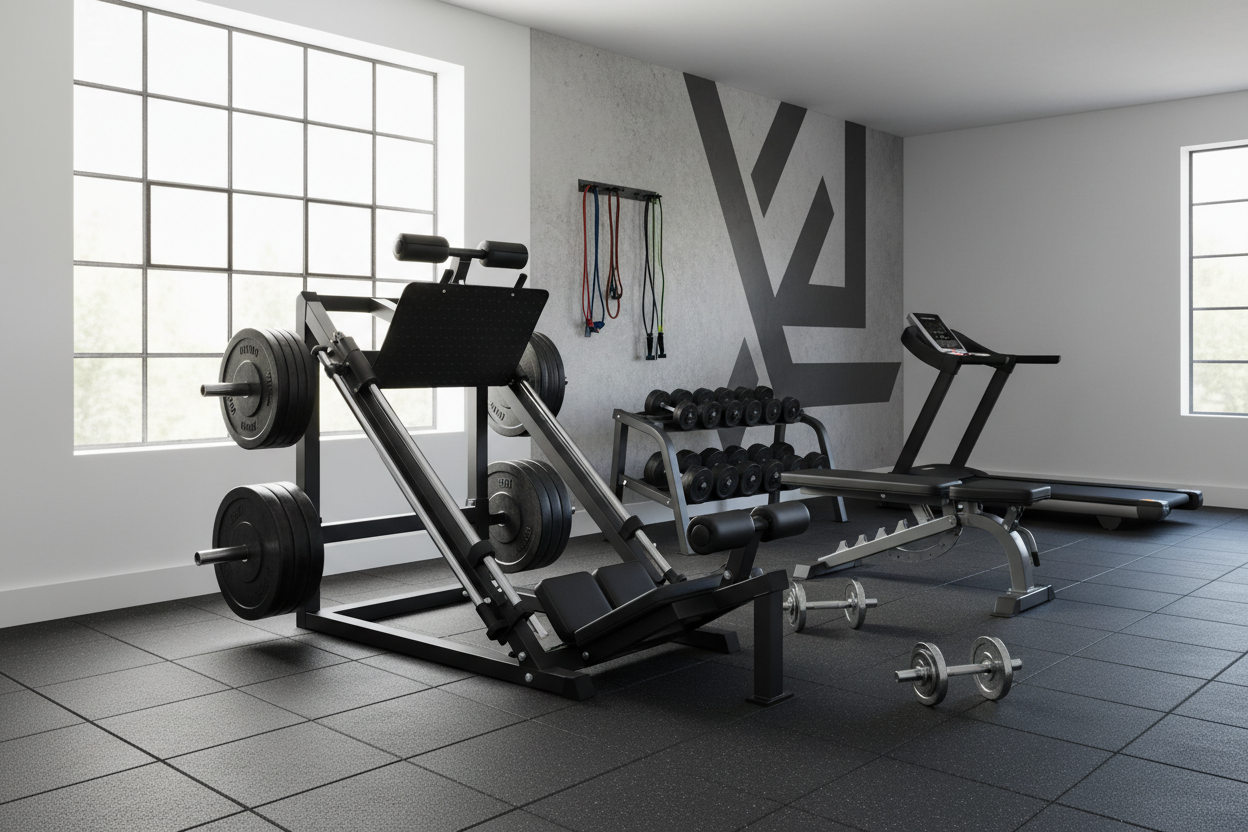
I used to be that guy. The one who sneered at anyone using a squat machine while I spent forty-five minutes warming up my lower back just to survive three sets of barbell squats. I thought machines were for the lazy or the uninitiated. I was wrong, and my skinny legs proved it.
After a decade of heavy lifting, my spine started begging for a break. I realized that if I wanted to actually fail because my quads gave out—not because my lower back was screaming—I needed to rethink my setup. Finding the right exercise machine for squats isn't about taking the easy way out; it's about removing the stability bottleneck so you can actually reach true muscular failure.
Quick Takeaways
- Hack squats provide the best stability for pure quad isolation.
- The Smith machine is an underrated tool for targeting the teardrop when you adjust your feet.
- Pendulum squats offer the most brutal strength curve but are hard to find.
- Avoid cheap, thin-gauge steel machines that wobble under real weight.
Why I Finally Stopped Worshipping the Barbell
Free-weight purists love to talk about 'functional' strength. But if your goal is hypertrophy, your core shouldn't be the reason you stop a set. When I started ditching my traditional squat stand in favor of specialized machines, my leg growth exploded. By removing the need to balance 400 pounds on my neck, I could finally focus 100% of my effort on the knee extensors.
A squat machine at gym settings allows you to push past the point where your form would normally break down on a barbell. You can grind out those last three reps with total safety. That is where the growth happens.
The Hack Squat: Heavy Loads Without the Spinal Tap
The hack squat is the king of the squat machine gym floor. Because you are locked into a fixed, angled sled, your back is pinned against a pad. This eliminates the 'shear force' on your spine that makes traditional squats so risky for some lifters. It is a pure squats workout machine designed for one thing: quad annihilation.
If you are building a home gym, you probably don't have room for five different units. I usually recommend looking for a 3-in-1 hack squat and leg press. These combo units use linear bearings and heavy-duty carriage systems to give you that commercial feel without taking up half your garage. You get the benefits of a dedicated squat workout machine and a press in one footprint.
The Smith Machine: Stop Hating on This Garage Gym Staple
The internet loves to hate the Smith machine, but it is an elite machine to do squats if you stop treating it like a barbell. The fixed vertical path is actually its greatest strength. Since you don't have to balance, you can walk your feet out in front of the bar.
If you have a Smith machine home gym station, you can lean back into the bar to create a more upright torso. By adjusting your foot placement, you can shift the tension directly onto the vastus medialis (the teardrop). It’s a surgical tool for leg development, provided you aren't trying to ego lift with terrible mechanics.
Pendulum Squats: The Rarest Beast on the Gym Floor
If you ever see a pendulum squat at a gym, cancel your plans and use it. It is arguably the most difficult squat machine ever built. The arc-like path moves with your body’s natural biomechanics, but the weight gets heavier as you reach the bottom of the rep. It creates a level of quad tension that a standard 45-degree sled just can't match.
It’s a full body squat machine in the sense that it requires serious grit to finish a set, even though your back is supported. Most home gym owners won't have one because they are massive and expensive, but for pure hypertrophy, they are the gold standard.
Should You Just Buy a Leg Press Instead?
A leg press is great, but it doesn't always translate to the same 'feel' as a squat. A true full body squat machine usually involves some level of axial loading (weight on the shoulders), which keeps your core somewhat engaged. If space is your biggest enemy, a compact 30-degree leg press might be the smarter play. You lose a bit of the 'squat' mechanics, but you gain the ability to walk around your gym without tripping over a massive hack squat sled.
How to Avoid Buying a Wobbly Death Trap
When you start looking for a cheap squat machine, you have to be careful. I’ve tested units that felt like they were made of recycled soda cans. If the machine uses plastic rollers instead of linear bearings, it’s going to feel 'chunky' after three months. Look for 11-gauge steel and a weight capacity of at least 600 lbs—even if you don't lift that much, the extra steel provides the stability you need to feel safe.
Personal Experience: My Budget Blunder
I once bought a squats workout machine from a big-box retailer because it was $200 cheaper than the one I actually wanted. Big mistake. The first time I loaded four plates on it, the frame actually twisted slightly. The 'smooth' slide felt like dragging a brick across sandpaper. I ended up selling it for half what I paid and buying the heavy-duty version anyway. Buy once, cry once—especially when your safety is on the line.
FAQ
Is a squat machine better than a barbell?
For pure muscle growth (hypertrophy), machines are often better because they provide more stability, allowing you to push your muscles to absolute failure without your balance giving out first.
Can I do a full body workout on a squat machine?
While primarily for legs, some machines allow for calf raises or even overhead presses if they are versatile enough, but they are mostly specialized tools for the lower body.
What should I look for in a home squat machine?
Prioritize linear bearings for a smooth travel path, a high-weight capacity (11-gauge steel), and a footprint that actually fits your space without blocking your other equipment.
Share:
How to Spot Bulletproof Used Gym Gear by the Life Fitness Logo
I Squeezed a Heavy-Duty Corner Home Gym Into an 8x8 Space