
I was at a local big-box gym last week, and the leg extension felt like it was fighting me, not my quads. It was jerky at the bottom and weightless at the top—a total mechanical disaster. This happens when a brand cares more about the paint job than the physics. I sat down with a veteran fitness equipment designer to figure out why some gear feels like an extension of your body while others feel like a heap of scrap metal.
Quick Takeaways
- Pivot points determine whether you feel the muscle or just joint pain.
- Cams (those oblong pulleys) are what make the weight feel 'even' throughout the rep.
- Cheap bearings are the number one cause of that 'crunchy' cable feel.
- Budget brands often copy the look of gear without understanding the blueprints.
The Invisible Math Behind the Perfect Rep
A professional gym equipment designer isn't just an artist; they are physicists with a lifting belt. The biggest hurdle in gym equipment design is the strength curve. Humans aren't equally strong throughout a movement. You are weaker at the bottom of a chest press than you are at the lockout.
If a machine uses a perfectly round pulley, the resistance stays the same, which actually makes the move feel harder where you are weakest. A designer uses 'cams'—specifically shaped pulleys—to vary the leverage. This ensures the machine gets heavier only when your muscles are in their strongest position. Slapping a cable on a frame is easy; timing that resistance curve is where the real engineering happens.
Why You Can't Just Copy a Hip Thrust Machine
You see this all the time on Amazon. A brand tries to reverse-engineer a dedicated hip thrust machine by looking at a photo. They get the dimensions close, but the pivot point is two inches off. That tiny error in exercise equipment design means the tension shifts from your glutes to your lower back halfway through the set.
When you are moving 300+ pounds on a specialized machine, the arc of the movement has to be perfect. If the designer didn't account for the femur length of the average user, the footplate ends up at an angle that kills your ankles. Commercial blueprints are guarded like state secrets for a reason—the math is the product, not the steel.
Space vs. Biomechanics: The Home Gym Dilemma
Designing for a garage is a nightmare for fitness equipment design. In a commercial gym, a designer has 2,000 square feet to play with. In your garage, you want one machine to do ten things. But when you design gym equipment for versatility, you often lose the 'perfect' feel of a single-purpose unit.
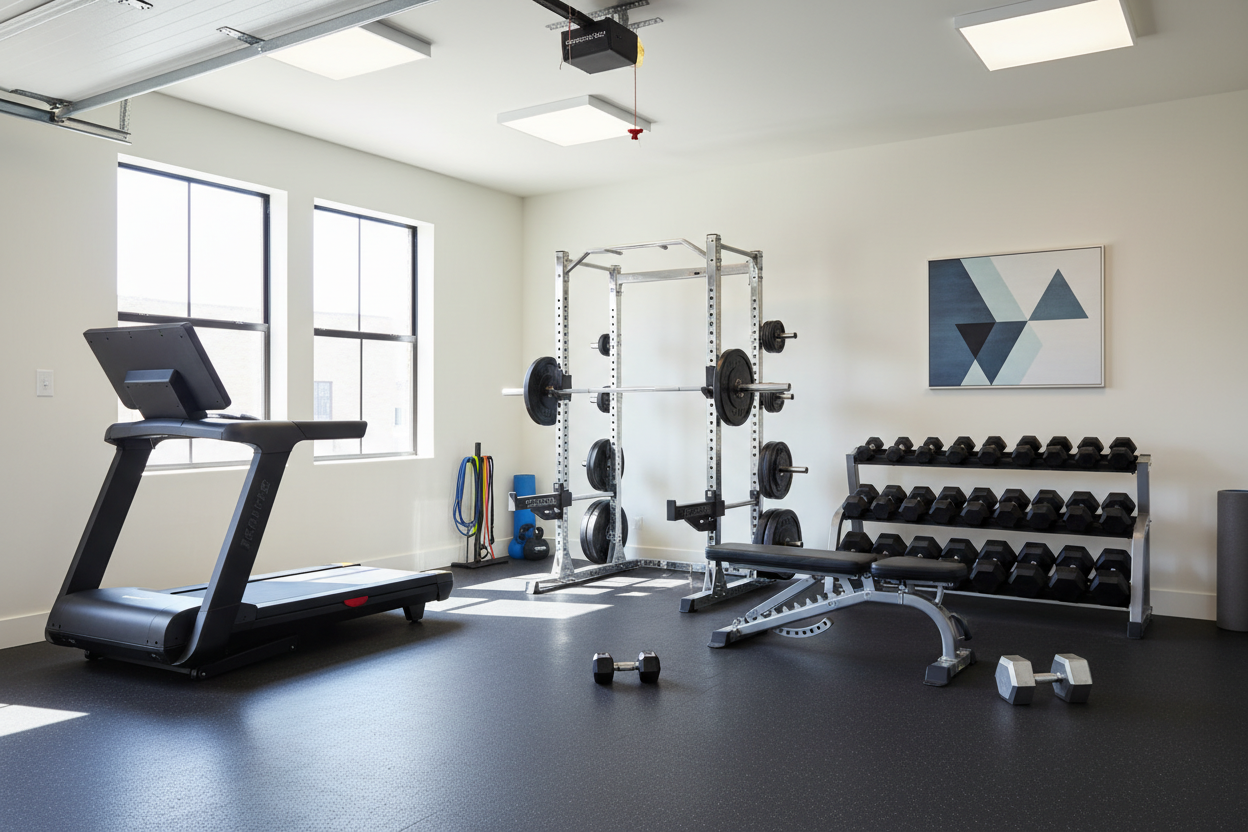
For many, the best home gym fitness equipment is actually the simplest—a rack, a bar, and plates. If you go complex, like a Smith machine home gym station, the engineering demands skyrocket. You need high-end linear bearings and case-hardened guide rods. If the designer skimps here to save space or cost, the bar will chatter and bind the second you add more than two plates per side.
Do You Really Need to Pay for Premium Engineering?
Most lifters trying to replicate Fitness 19 equipment realize quickly that commercial gear is built for 100,000 reps and 300-lb meatheads. You might not need a 7-gauge steel frame that can survive a nuclear blast, but you do need decent design gym equipment that doesn't wreck your elbows.
The 'good enough' threshold is usually found in the pulleys. Look for fiberglass-reinforced nylon or aluminum pulleys with sealed bearings. If a machine uses plastic bushings instead of bearings, it doesn't matter how heavy the weight stack is—the friction will ruin your gains. Pay for the movement quality, not the flashy LCD screen.
How to Spot Lazy Engineering Before You Buy
When outfitting a home gym, you have to be a detective. Look at the cable specs; you want 7x19 aircraft-grade cable coated in nylon. Look at the upholstery. Is it double-stitched or just stapled to a piece of plywood? Lazy gym machine design shows up in the details you usually ignore until the third month of use.
Check the adjustments. A well-designed machine uses pop-pins that snap into place with zero wiggle. If the seat wobbles before you even sit on it, the tolerances are trash. That wobble will only get worse once you start moving heavy loads. Trust the brands that talk about 'moment arms' and 'pivot points' rather than just 'heavy-duty steel.'
My Personal Experience
I once bought a budget functional trainer because it was $500 cheaper than the name brand. On paper, the specs were identical. In reality, the 'fitness equipment designer' clearly never used the machine. The pulleys were so close together that my knuckles hit the frame on every fly. I ended up selling it at a loss three months later. Now, I check the pulley width before I even look at the price tag.
FAQ
Is a heavier weight stack always better?
Not if the pulleys suck. A 200-lb stack with high friction feels heavier and jerkier than a 300-lb stack with high-end bearings. Smoothness beats raw weight every time.
What is a 'cam' in gym equipment?
It is an oblong-shaped pulley that changes the mechanical advantage as it rotates. It makes the weight feel lighter or heavier at specific points to match your body's natural strength.
Can I fix a machine that feels 'crunchy'?
Sometimes. Cleaning the guide rods with silicone spray helps, but if the internal bearings are cheap plastic, no amount of lube will make it feel like commercial gear.
Share:
I Bought 4 Models to Find the Best Total Gym for Home
What Nobody Tells You About Lifting on Inspire Home Gyms