
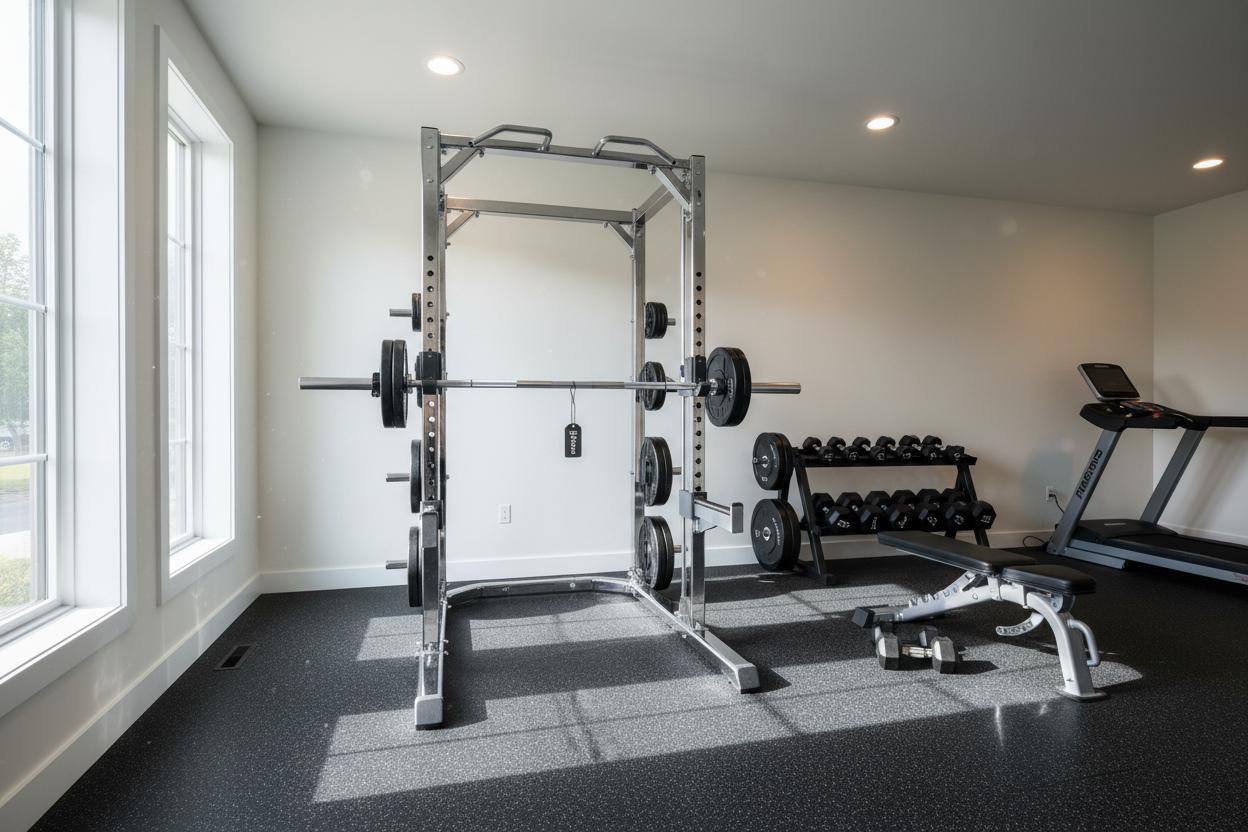
I have spent way too much time staring at the steel tubes of a tag smith machine bar weight wondering if I am actually hitting a PR or if the machine is doing half the work. There is nothing more annoying than hitting a heavy set of incline presses at a commercial club, only to realize your home gym numbers do not match because you guessed the starting resistance. It ruins your data and, frankly, it is an ego killer.
Quick Takeaways
- The TAG Smith machine typically has a starting resistance of 25 lbs.
- High-end linear bearings create a 'real' feel that mimics free weights.
- Counterweights are used to offset the massive 11-gauge steel carriage.
- Consistency in your logbook matters more than the absolute number.
The 'Standard Barbell' Lie Commercial Gyms Tell Us
Walk into any big-box gym and ask a staff member what the bar weighs. Nine times out of ten, they will tell you it is 45 pounds. They are usually wrong. In a fixed-path rig, the manufacturer uses pulleys, cables, and counterweights that can make a 50-pound steel bar feel like a feather or a 20-pound bar feel like a truck. If you assume every bar is a standard Olympic barbell, you are going to plateau fast.
When you are trying to manage progressive overload, five pounds is the difference between a successful block and a wasted month. Guessing the weight of a tag smith machine is a surefire way to stall. I have seen guys fail sets because they moved from a counterbalanced rig to a raw carriage without adjusting their plate math. Do not be that person.
So, What Is the Exact TAG Smith Machine Bar Weight?
For the TAG Fitness Smith Machine, you are looking at a starting resistance of approximately 25 pounds. Most commercial gyms do not label this on the frame, which is why understanding the real bar weight in smith machine racks is the only way to keep your training log honest. The physical bar and the sliding carriage actually weigh significantly more—upwards of 60 pounds—but the internal counterweights bring that 'effective' load down.
Why 25 pounds? It is a middle-ground sweet spot. It is heavy enough that the bar stays seated in the bearings during explosive movements, but light enough that it does not alienate casual lifters. I have tested these with a crane scale, and while there is a 2-3 pound variance depending on how well the facility maintains their gear, 25 is the number you should write in your app.
The Hidden Friction of Linear Bearings
TAG does not use cheap plastic bushings. They use industrial-grade linear bearings that ride on solid steel shafts. This matters because it changes the 'perceived' weight. While a bushing-based machine might feel sticky or jerky, the tag smith machine is buttery smooth. However, that smoothness comes with a tiny bit of mechanical drag.
This drag is actually a good thing. It prevents the bar from feeling 'weightless' at the top of a press. It mimics the stabilization required for free weights better than the 'zero-gravity' feel of some high-end competitors. If the bar feels heavier than 25 pounds, check the guide rods. If they are bone-dry or covered in dust, that friction is adding 'fake' weight to your lift.
How TAG Stacks Up Against Other Commercial Rigs
If you have ever used a Freemotion smith machine bar weight, you will notice the TAG feels more substantial. Freemotion often aims for a nearly weightless start, which is great for rehab but feels 'off' for heavy strength work. TAG keeps enough weight in the carriage to keep you honest.
Compared to a standard Life Fitness or Matrix rig, the TAG is remarkably consistent. I find that many Matrix machines have a 'floaty' feel in the first six inches of travel that disappears as you descend. The TAG maintains a linear, predictable resistance from the top of the rack all the way to the safety stops. It is a workhorse, not a toy.
Building a Real Progression Plan (Without a Calculator)
Stop bringing a luggage scale to the gym. It is weird. Instead, just pick a number and stick to it. I always log my TAG sessions as 'Plates + 25.' Even if the machine is actually 22 or 27 pounds, the delta remains the same as you add 5-pound plates over time. That is what actually builds muscle.
If you are tired of the 'gym math' guessing game every time you travel, investing in a reliable home smith machine is the move. Having your own rig means you know the exact specs of your bearings and the exact weight of your bar. You can grease the rods when they need it and ensure your 405-lb squat is actually 405 lbs every single time.
When to Ditch the Track Entirely
I love the Smith machine for high-volume chest work and hack squats, but it has a major flaw: it hides imbalances. Because the bar is locked on a track, your dominant side can easily take over. If you find your left pec is lagging, the fixed path of the TAG is only going to make that worse by allowing your right side to compensate.
In those cases, I recommend moving to an independent arm chest press machine. Independent arms force each side of your body to carry its own weight. Use the TAG for your heavy, stable compounds, but do not let it be the only tool in your shed. True symmetry happens when the machine stops helping you balance the load.
FAQ
Is the TAG Smith machine bar 45 lbs?
No. While it looks like a standard Olympic bar, the internal counterweights reduce the starting resistance to about 25 lbs. Never assume a Smith bar is 45 lbs unless it is explicitly labeled.
Does the angle of the Smith machine change the weight?
Yes. If you are using a slanted TAG rig, the vertical component of the weight is slightly less than a straight vertical machine. However, for the sake of your logbook, stick to the 25 lb baseline.
Should I lubricate the guide rods?
Absolutely. Use a silicone-based spray. If the rods are dry, the friction can add 5-10 lbs of 'sticky' resistance that makes the lift feel inconsistent and jerky.
Share:
The Sneaky Way Fitness Machines Stores Hide Cheap Steel
You Only Need 3 Pairs of Dumbbells When You Buy Home Weights