
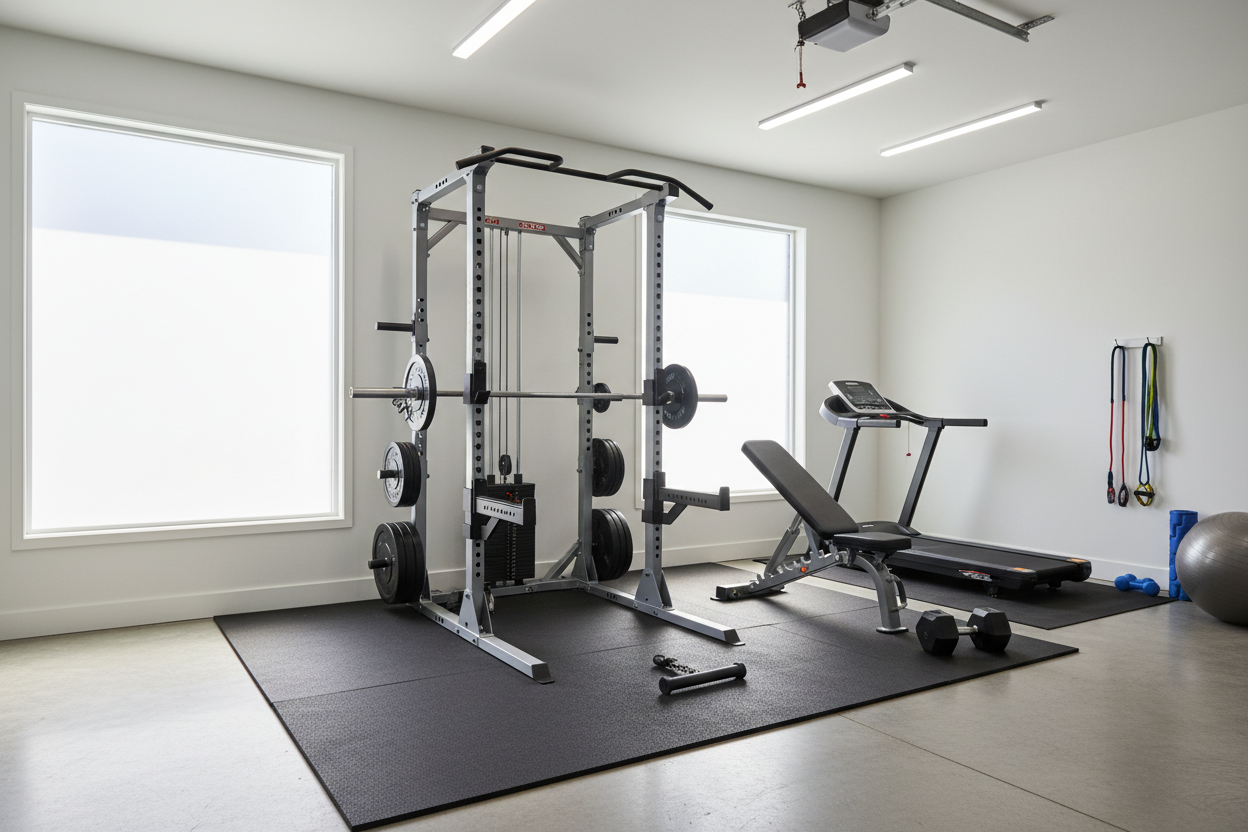
I remember staring at my garage wall three years ago, wondering why my back looked like a sheet of plywood despite hitting 50 pull-ups a session. I had the 'V-taper' from the side, but from the back? Nothing. Flat as a pancake. I was doing the work, but I was using the wrong tools for the job.
Building a thick, powerful posterior chain requires more than just hanging from a bar. Choosing the right back exercise home equipment is about filling the gaps that gravity and basic bodyweight movements leave behind. You need to hit the muscle from angles that a standard doorway bar simply can't reach.
- Pull-ups primarily target vertical pull; you need horizontal variety.
- Horizontal rows are non-negotiable for mid-back and rhomboid thickness.
- Cable tension provides a constant load that dumbbells often lose at the top of the rep.
- Space-saving pulley systems are usually a better investment than cheap multi-gyms.
The 'Pull-Up Only' Trap Most Home Lifters Fall Into
The pull-up is the king of bodyweight exercises, but it's a specialist, not a generalist. It builds great width by hammering the lats, but it does almost nothing for the 'meat' of your back—the rhomboids, mid-traps, and teres major. To get that 3D look, you have to pull things toward your chest, not just pull your chest to a bar.
Relying on a single plane of motion is how you end up with shoulder imbalances and a physique that looks unfinished. We need to talk about back exercise home equipment that allows for horizontal rowing and varied grip widths. Building a complete back requires targeting different planes of motion, especially the ones that force your shoulder blades to retract under heavy load.
Why You Need Horizontal Pulling (And How to Do It Cheaply)
Horizontal pulling is where the thickness happens. When I tested 50 pieces of exercise equipment for home (most suck, by the way), the ones that survived were the heavy-duty row attachments and versatile suspension trainers. You need gear that lets you pull weight toward your belly button without your lower back giving out first.
If you are on a budget, a set of gymnastic rings is the best $30 you will ever spend. But for pure hypertrophy, adjustable dumbbells or a chest-supported row setup are mandatory. I often use a basic flat bench and a pair of 50-lb dumbbells to mimic a seal row. It is awkward to set up, but the stimulus is night and day compared to a standard bent-over row where your form breaks down long before your lats do.
Can You Fit a Dedicated Lat Pulldown in a Spare Room?
The 'space-to-gains' ratio is a metric every home lifter lives by. A full-sized, plate-loaded lat tower usually takes up about 12 to 15 square feet. If you are building out a dedicated home gym, dedicating floor space to a standalone cable tower is often worth the sacrifice because of the sheer versatility it offers.
However, if you are tight on room, don't buy a cheap, shaky tower that wobbles when you load two plates. Look at rack-mounted pulley systems. These use your existing power rack as the frame. It is the smartest home exercise equipment for back training because it adds zero footprint. I have used $100 pulley kits that felt smoother than $600 standalone machines, provided you use a little silicone spray on the cables to keep things gliding.
The Truth About Multi-Gym Cables for Back Hypertrophy
People constantly ask me is all in one exercise equipment for home just a gimmick, and the answer usually comes down to the friction of its cable pulleys. Most 'all-in-one' stations use cheap plastic pulleys that create a jerky, inconsistent resistance. That is a death sentence for back hypertrophy, where the 'stretch' at the top of the movement is the most important part.
If the weight stack only goes up to 150 lbs, a strong lifter will outgrow it on seated rows within six months. You need a 1:1 or 2:1 ratio that actually challenges your central nervous system. I would much rather have a single heavy-duty cable column with a 250-lb stack than a ten-station machine that feels like it is held together by hope and zip ties. High-quality cables allow for face pulls, single-arm rows, and lat pulldowns with a smooth eccentric phase that builds real muscle.
Stop Overthinking: My 3-Piece Back Building Setup
You do not need a commercial warehouse to build a pro-level back. If I had to start over in a spare bedroom, here is exactly what I would buy: a sturdy power rack with a multi-grip pull-up bar, a plate-loaded high/low pulley attachment, and a pair of heavy adjustable dumbbells. That is the entire kit.
This setup covers your vertical pulls, your heavy horizontal rows, and your isolation work like face pulls or straight-arm pulldowns. Skip the fancy machines with the neon lights. Stick to the basics, load them heavy, and focus on the squeeze. Your t-shirts will start fitting differently in about eight weeks.
My Biggest Gear Mistake
I once bought a 'bargain' lat pulldown machine from a big-box store for $180. It looked the part, but the guide rods were slightly bowed. Every time I pulled more than 120 lbs, the carriage would catch and stutter. It ruined my mind-muscle connection and I ended up selling it for $40 just to get it out of my garage. Lesson learned: if the steel is thin and the pulleys are plastic, stay away.
FAQ
Do I really need a cable machine for my back?
You do not strictly need it, but it is the most efficient way to keep constant tension on the muscle. Dumbbells are great, but the resistance curve drops off at the top of a row. Cables keep the tension high through the entire range of motion.
Are resistance bands good for back growth?
They are fine for finishers or face pulls, but they are terrible for primary movements. The resistance is lightest where you are strongest. Use them as an accessory, not the main course of your workout.
What is the best grip for lat growth?
A neutral grip (palms facing each other) usually allows for the greatest range of motion and the least amount of shoulder stress. It lets you tuck your elbows and really drive them back to maximize lat contraction.
Share:
Why Every Rig Feels Cheap After an Atlantis Smith Machine
Can Compact Muscle Building Machines Actually Deliver Real Size?