
I remember walking into a hardcore powerlifting basement in 2012. If you so much as looked at the lone, dusty Smith machine in the corner, you were practically excommunicated. The consensus back then was simple: are smith machines bad? Yes, because they were 'cheating' and 'unnatural.'
We’ve all seen the memes. The guy doing quartersquats while leaning against the bar like it’s a recliner. But after a decade of wrecking my joints on heavy triples and realizing that my rear delts don't care about 'functional movement patterns' when I’m trying to grow them, my stance has shifted. The hardware isn't the enemy; the ego is.
Quick Takeaways
- Stability is a tool: Removing the balance requirement lets you hammer a specific muscle to absolute failure safely.
- Fixed paths aren't 'dangerous': They just require you to set your foot or bench position more precisely to match your anatomy.
- Home gym gold: Modern combo units save massive floor space by merging the rack, Smith, and cables.
- Not for max strength: If you want to compete in powerlifting, the barbell is your king. If you want to look like you lift, the rails are your friend.
The Elephant in the Gym: Where Did the Hate Come From?
The stigma started with the functional training boom. Suddenly, every trainer with a clipboard was obsessed with 'stabilizer muscles.' The logic was that because the bar is on tracks, your body doesn't have to work to keep it level. People started asking is the smith machine bad because it supposedly makes you weak in real-life scenarios.
While it's true that you aren't training your core to balance a heavy load, that’s exactly the point. When I’m doing high-rep chest work at the end of a session, I don't want my stabilizers to be the weak link. I want my pecs to quit first. The internet hive mind decided that why are smith machines bad was a settled debate, but they forgot that bodybuilders have been using them to build pro-level physiques for fifty years.
The Stabilizer Argument: Free Weights vs. Locked Rails
Let’s talk mechanics. In a free-weight squat, your brain is constantly micro-adjusting to keep you from falling over. That’s great for athleticism. But on a Smith Machine, that stability is built-in. Modern units use linear ball bearings that are smooth as silk, unlike the old-school bushings that felt like sliding a pipe through sand.
By removing the need to balance, you can actually produce more force. Think about it: if you aren't worried about the bar drifting forward on a lunging movement, you can drive harder into the floor. You aren't neglecting your stabilizers; you're just choosing to prioritize the prime movers for a specific block of training. It’s a tactical trade-off, not a flaw.
So, Is the Smith Machine Bad for Building Muscle?
Short answer: No. It’s actually a hypertrophy cheat code. Hypertrophy is about mechanical tension and metabolic stress. When you use the rails, you can take a set to the point where your muscles are literally shaking without the fear of the bar pinning you to the bench. This is What Are Smith Machines Actually Doing For Your Gains—they provide a safety net for intensity.
I’ve found that for movements like high-foot-placement squats or behind-the-neck presses, the fixed path allows for a mind-muscle connection you just can't get with a shaky barbell. You can lean into the bar, shift your center of gravity, and target the quad sweep or the medial delt with surgical precision. If your goal is aesthetic, the 'cheating' argument is irrelevant.
3 Lifts Where the Fixed Path Actually Beats a Barbell
There are three specific moves where I will choose the rails every single time. First, the heavy shrug. A barbell scrapes against your thighs; on the Smith, you can stand slightly forward and pull straight up for a massive trap contraction. Second, the seated overhead press. You can focus entirely on the shoulder drive without worrying about the bar hitting your nose or drifting behind your head.
Third, and most importantly, is the decline press. Why the Smith Machine Decline Press Is a Lower Chest Cheat Code comes down to the angle. You can set the bench perfectly and hammer the lower pecs with a heavy load, solo, without needing a spotter to help you unrack a precarious barbell from a weird angle. It’s safer, more stable, and hits the target better.
Making the Hardware Work in Your Garage Gym
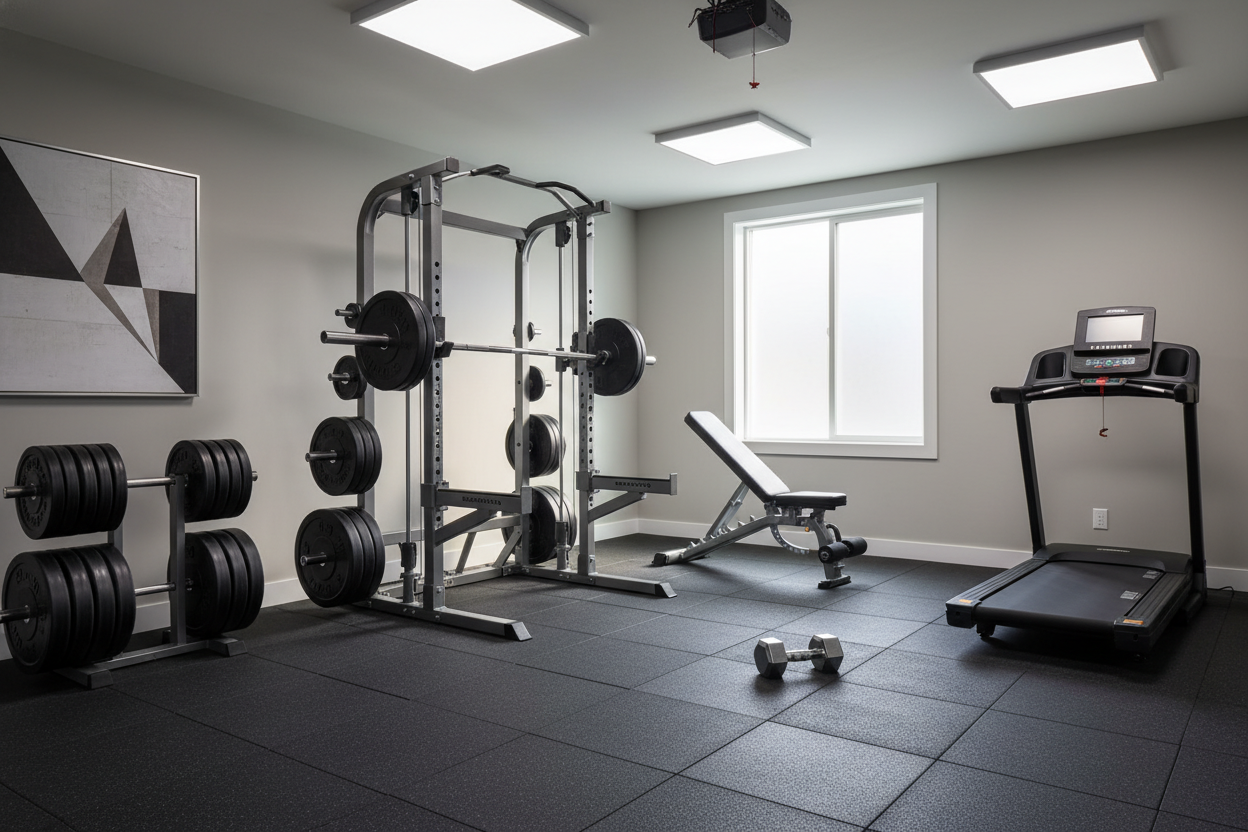
If you're building a home gym, space is your most valuable currency. I used to tell people to buy a power rack and never look back. But if you’re tight on room, a standalone Smith is a waste of space. Instead, look at integrated units like the All In One Smith Machine With Cable Crossover S1 V4.
These units give you the best of both worlds: a squat rack for your 'big' lifts and a Smith system for your accessory work. It fits in a footprint not much larger than a standard rack but replaces three different machines. Just make sure you check the weight capacity—anything under 300 lbs on the Smith bar is going to feel flimsy once you start moving real weight.
Personal Experience: My 'Aha' Moment
I spent five years refusing to touch a Smith machine. Then I tore a minor ligament in my wrist. I couldn't balance a barbell to save my life, but I could still press on a Smith machine because the path was guided. That injury taught me that the machine is just a tool. My biggest mistake was being a purist for the sake of an image. Now? I use it for 20% of my training, mostly for high-rep 'pump' work, and my joints have never felt better.
FAQ
Is the Smith machine easier than free weights?
Yes and no. The bar weight is often counterbalanced (sometimes starting at just 15 lbs instead of 45 lbs), and you don't have to balance it. However, because you can't 'cheat' the path, you might find certain ranges of motion actually feel harder on the target muscle.
Can you squat on a Smith machine?
Absolutely, but don't try to mimic a free-weight squat. Put your feet slightly forward and use it to stay upright. This turns it into a quad-dominant movement that feels more like a hack squat than a traditional back squat.
Why do people say Smith machines cause injury?
Usually because they try to force their body into the machine's path rather than adjusting their position to the machine. If your feet are in the wrong spot, the fixed path can put stress on your knees or lower back. Adjust your stance until it feels natural.
Share:
I Ignore Most Top-Rated Home Gym Equipment (Here Is What I Buy)
I Tested 12 All-in-Ones to Find the Best Gym Machine for Home