
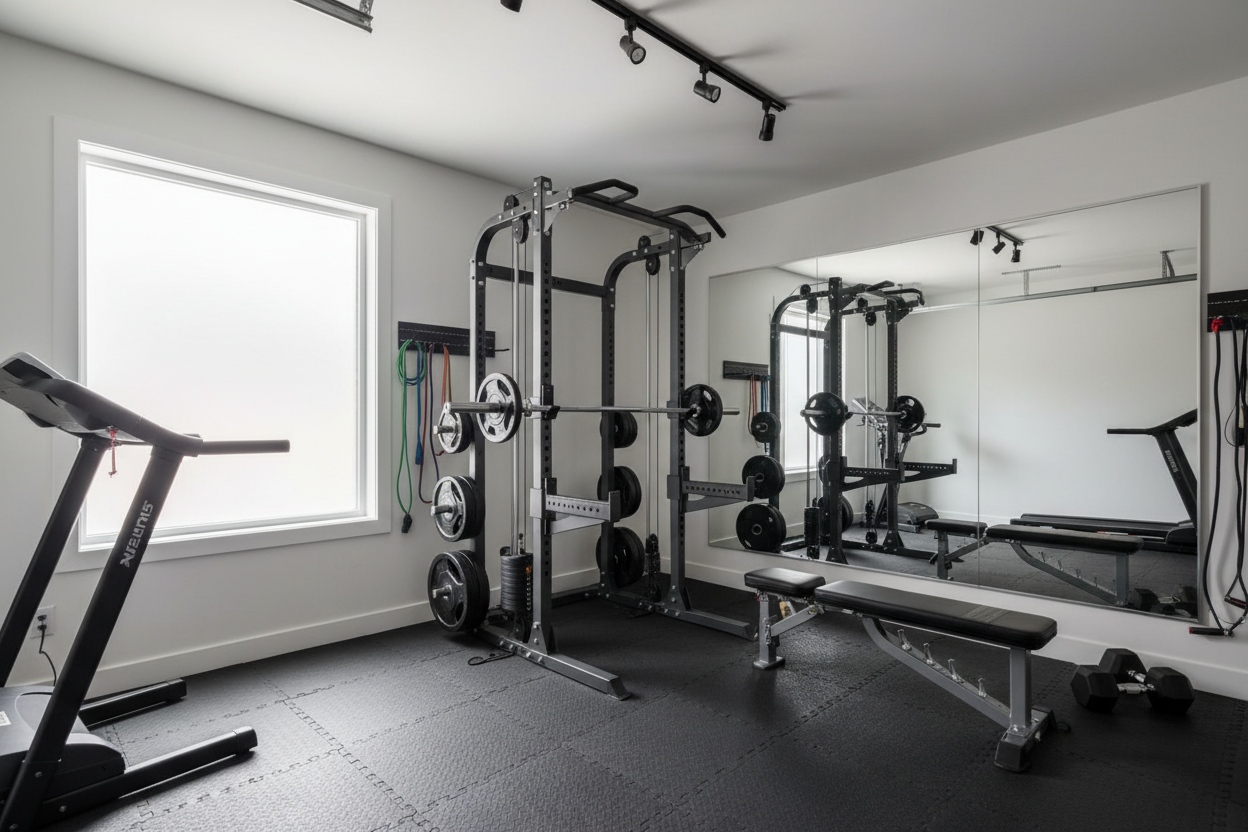
I remember the exact moment I realized my local commercial gym was a lost cause. The membership price had just jumped 20%, the squat racks were permanently occupied by teenagers filming TikToks, and the air smelled like a locker room that hadn't seen a mop since 2019. I started hunting for work out machines for home at 2 AM, trying to figure out if I could actually fit a leg press in a spare bedroom without the floor joists giving up.
Free Weights vs. Machines: The Basement Edition
If you are designing a home gym, you quickly learn that square footage is your most expensive resource. A commercial club has 20,000 square feet to waste on a seated calf raise machine that only gets used twice a day. You do not have that luxury. You have to be ruthless about every piece of gear that crosses your threshold.
The reality is that free weights are the most efficient use of space, but they aren't the whole story. While a barbell and a rack handle 80% of your needs, the right exercise workout station provides things a barbell cannot: isolation, constant tension, and safety when you are training alone. You just have to make sure the machine earns its keep.
- Cables offer the best versatility-to-footprint ratio in a garage.
- Avoid 'all-in-one' systems that weigh less than a standard barbell set.
- Free weights are king for strength, but machines are better for training to failure solo.
- Measure your ceiling height before looking at any vertical workout systems.
When Does an Exercise Workout Station Actually Make Sense?
So, when does a dedicated machine actually justify its footprint? I usually point people toward them for three specific scenarios: injury rehab, bodybuilding-style isolation, and safety. If you are recovering from a shoulder injury, a fixed path of motion is far safer than a wobbling dumbbell. It allows you to target the muscle without the stabilizing tax that might aggravate a joint.
There is also the factor of mechanical failure. If you want to push your quads to the absolute limit, doing it on a machine is safer than doing it under a heavy bar when there is no one around to spot you. However, you have to be honest about your goals. I often get asked if dedicated upper body workout machines for home like a chest press are worth it. Usually, the answer is no—unless you have the room to spare and a very specific reason to avoid the bench press.
The Problem With Most Workout Systems for Home
The biggest trap for new lifters is the cheap, 'do-it-all' home exercise system. These workout systems for home promise 50 different exercises but usually do all of them poorly. They are often built with thin-walled steel and plastic bushings that squeak after a month of use. A 150-pound workout set for home might look good in a catalog, but if the frame flexes when you pull a handle, your muscles aren't getting the consistent resistance they need.
The Cable Exception: Why Pulleys Earn Their Keep
If you want the most bang for your buck in resistance home gyms, look at cables. A solid functional trainer or a dual-pulley tower is the MVP of any small space. Unlike a fixed-path machine, cables allow you to move through natural planes of motion while maintaining tension throughout the entire rep. I always tell people that the best at home workout machines use cables not bands because the resistance is linear and predictable. You do not get that weird 'snap-back' feeling that elastics provide at the end of a movement.
Smith Machines: The Ultimate Solo Lifter Hack?
For the lifter who trains entirely alone, a Smith machine home gym station is a legitimate safety hack. I spent years as a free-weight purist, but after one too many close calls on a heavy bench press with no spotter, I changed my tune. A guided barbell workout station home setup lets you rack the weight with a quick flick of the wrist. It allows you to push your limits on squats and presses without the fear of being pinned to the floor.
What About New Home Exercise Equipment for Cardio?
Cardio is where most people waste the most space. A massive treadmill becomes a permanent centerpiece of the room, often turning into a very expensive place to hang laundry. If you are looking at new home exercise equipment for conditioning, prioritize pieces that can be stashed away. For example, a foldable upright exercise bike gives you a 16-level magnetic resistance workout but can be rolled into a closet when you are done. Don't let a cardio machine dictate the layout of your entire training space.
My Personal Experience
I once bought a 'bargain' leg extension machine from a local liquidator. It looked great in the photos, but the pivot point was about three inches off where a human knee actually bends. Every time I used it, my joints felt like they were being pried apart. I ended up selling it for half what I paid just to get my floor space back. Lesson learned: if the biomechanics are garbage, the price doesn't matter.
Home Equipment FAQ
Do home machines require a lot of maintenance?
Mostly just cable lubrication and checking bolts. If you buy a machine with pulleys, a quick spray of silicone lubricant on the rods once a month keeps things smooth. Always check the cable tension to ensure nothing is fraying.
How much ceiling height do I really need?
Most cable towers and Smith machines require at least 82 to 84 inches. If you have a basement with low-hanging ductwork, measure the lowest point, not the ceiling height itself. You don't want to realize your pull-up bar is unusable after you've spent three hours assembling it.
Are machines better than free weights for beginners?
They are 'easier' because the path is fixed, but they don't teach you how to stabilize weight. I recommend a mix. Use machines to build a baseline of strength, but don't neglect the barbell if you want to develop real-world coordination.
Share:
What Actually Is That Terry Crews Workout Machine on Instagram?
How I Program the Best At Home Total Body Workout in 45 Minutes