
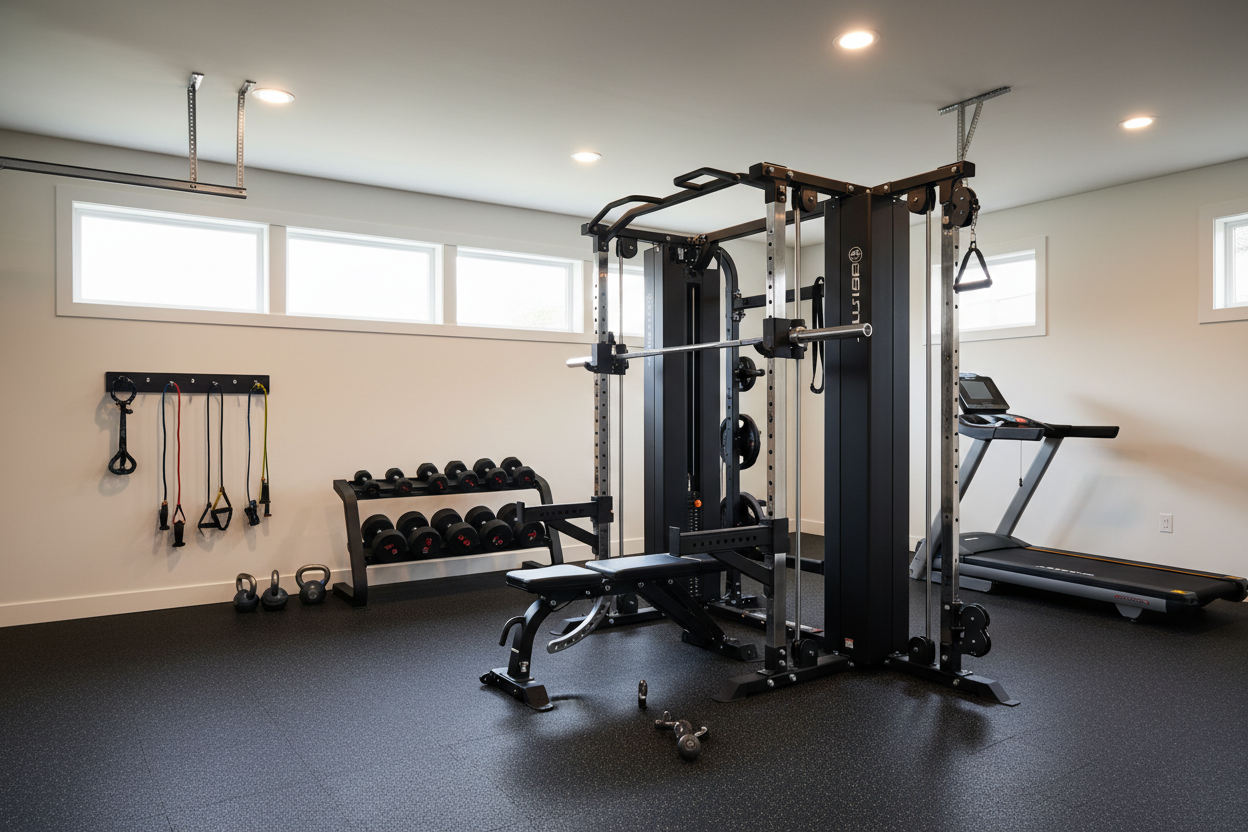
I remember the exact moment I decided to quit my commercial gym. It wasn't the $80 monthly fee or the guy doing curls in the squat rack. It was the realization that I spent twenty minutes of my hour-long workout just waiting for the cable crossover to open up. I started hunting for an all in one gym machine that could actually handle a heavy leg day without shaking like a leaf in the wind.
The skepticism is real. We've all seen those late-night infomercials for 'total body' systems that look like they're made of recycled soda cans. But the market has shifted. You can now get professional-grade steel and commercial-spec pulleys in a footprint that doesn't require a second mortgage or a warehouse-sized garage.
- Footprint: Most high-end units require about a 7' x 8' area for safe operation.
- Build Quality: Look for 11-gauge or 12-gauge steel; anything thinner is a toy.
- Versatility: A true all-in-one should combine a rack, a functional trainer, and a Smith system.
- Weight Stacks: Dual stacks of at least 200 lbs are the baseline for serious accessory work.
The 'Gym in a Box' Promise vs. Garage Gym Reality
The dream is simple: walk ten feet into your garage and have everything you need for a PR. But when you start building out a home gym, you quickly realize that space is your most valuable currency. A standalone power rack is great, but then you need a separate cable machine, a lat pulldown station, and a place to store 500 pounds of plates. Suddenly, your two-car garage is a zero-car garage.
This is where the all-in-one home gym concept actually makes sense. By consolidating the uprights of a rack with the guide rods of a cable system, you save roughly 30-40% of the floor space. The skepticism usually comes from 'jack of all trades, master of none' syndrome. If the steel is flimsy or the pulleys are plastic, the whole experience feels cheap. I look for units that prioritize the rack first—if you can't safely squat 400 lbs in it, the fancy cables don't matter.
Breaking Down the Big Three: Racks, Cables, and Fixed Paths
To replace a commercial club, a machine has to nail three distinct disciplines. First, it needs a functional half-rack or power rack with adjustable J-cups and spotter arms. If I'm benching alone at 5 AM, I need to know those safeties aren't going to snap. Second, it needs a dual-cable system for flys, rows, and pushdowns. Third, a Smith machine component is the 'secret sauce' for high-volume hypertrophy work when your stabilizers are fried.
The debate usually settles on choosing a power rack or Smith machine for your primary heavy lifting. A high-quality all-in-one doesn't force you to choose. It gives you the free-weight uprights for your primary strength work and the fixed-path bar for your burnout sets or rehab movements. I've found that having both in one footprint actually keeps me more consistent because the transition time between a heavy back squat and a controlled Smith machine lunge is basically zero.
Why the Guide Rods Need to Glide (Not Grind)
There is nothing that ruins a workout faster than a 'sticky' Smith machine. If you're using a Smith machine home gym station, the quality of the linear bearings is everything. Cheap units use plastic bushings that catch and stutter, especially if the bar isn't perfectly centered. You want high-grade, case-hardened steel guide rods and industrial bearings. When you rack the bar, it should feel like it's sliding on silk, not sandpaper. I always check if the rods are pre-lubricated or if they require constant maintenance—real equipment should work for you, not the other way around.
The Pulley Ratio Problem Nobody Mentions
Let's talk about cable math. Most all-in-one units use a 2:1 ratio. This means if you have 200 lbs on the stack, it feels like 100 lbs in your hand, but you get twice the cable travel. This is perfect for functional movements and shadow boxing because you won't 'run out' of cable. However, if you're a heavy hitter looking for 1:1 ratios for heavy lat pulldowns, you need to verify the machine's pulley configuration. I've seen guys buy a machine thinking they can do 200-lb rows, only to realize the 2:1 ratio makes it feel like a warm-up. Check the specs before you drop the cash.
Does an All-In-One Home Gym Actually Save You Money?
Let's do some 'garage math.' A quality 3x3 power rack is $800. A decent functional trainer is $1,500. A dedicated lat pulldown/low row machine is another $1,000. Toss in a Smith machine for $1,200, and you're at $4,500—and you've used up 150 square feet. A premium consolidated unit usually lands between $2,500 and $4,000. You're saving roughly a thousand bucks and half your floor space. To me, that's the difference between a gym that fits in my life and a gym that takes over my house. Plus, you only have one frame to bolt down and one piece of equipment to maintain.
What It Looks Like When Engineering Gets It Right
When you're looking at a rig like an all in one Smith machine with cable crossover, look at the pulleys first. Are they nylon or aluminum? Aluminum pulleys with sealed bearings last a lifetime and provide a much smoother 'pull' than the plastic ones found on entry-level gear. I also look for a counterbalanced Smith bar. A standard Smith bar can weigh 45-55 lbs; a counterbalanced one allows you to start at zero, which is huge for overhead presses or training family members who might be new to lifting. Heavy-duty 11-gauge steel and a powder-coated finish aren't just for looks—they prevent the frame from swaying when you're doing weighted pull-ups.
Should You Finally Ditch the Commercial Gym?
If you're a competitive powerlifter who needs a specialized monolift and a calibrated competition bench, keep your membership. But for 95% of us—the people who want to get strong, look better, and stop wasting time in traffic—the all-in-one is the winner. It removes the friction of training. My 'downside' experience? I once bought a unit with a 14-gauge frame because it was on sale. Every time I racked 225 lbs, the whole thing groaned and shifted an inch. I sold it at a loss two months later. Don't make that mistake. Buy the heavy steel first.
FAQ
How much ceiling height do I need?
Most units stand between 82 and 86 inches. I recommend at least a 90-inch ceiling so you don't smack your head on the pull-up bar or hit the ceiling with your plates during overhead presses.
Can I do heavy squats on an all-in-one?
Yes, provided the unit has external half-rack uprights and rated J-cups. Look for a static weight capacity of at least 700 lbs on the rack portion to ensure it can handle real loads.
How hard are these to assemble?
It's a weekend project. Expect 6-10 hours of work. Use your own socket wrench set rather than the flat metal 'wrenches' they include in the box; your knuckles will thank me later.
Share:
I Ignored Exercise Equipment Dimensions and Ruined My Garage Gym
The 'No-Embarrassment' Beginner Gym Machine Workout I Give Newbies