
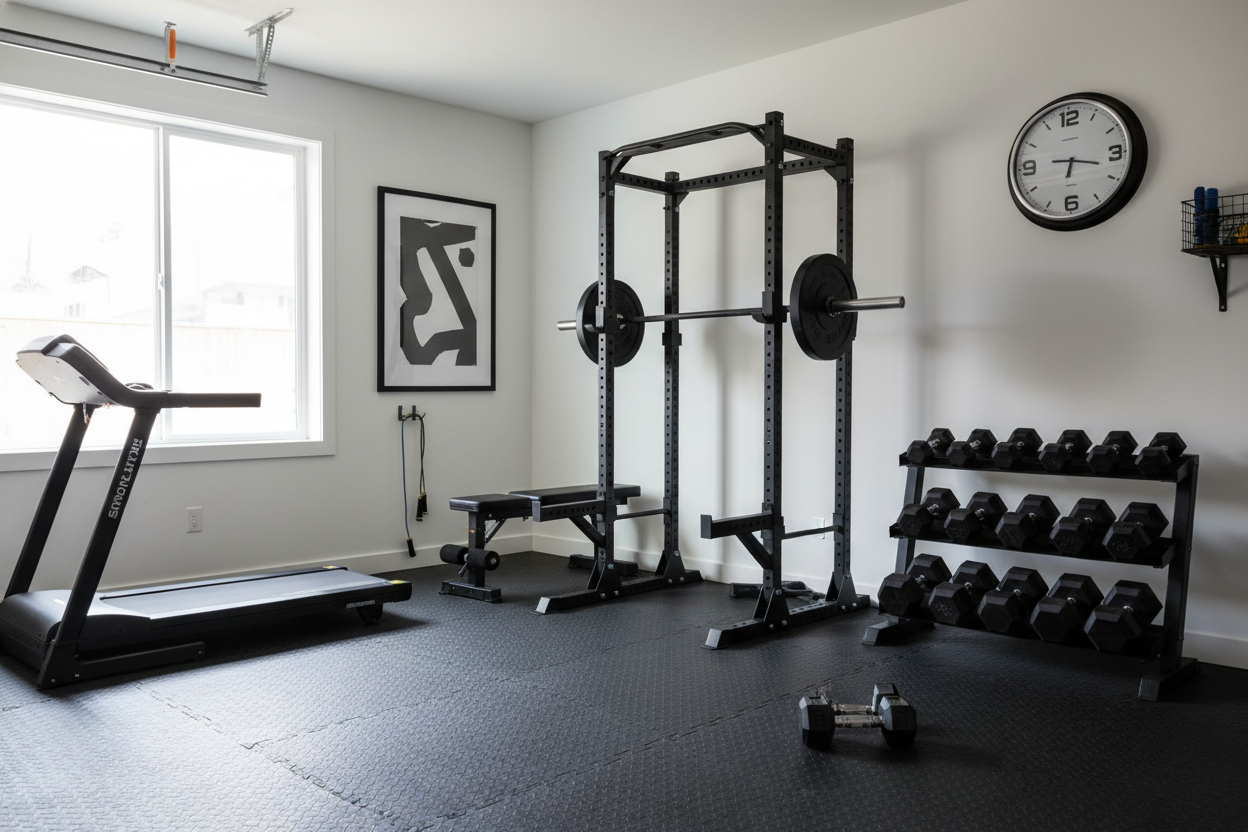
I remember standing in my garage three years ago, staring at a $3,000 functional trainer in an online shopping cart. I almost pulled the trigger because I was convinced my progress had stalled due to a lack of pulleys and cables. Then I looked at my dusty rack and realized I hadn't even hit a double-bodyweight squat yet. Investing in simple equipment for home exercise isn't a compromise; for most of us, it is the most direct path to results because it removes the fluff and forces you to move heavy objects through space.
Quick Takeaways
- Mechanical tension builds muscle, whether it comes from a $5,000 rig or a $50 kettlebell.
- Simple gear like loadable dumbbells and an adjustable bench covers 95% of all hypertrophy needs.
- Progressive overload can be achieved through tempo and unilateral work, not just adding plates.
- Compact cardio tools like jump ropes often burn more calories per square foot than bulky treadmills.
The Trap of Overcomplicating Your First Setup
Beginners often fall into the trap of buying elaborate machines with 20 different attachments before they can perform a proper hinge. It is a form of procrastination. You think that if you buy the 'Pro-Series-Mega-Rack,' the gains will follow. In reality, you need to stop blaming your gear, fix your workout at home gym instead, and focus on the basics. I have seen guys with nothing but a pair of 45-lb plates and a pull-up bar build more impressive physiques than people with a commercial-grade membership.
The more moving parts a machine has, the more points of failure it introduces. Simple gear forces you to stabilize the weight yourself. That stabilization is exactly what builds the 'core strength' and functional muscle everyone claims to want. Before you buy a machine that does the balancing for you, master the movements where you do the work.
What Actually Qualifies as 'Simple' Gear?
To me, the gym at home essentials are tools with zero motors, minimal maintenance, and maximum versatility. If a piece of equipment only does one thing—like a leg extension machine—it is a luxury, not a necessity. Real at home gym equipment essentials should allow you to perform at least a dozen different movements.
Think about a sandbag. You can clean it, press it, squat it, carry it, and throw it. It has no cables to snap and no bearings to grease. That is the gold standard for simplicity. We are looking for high-yield tools that take up less than 10 square feet of floor space but provide enough resistance to keep you growing for years.
Free Weights vs. Resistance Bands
This is the classic debate for anyone picking out essentials for at home gym use. Free weights, specifically dumbbells, provide constant mechanical tension. A 50-lb dumbbell is 50 lbs at the bottom and 50 lbs at the top. This is the gold standard for hypertrophy. However, they are heavy and can be expensive to ship.
Heavy-duty resistance bands offer variable resistance—the movement gets harder as the band stretches. They are the ultimate at home workout essential equipment for people who travel or have zero storage. While I prefer weights for my primary lifts, bands are unbeatable for face pulls, tricep extensions, and adding 'peak contraction' tension to your lifts. If you are on a budget, start with bands, but aim for iron.
The Ultimate Low-Tech Workout at Home Set
If I had to start over in a 10x10 spare bedroom, my workout at home set would consist of three things: an adjustable bench, a pair of loadable dumbbells, and a doorway or wall-mounted pull-up bar. That is it. An adjustable bench that handles at least 600 lbs allows for incline, flat, and seated presses. Loadable dumbbells—the ones where you slide standard or Olympic plates onto a handle—save you thousands of dollars compared to a full rack of fixed weights.
When you are building a functional home gym, you need to prioritize the 'big rocks.' A pull-up bar gives you a vertical pull, the dumbbells handle your presses and rows, and the bench allows for a massive range of chest and shoulder work. You do not need a cable crossover when you can do a floor fly or a weighted push-up. Keep the footprint small and the intensity high.
Cardio Without the Treadmill Motor
Treadmills are the biggest space-wasters in the home fitness world. They are loud, they break, and they eventually become expensive clothes hangers. You can get a world-class conditioning session with a $15 speed rope or a single 24kg kettlebell. Kettlebell swings are essentially 'cardio with a soul'—they build your posterior chain while redlining your heart rate.
If you have bad knees or just hate impact, skip the elliptical. A foldable upright exercise bike is a much better play. It gives you the 16-level magnetic resistance you need for zone 2 or HIIT sessions, but you can tuck it into a closet when you are done. It is about getting the heart rate up without sacrificing half your living room to a machine that sounds like a jet engine.
How to Scale Resistance Without Buying Bigger Machines
The biggest fear with at home gym equipment essentials is 'maxing out.' You think once you can press your heaviest dumbbell, you are done. That is a lack of creativity, not a lack of gear. You can make a 50-lb dumbbell feel like 80 lbs by changing the tempo. Try a 4-second eccentric (lowering phase) and a 2-second pause at the bottom of a chest press. I guarantee you will not need more weight for a while.
Unilateral movements are your best friend. If you can squat your heaviest weights easily, switch to Bulgarian split squats. By putting one leg on your bench and holding the weights, you are effectively doubling the load on your working leg. You do not need a leg press machine; you just need to stop being afraid of split squats.
When Do You Actually Need to Upgrade?
Simple gear works until it doesn't. You will know you have outgrown your basic essentials for at home gym use when your 'high-rep' sets are hitting 30+ reps and you can no longer create enough mechanical tension to trigger growth. This usually happens first on compound movements like squats and deadlifts.
When you reach that point, it is time to look at a Smith machine home gym station. This is the logical next step because it provides the safety of a fixed track for heavy lifting without needing a spotter. It takes up more space, sure, but once you are benching 225+ lbs alone in a garage, that safety and stability become worth every penny and every square inch.
Personal Experience: The Wobbly Bench Lesson
When I first started my home setup, I bought the cheapest adjustable bench I could find on a clearance site. It was light, easy to move, and felt like a bargain. Three weeks later, I was doing a set of 80-lb dumbbell presses when the backrest adjustment pin sheared off. I ended up flat on my back with 160 lbs of iron hovering over my face. I learned the hard way that 'simple' doesn't mean 'cheap.' Now, I look for 11-gauge steel and a tripod base. If you're going to buy minimal gear, make sure the gear you do buy is overbuilt.
FAQ
Can I really build muscle with just dumbbells?
Absolutely. Your muscles don't have eyes; they only recognize tension. If you can provide enough resistance to reach near-failure in the 6-15 rep range, you will grow. Dumbbells actually allow for a greater range of motion than most barbells.
What is the best floor protection for a home gym?
Skip the 'fitness' foam tiles; they tear too easily. Go to a farm supply store and buy 3/4-inch rubber horse stall mats. They are indestructible, dampen sound, and will protect your subfloor from dropped weights better than anything else.
Is a pull-up bar worth the risk to my door frame?
If you weigh over 200 lbs, skip the 'tension' bars. Get a version that bolts into the wall studs or a standalone power tower. It's better to have a few screw holes in the drywall than a trip to the ER because the trim gave out.
Share:
What the Hell is a Bushing? Barbell Parts Names Translated
Why Your Incline Workout Bench Leaves Your Head Hanging Off