
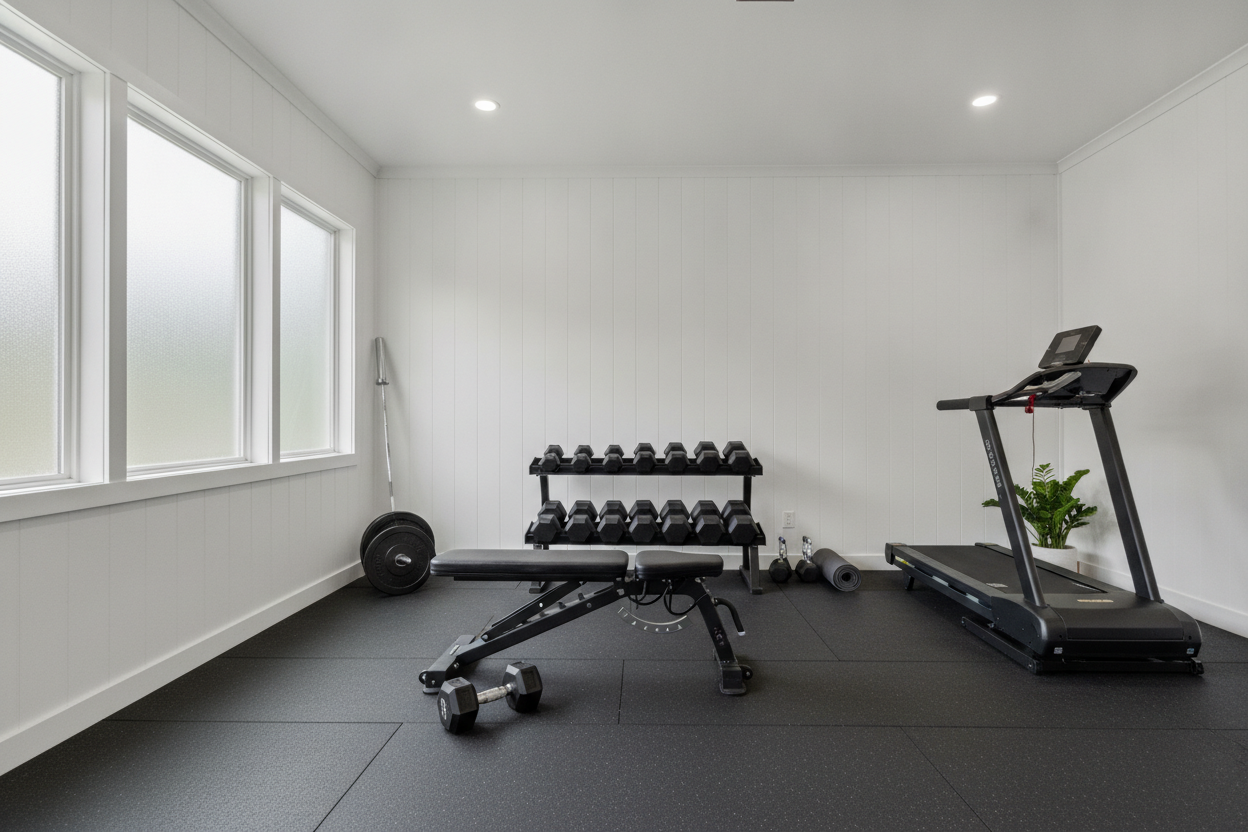
I remember the exact moment I realized my massive power rack was a glorified clothes hanger. I was staring at a $2,500 invoice for a new set of plates while my garage floor was already disappearing under a mountain of steel. I eventually sold the rack, bought a high-end weight bench and dumbbells, and honestly? My joints have never felt better, and my chest has actually grown. Most people think they need a commercial-grade cage to build a physique, but that is just effective marketing from equipment companies.
Quick Takeaways
- Dumbbells allow for a natural arc of motion that saves your shoulders compared to a fixed bar.
- A dedicated dumbbell weight bench needs a narrower pad than a barbell bench to allow for full range of motion.
- Adjustable benches are non-negotiable for hitting the upper chest and back properly.
- You can fit a world-class training setup in a 6x8 foot corner of your bedroom or garage.
The Illusion That You Need a Massive Power Rack
Social media has convinced us that if you are not squatting in a $3,000 cage with laser-cut holes, you are not really training. It is nonsense. I spent five years chasing a 405-lb barbell squat only to realize my knees were trashed and my quads were average. When I switched to a minimalist setup, the focus shifted from 'moving the bar' to 'taxing the muscle.'
The power rack is great if you want to be a professional powerlifter. But if you want to look like you lift, dumbbells are arguably superior. They force every small stabilizer muscle in your rotator cuff and core to fire. You cannot hide weaknesses with a dumbbell. If your left arm is weaker than your right, you will know by the third rep. That forced symmetry is what builds a balanced, injury-resistant frame.
Why a Dedicated Dumbbell Weight Bench Changes the Game
When you start browsing for a dedicated Weight Bench, you will notice a massive variety in pad designs. Most beginners just look at the price tag, but the secret is in the dimensions. A bench designed for a heavy barbell press often features a wide, 12-inch pad to give the lifter a massive base of support. While that feels secure, it is a nightmare for dumbbell work.
With dumbbells, you want your shoulder blades to be able to move freely. If the pad is too wide, it locks your scapula in place, which puts a ton of unnecessary shearing force on the front of your shoulder. A slightly narrower pad—around 10 to 10.5 inches—allows your shoulders to wrap around the bench at the bottom of the movement. This creates a deeper stretch and a much more powerful contraction.
The Elbow Clearance Issue Most Beginners Ignore
Range of motion is the king of hypertrophy. If you are using a bench with a 'fat pad,' your elbows will likely strike the top of the bench before your chest is fully stretched. This effectively cuts off the most productive part of the rep. I have seen guys wonder why their chest development has stalled, only to realize they have been doing half-reps for months because their equipment was physically in the way. You want a bench that gets out of your way, allowing your elbows to drop below the plane of your torso without interference.
The 4 Main Lifts That Prove You Don't Need Barbells
You can build a pro-level physique with just four movements if you push the intensity. First, the Bulgarian Split Squat. It is the most hated exercise in the gym for a reason—it works. Holding heavy dumbbells at your sides while one foot is elevated on the bench targets the quads and glutes more effectively than a back squat ever could, without the spinal compression.
Second, the incline press. Using something like the Adjustable Weight Bench Owb01 allows you to toggle between 30 and 45 degrees. This is the sweet spot for that 'shelf' look on the upper chest. Third, chest-supported rows. By lying face-down on the incline bench, you eliminate momentum. It is pure lat and rhomboid recruitment. Finally, the seated overhead press. Doing these seated saves your lower back and lets you focus entirely on boulder shoulders.
Will Your Frame Survive Progressive Overload?
Minimalism does not mean buying cheap. If you are serious, you will eventually be hoisting 80, 90, or 100-pound dumbbells. If you weigh 200 lbs, that is 400 lbs of total stress on the frame. A lot of those 'Amazon Special' benches are made of thin 14-gauge steel that will start to creak and wobble within six months. You want at least 11 or 12-gauge steel and a bolt-together design that feels like a rock.
Stability is a safety issue, but it is also a performance issue. If your brain senses the bench is wobbling, it will neurologically 'downshift' your strength to protect you. You cannot lift heavy on a shaky foundation. If you are looking for something that saves space but still holds up, you might ask Can a Portable Weight Lifting Bench Handle Heavy Dumbbells?. High-quality folding models do exist, but you have to check the weight ratings carefully. Don't settle for anything rated under 600 lbs total capacity.
How to Layout Your Minimalist Lifting Space
One of the best things about a dumbbell weight bench setup is the footprint. You do not need a dedicated 400-square-foot room. A 6x8 foot area is plenty. This gives you enough room to slide the bench around and have a clear 'drop zone' for the weights. I recommend 3/4-inch rubber stall mats. They are cheaper than 'fitness flooring' and will actually protect your subfloor when you have to bail on a heavy set of rows.
Keep your dumbbells on a small tiered rack if possible. Tripping over a 50-lb hex head in the middle of a superset is a rite of passage I would recommend avoiding. If you are in an apartment, look for urethane-coated dumbbells; they are quieter and will not leave black scuff marks on your walls or bench upholstery.
My Personal Experience: The 'Wobble' Lesson
Early in my home gym days, I bought a bench because it folded down to four inches thick. It looked great in the photos. The first time I tried to do a set of 75-lb incline presses, the whole thing shifted two inches to the left. I nearly dropped a weight on my face. I realized then that 'portable' often means 'flimsy.' Now, I look for a wide rear stabilizer bar and a tripod front design. It is worth the extra investment to know the bench is not going to fold while I am under it.
FAQ
Can I build big legs with just dumbbells?
Absolutely. Bulgarian split squats, lunges, and Romanian deadlifts with heavy dumbbells are arguably more effective for hypertrophy than barbell work because they allow for more natural movement patterns and high volume without frying your central nervous system.
How much weight capacity do I really need?
Aim for a bench rated for at least 600-800 lbs. Remember, this includes your body weight plus the weights you are holding. A 200-lb man using 100-lb dumbbells is already at 400 lbs of load, leaving very little margin for safety on a cheap bench.
Is a flat bench enough for a home gym?
It is better than nothing, but an adjustable bench is the better investment. Without an incline setting, you lose the ability to target the upper chest and perform effective chest-supported back exercises that are staples of a dumbbell-only routine.
Share:
I Spent a Month Testing the Best Equipment at Planet Fitness
The Best Dumbbell Set for Your Garage Isn't a 10-Piece Rack