
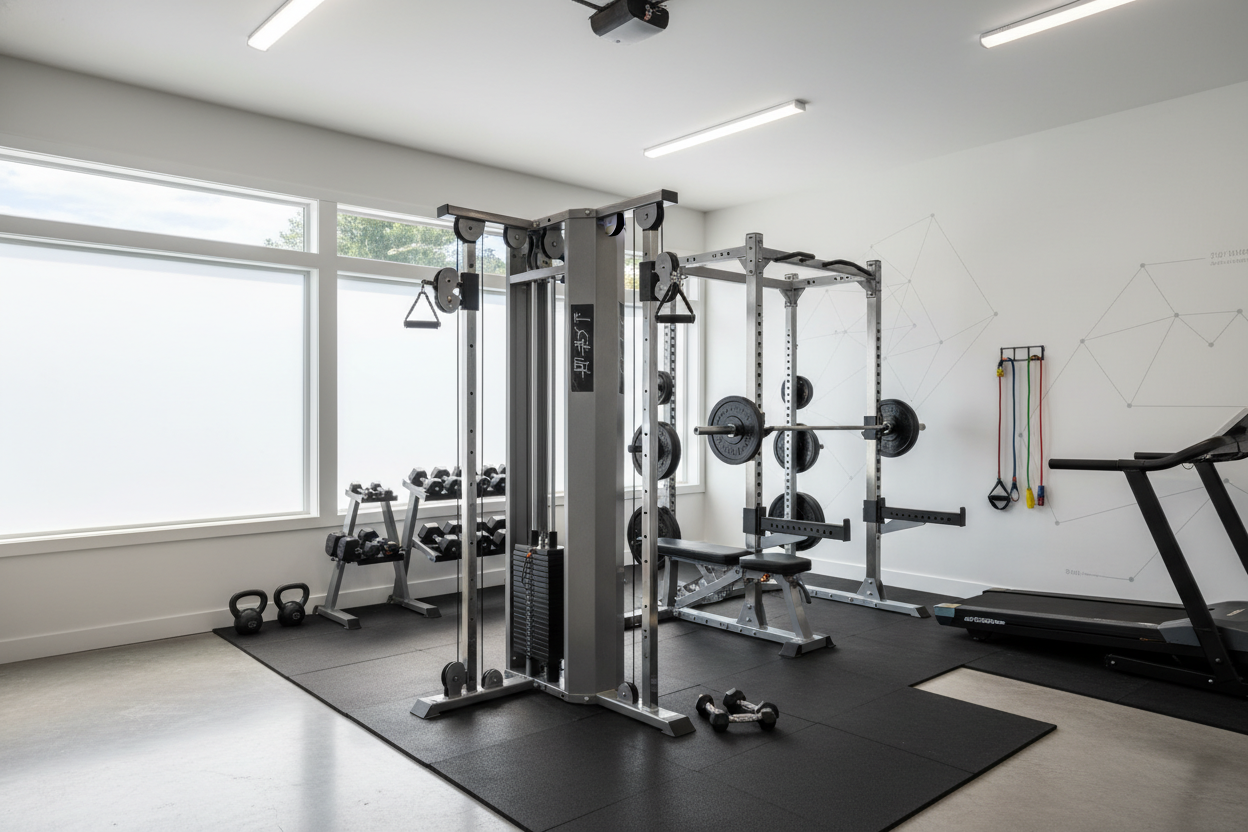
I remember the first time I felt like a 'real' lifter. I was pinned under a 225-lb barbell in my garage, my knees were shaking, and I was terrified of the neighbors finding me crushed under my own ego. Back then, I believed the lie that if it wasn't a free weight, it was a waste of time. I looked down on anyone using a selectorized stack while I grinded out back squats that felt more like a circus act than a leg workout.
Years later, after several lower back tweaks and a garage full of equipment that I’ve personally bolted, unbolted, and sweated through, I’ve realized something: my quads don't have eyes. They don't know if the resistance comes from a piece of cast iron or a 200-lb cable stack. If you're asking can you build muscle using machines, the answer is a resounding yes—and for many people, it’s actually the faster route to size.
- Muscle growth is driven by mechanical tension, not the shape of the weight.
- Machines offer superior stability, allowing you to push closer to failure without a spotter.
- Free weights are better for 'functional' athleticism, but machines often win for pure aesthetics.
- A well-designed machine-only program can hit every major muscle group with zero gaps.
The Cult of the Barbell (And Why It's Misleading)
There’s a weird elitism in the home gym community. People act like if you aren't doing the 'Big Three' with a barbell, you're just playing around. I used to be one of those guys. I spent thousands on a competition-spec power bar and calibrated plates, thinking they were the only keys to growth. I thought machines were for people who weren't 'serious.'
But here’s the reality: your muscles are biological engines that respond to force. When you contract a muscle against resistance, it creates tension. That tension triggers the chemical signals for hypertrophy. The barbell is just one tool to create that tension—it isn't the only one, and it's definitely not magic. Physics doesn't care about your gym's 'hardcore' aesthetic.
Why Your Muscles Can't Tell the Difference
Mechanical tension is the primary driver of muscle growth. When you’re at the bottom of a hack squat, your quads are under immense stretch and load. They don't care if that load is balanced on your back or guided by a steel rail. This is why the question of can you build muscle with just machines is so easy to answer: your biology doesn't discriminate against cables.
In fact, machines often provide more consistent tension through the entire range of motion. A cable bicep curl, for instance, keeps the weight pulling against you even at the top of the movement, whereas a dumbbell curl loses tension once your forearm is vertical. That constant load is a massive win for hypertrophy that free weights simply can't match without some creative setup.
The Hidden Hypertrophy Advantage of Fixed-Path Lifts
The biggest secret to getting big is stability. If you're doing a standing overhead press, about 30% of your brain power is dedicated to not falling over or arching your back into a snap-city position. When you remove the need for balance, you can funnel 100% of your effort into the target muscle. It’s the difference between fighting the weight and fighting your own coordination.
Take shoulder training. Can You Actually Build Big Delts With a Shoulder Press on Smith Machine? Absolutely. Because the path is fixed, you can grind out those last two 'ugly' reps that would be dangerous with a barbell. Same goes for lower body. Using a dedicated hip thrust machine allows you to load 400+ lbs without the barbell crushing your pelvis or sliding off your hips. That stability equals more force, which equals more growth.
How to Build a Complete Routine Without Free Weights
If I had to start my gym from scratch today with zero barbells, I’d look for something that covers the basic human movement patterns: push, pull, hinge, and squat. You can do all of these on a high-quality cable or Smith system without ever needing to chase a rolling dumbbell across the floor.
For a home setup, space is usually the bottleneck. That’s why I’m a fan of versatile units like the All In One Smith Machine With Cable Crossover S1 V4. It gives you the guided path for heavy presses and squats, plus the cables for flyes, rows, and lat pulldowns. You aren't missing any muscle groups; you're just trading the barbell for a smoother, more controlled experience that keeps your joints feeling fresh.
Where Machines Actually Fall Short
I’m not saying machines are perfect. If you want to be a competitive powerlifter or an Olympic athlete, you need to move free weights. Machines don't challenge your 'stabilizer' muscles—the small muscles in your core and around your joints that keep everything aligned. If you only ever use machines, you might find yourself feeling a bit stiff when you try to move a heavy couch in the real world.
There’s also the 'fit' issue. Not every machine is designed for every body type. If you’re 6'5' or 5'2', some leg extensions might feel like a torture device for your knees because the pivot points don't align. I’ve owned machines that I had to sell simply because the lever arms were too short for my reach. Barbells, for all their faults, are infinitely adjustable to your limb lengths.
The Final Verdict: Stop Feeling Guilty About the Cables
If your goal is to look like you lift, stop worrying about the 'hardcore' factor of free weights. Machines allow for high-volume, high-intensity training with a much lower risk of injury. I still love my barbell, but on the days my lower back feels like it’s made of glass, I’m thankful for the cable stack. You can absolutely get jacked without ever touching a plate-loaded bar.
Can you build muscle using machines only?
Yes. As long as you are progressively overloading—adding weight or reps over time—your muscles will grow. Many professional bodybuilders use machines for the majority of their training to minimize joint wear and tear while maximizing isolation.
Is it harder to build muscle with machines?
Actually, it's often easier. Because you don't have to worry about balance or technique as much, you can reach true muscular failure more often, which is a key trigger for growth.
Do machines count as 'functional' strength?
It depends on your definition. If 'functional' means having big, strong muscles that can move heavy things, then yes. If it means being able to balance on one leg while throwing a medicine ball, then probably not. For pure size, machines are plenty functional.
Share:
The Dirty Secret Behind Most 'Top-Rated Fitness Equipment'
I Built a Real Routine Using Only the Equipment at Planet Fitness