
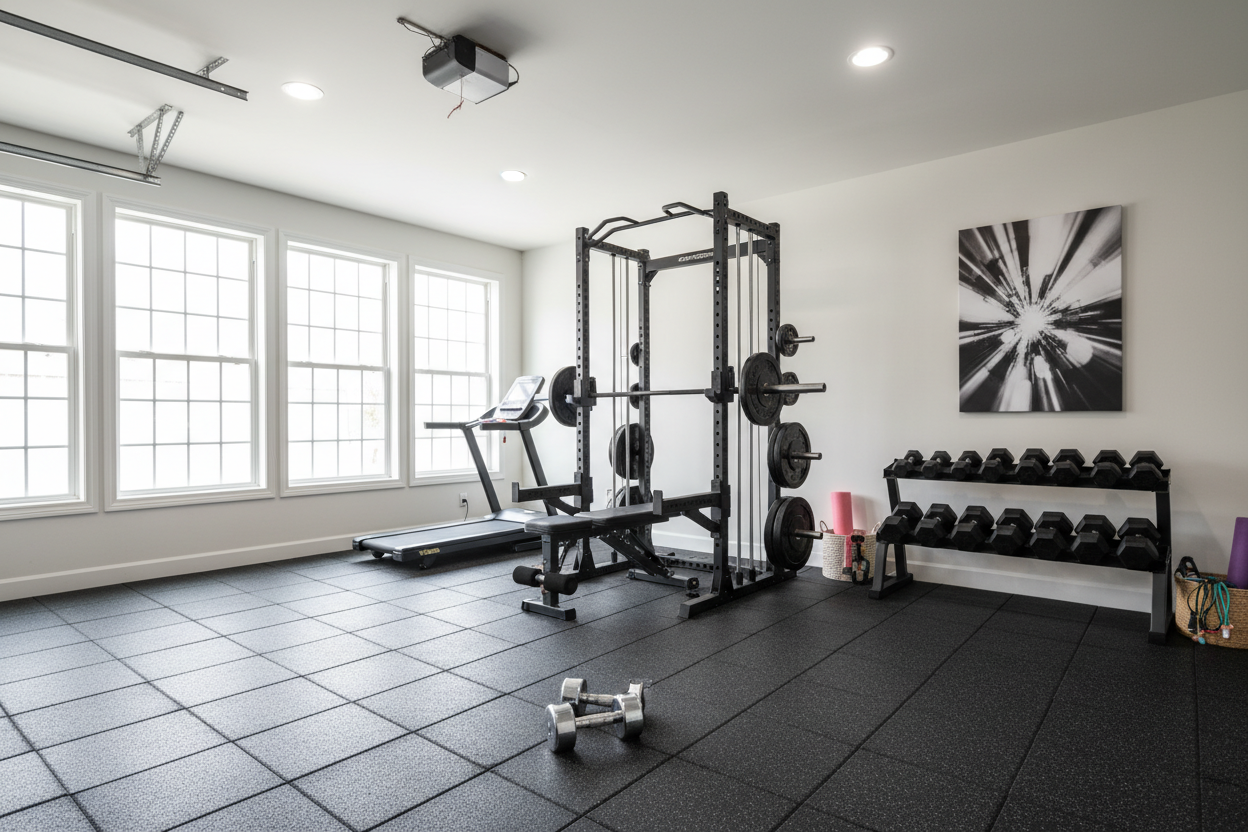
I spent years convinced that if you weren't using a raw barbell for every single lift, you weren't actually training. Then I turned thirty, my garage became my primary sanctuary, and I realized that training alone at 6:00 AM requires a bit more than just 'grit'—it requires not getting pinned under a 300-pound bar when your CNS decides to check out early. That is why the power cage with smith machine has moved from a commercial gym luxury to a legitimate home gym staple.
Quick Takeaways
- Safety First: The built-in safeties on a smith machine power cage allow you to train to failure without a human spotter.
- Space Efficiency: Combining a rack and a smith track saves roughly 15-20 square feet compared to buying separate units.
- Build Quality Matters: Look for 11-gauge steel and linear bearings; avoid nylon bushings if you want a smooth pull.
- Versatility: It is the ultimate tool for hypertrophy and rehab, though purist powerlifters might find the extra hardware distracting.
The All-In-One Dilemma: Why Combine Them?
The old-school mentality was simple: you buy a beefy four-post rack for your heavy triples and, if you have the space, maybe a standalone Smith Machine for your high-rep accessory work. But let's be real—most of us are working with a two-car garage at best, and usually, one of those spots is occupied by a lawnmower and a stack of winter tires. We do not have the luxury of dedicated zones for every modality.
The modern smith machine power rack solves this by utilizing the same vertical uprights for both free-weight J-cups and the fixed-path smith bar. It is an evolution born of necessity. Ten years ago, these combo units were mostly flimsy, 'as-seen-on-TV' junk that wobbled if you looked at them too hard. Today, manufacturers are using 3x3 inch, 11-gauge steel tubing that rivals commercial-grade rigs. You are no longer choosing between a sturdy rack and a functional smith machine; you are getting both in a footprint that is usually no larger than 50 by 65 inches.
What Happens When You Merge Free Weights and Fixed Paths?
When you start using a power rack with smith machine, your training flow changes. You can hit your heavy, stabilizing-muscle-intensive back squats on the front of the rack, then immediately strip the bar and move inside for high-volume smith machine lunges or shrugs. It turns your rack into a multi-station circuit. The transition is seamless, provided you bought a unit that does not require you to disassemble half the machine just to switch modes.
The Good: Spotter-Free Overload
The biggest win for a cage smith setup is the ability to push your limits safely. If you are chasing hypertrophy, you need to get close to—or hit—technical failure. Doing that on a standard bench press when you are alone in a garage is a recipe for a viral 'gym fail' video. With a smith cage machine, a flick of the wrist locks the bar into the nearest cutout. I have used this to blast my chest with 1.5-reps and slow eccentrics that would be suicidal with a free-weight barbell. It removes the fear factor, allowing you to focus entirely on the mind-muscle connection rather than 'will I die today?'
The Bad: Footprint and Depth Compromises
Here is the honest truth most reviewers gloss over: a smith power rack can feel crowded. Because you have guide rods and a fixed bar living inside the cage, the internal working space is often tighter than a dedicated power rack. I have tested racks where the guide rods were positioned exactly where I wanted to set my feet for a wide-stance sumo pull.
Furthermore, if the rack is not deep enough—ideally at least 30 inches of internal space—the smith bar can interfere with your bar path when you are using a standard Olympic barbell on the outside J-cups. Always check the schematics. If the smith track is bolted too close to the front uprights, you will find yourself clanking plates against the guide rods during your warm-up sets. It is an annoyance that can turn a $2,000 investment into a daily headache.
How to Spot a Flimsy Cage Smith Setup
If the box arrives and the steel feels like a soda can, you are in trouble. For a combo unit, 11-gauge steel is the gold standard. Anything thinner, like 14-gauge, will flex and shimmy when you are re-racking a heavy smith bar. You also need to look at the movement mechanism. Cheap racks use nylon bushings that feel 'sticky' and jerky. You want professional-grade linear bearings. They provide that 'floating on air' feeling that makes the smith machine actually useful for smooth, controlled reps.
Stability is the next hurdle. A standalone rack is easy to bolt down, but a hybrid unit has more moving parts. Check the base frame. Does it have a wide rear stabilizer? Does it allow for floor anchoring? I’ve seen The Truth About Rack Attachments for Smith Machine Lifts and it’s clear: a built-in integrated track is infinitely more stable than those aftermarket 'bolt-on' smith attachments that try to turn a regular rack into a hybrid. Those add-ons often have a ton of play in the sleeves, which ruins the fixed-path benefit.
Is This the Right Rig for Your Training Style?
If your goal is purely aesthetic—building massive quads, shoulders, and chest—the smith machine power rack is your best friend. It is a hypertrophy tool through and through. It allows for mechanical drop sets and forced reps that are nearly impossible with free weights alone. However, if you are a competitive Olympic lifter who needs to drop weights from overhead, or a purist powerlifter who only cares about the 'Big Three,' the extra hardware of a smith setup might just get in your way.
For the lifter who wants it all, I often point toward something like the Dual Pulley Power Rack Functional Trainer Dp01 V4. It represents the pinnacle of this hybrid trend, integrating not just the smith and the rack, but also a functional trainer cable system. It is the ultimate 'no excuses' rig. If you have the budget and the ceiling height, getting a unit that handles your heavy squats, your fixed-path presses, and your cable flyes in one spot is the smartest way to build a world-class gym in a small space.
Personal Experience: The 'Wobble' Lesson
I once bought a budget-tier smith combo because the price was too good to pass up. On paper, it had everything. In practice, the first time I loaded 225 lbs on the smith bar for some incline presses, the entire rack groaned. The guide rods weren't perfectly vertical, creating a 'catch' halfway through the rep. I ended up selling it for half what I paid three months later. My mistake was prioritizing features over steel quality. If you are going to buy a hybrid, buy one that weighs at least 300 lbs unassembled. Weight equals mass, and mass equals stability.
Frequently Asked Questions
Can I use a regular barbell on a smith machine power rack?
Yes. Almost all these units feature standard J-cups on the front uprights, allowing you to use a 7-foot Olympic bar just like you would on a traditional power rack. The smith bar stays tucked away or can be moved to the top of the track.
How much weight can the smith bar handle?
This varies by brand, but a quality unit should be rated for at least 600 lbs. Keep in mind the 'starting weight' of a smith bar is usually lighter than a standard 45-lb bar—often around 25 to 30 lbs due to the counterbalancing or the hollow nature of the internal bar.
Is assembly difficult for a combo rack?
It is a project. Expect to spend 4 to 6 hours on assembly. Because of the guide rods and the internal bearings, precision is key. If you don't level the rack perfectly, the smith machine will have drag.
Share:
Your Ceiling Is Too Low: The Truth About Smith Machine Height
The Exact Body-Solid Smith Machine Bar Weight (I Measured It)