
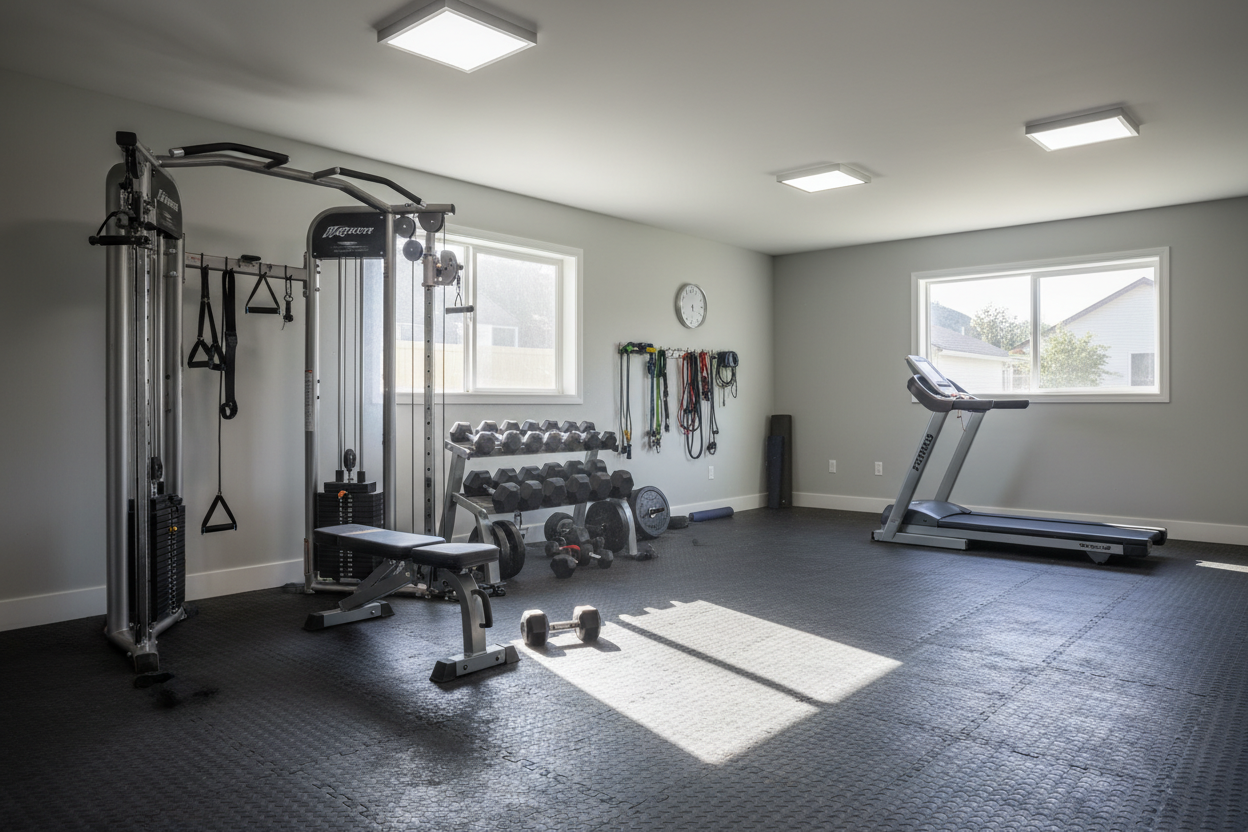
I remember the exact moment I realized my garage setup was a disaster. I was trying to do a chest-supported row using a bench propped up on a stack of bumper plates while my wife's car was inches away from my shins. I had spent two years buying 'deals' on Craigslist and Amazon, yet I still couldn't perform a basic lat pulldown without a sketchy setup involving a resistance band and a rafters beam.
Trying to build a complete gym for home use by buying one random piece of gear at a time is a trap. You end up with a collection of mismatched iron that takes up too much space and still leaves massive gaps in your training. If you're tired of the 'yard sale' aesthetic and actually want to get a professional workout in your pajamas, we need to talk about what a real all-in-one setup looks like.
Quick Takeaways
- Piecemeal gyms often cost more in the long run due to redundant shipping and wasted floor space.
- A true complete setup must allow for vertical pulling and adjustable cable work, not just barbell movements.
- Pulley ratios (1:1 vs 2:1) are the most overlooked spec that can ruin a machine's utility.
- Floor protection is non-negotiable for heavy multi-stations to prevent slab cracking.
The Piecemeal Trap (And Why Your Garage Looks Like a Yard Sale)
We've all been there. You start with a set of adjustable dumbbells. Then you find a 'great deal' on a squat stand that doesn't have safety spotters. Six months later, you're buying a separate cable tower because you realized your triceps are disappearing. Before you know it, your 400-square-foot garage has 100 square feet of usable space because of all the footprints these individual machines require.
The problem with a piecemeal gym isn't just the clutter; it's the lack of synergy. That cheap bench you bought doesn't quite fit the height of your new rack. The barbell knurling feels like sandpaper compared to your dumbbells. You spend more time moving gear around to make room for the next lift than you do actually lifting. It kills your momentum and, frankly, makes you want to skip the workout entirely.
When you buy a unified system, everything is engineered to work together. The bench is the right height for the rack, the cables are positioned to work with the pull-up bar, and the weight increments are consistent. You stop being a logistics manager and start being a lifter again. If your goal is a 'home gym complete' experience, you have to stop thinking about pieces and start thinking about systems.
What Does a 'Complete Gym for Home' Actually Mean?
A 'complete' gym isn't defined by how many shiny knobs it has. It's defined by movement patterns. If you can't effectively perform a heavy squat, a vertical pull, a horizontal push, and a hinge movement, your gym is incomplete. Most people get the squat and push down with a basic rack and bench, but they fall flat on the pulling and isolation movements.
To truly replace a commercial membership, you need three things: heavy free weight capacity, functional cable versatility, and a way to safely push to failure. This means a rack (or Smith machine) for your heavy compounds, a high/low pulley system for your lats and rows, and enough adjustability to hit small muscle groups like rear delts and calves. If you're missing the cables, you're missing 40% of the exercises that actually build a physique.
I've seen guys with $5,000 racks who still go to the local YMCA once a week just to use the cable crossover. That's a failure of planning. A complete setup should feel like you have no excuses left. You shouldn't need a 'gym day' away from home because your garage can't handle face pulls or cable flies.
The Cable Crossover Dilemma
Cables are the soul of a modern home gym. While barbells are king for raw strength, cables provide the constant tension required for hypertrophy. The issue with most 'add-on' cable attachments for racks is that they feel like an afterthought. They're often jerky, have a limited range of motion, or use plastic pulleys that scream after three weeks of use.
A dedicated multi-station solves this by using dual-adjustable pulleys. This allows you to set the height exactly where you need it for everything from cable curls to woodchops. When the cables are integrated into the main frame, the whole unit becomes more stable. You don't have to worry about a light cable tower tipping over when you're pulling a heavy row.
The All-in-One Myth vs. Reality
There's a lingering stigma that all-in-one machines are just 'fancy bowflexes' that don't hold up to real weight. That might have been true in 1995, but the industry has shifted. Modern functional trainers and Smith hybrids are built with 11-gauge steel and commercial-grade components. They are designed to take a beating.
The real advantage of these units is safety, especially if you train solo. A Smith machine home gym station allows you to go heavy on squats or bench press without needing a spotter. You can rack the bar with a quick flick of the wrist. For those of us who lift at 5 AM before the kids wake up, that peace of mind is worth the investment. You aren't sacrificing 'functional' strength; you're gaining the ability to train harder without the risk of getting pinned under a bar.
However, the reality check is space. These machines are beasts. They typically require a footprint of at least 6 feet by 7 feet, plus room for you to move around them. You have to measure twice and buy once. Don't assume it will 'just fit' next to the lawnmower. It won't.
The One Spec You Can't Ignore
If you're looking at a spec sheet and your eyes are glazing over, focus on one thing: the pulley ratio. This is the difference between a machine that grows with you and one you'll outgrow in a month. A 1:1 ratio means 100 lbs on the stack feels like 100 lbs. A 2:1 ratio means 100 lbs feels like 50 lbs but gives you more cable travel. Most functional trainers are 2:1, which is great for athletic movements, but can be frustrating for heavy lat pulldowns.
When finding the best complete home gym, you also need to look at the weight stack limits. I once bought a machine with a 150-lb stack thinking it was plenty. Within six months, I was maxing it out on tricep pushdowns. Look for units that offer 200-lb stacks or higher, or those that allow you to add 'piggyback' plates for extra resistance.
Ground Control: Protecting Your Foundation
You cannot drop an 800-pound all-in-one unit onto bare concrete and expect your garage floor to survive. I made this mistake with my first power rack and ended up with a spiderweb of cracks that cost a fortune to fix when we sold the house. Concrete is strong in compression but brittle under impact.
At a minimum, you need a heavy-duty 4x8 gym mat made of high-density rubber. These mats don't just protect the floor; they deaden the noise and provide a stable, non-slip surface for your feet. Puzzle mats from the big-box store are for yoga and kids' playrooms—they will compress and shred under the weight of a real multi-station. Get the 3/4-inch thick stall mats or dedicated gym flooring if you want your setup to stay level and your foundation to stay intact.
The Final Verdict: Should You Pull the Trigger?
If you have the space and the budget, a unified system is almost always better than a piecemeal one. It saves you the headache of matching parts, provides a safer environment for solo lifting, and ensures you aren't skipping vital exercises because you lack the equipment. It's an investment in your consistency.
For the lifter who wants a home gym complete with everything needed for a pro-level physique, look for a unit that combines a rack or Smith machine with a high-quality cable system. It might hurt the wallet upfront, but it's cheaper than a decade of gym memberships and far more convenient than a garage full of mismatched junk. Stop shopping for parts and start building your sanctuary.
Personal Experience: My 'Cheap' Mistake
Early on, I bought a cable crossover tower that was so light I had to bolt it to the floor just to do face pulls without it lifting off the ground. The cables were coated in a cheap plastic that started peeling within three months, causing the whole thing to 'stutter' during reps. I eventually sold it for a 70% loss and bought a proper all-in-one unit. Don't be like me. Buy the heavy steel the first time; your future self (and your joints) will thank you.
FAQ
How much ceiling height do I need for an all-in-one gym?
Most standard units are between 80 and 84 inches tall. However, you need at least 90 inches of clearance if you plan on doing pull-ups without hitting your head on the ceiling. Always check the 'active' height, not just the static frame height.
Are Smith machines bad for your joints?
Not if used correctly. While the fixed path is different from free weights, modern Smith machines often have a slight 7-degree slant to mimic the natural bar path of a press or squat. They are excellent for hypertrophy and safe solo training.
Can I assemble these machines myself?
Yes, but grab a buddy. These units arrive in multiple heavy boxes and usually take 4 to 8 hours to assemble. You'll need a socket set and some patience. If you aren't handy, many companies offer professional assembly services—it might be the best $200 you ever spend.
Share:
Forget the Garage: Real Home Gyms Ideas for Spare Bedrooms
The Brutal Math Behind Buying a Dumbbells Set for Your Gym