
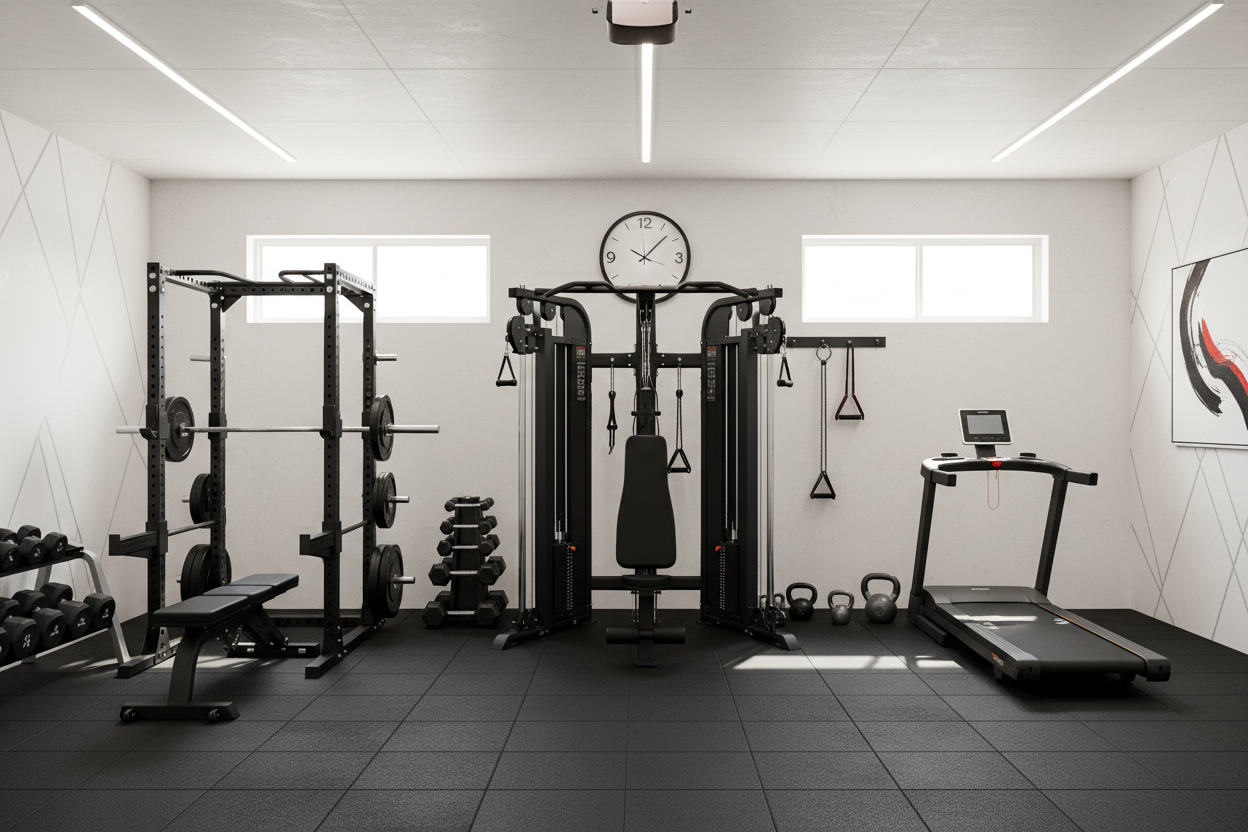
I remember staring at a monthly bank statement and seeing $180 gone for a 'luxury' club I visited twice. The commute was a grind, the squat racks were always camped out by teenagers filming TikToks, and the air smelled like industrial lavender masking old sweat. I went home and started scrolling for the best all in-one workout machine, but most of what I found looked like it belonged in a 1994 late-night infomercial. It was all plastic pulleys and cables that looked like they’d snap if you looked at them funny.
Quick Takeaways
- Look for 11-gauge or 12-gauge steel; anything thinner will wobble when you start moving real weight.
- Dual pulley systems are superior to single-stack setups for functional movement.
- Ensure the Smith bar has high-quality bearings—bushings are loud and jerky.
- Measure your ceiling height twice; many rigs require at least 84 inches of clearance.
The Problem With Old-School Multi-Gyms
We’ve all seen them at garage sales: those dusty, monolithic rigs with a single 150-lb weight stack and a fixed-path chest press. The 90s were a dark time for home fitness. Those machines were built on the idea that humans move in perfect, robotic lines. They didn't account for the fact that my shoulder doesn't rotate the same way yours does. If you wanted to do a standing cable fly or a low row, you were usually out of luck or stuck with a clunky attachment that took ten minutes to swap.
The shift toward the best all in one gym machines today has been driven by the 'functional trainer' movement. We realized that cables should be adjustable and that a rack should do more than just hold a bar. The old-school rigs failed because they were boring and restrictive. Modern lifters want the freedom of a cable crossover combined with the safety of a rack. If a machine doesn't let you hit a face pull, a heavy squat, and a lat pulldown in the same 6x6 footprint, it’s just taking up space that could be used for a better rig.
What Actually Makes a Rig Worth Your Money?
If you’re dropping four figures on equipment, you shouldn't settle for 'good enough.' The first thing I check is the steel. If a company doesn't list the gauge, it’s probably thin 14-gauge junk. You want a heavy-duty frame that doesn't dance across the floor when you’re doing pull-ups. A solid Smith Machine Home Gym Station serves as the backbone of a serious setup. It provides the structural integrity needed to support both the cable pulleys and the integrated barbell systems.
Next, look at the pulley ratio. A 2:1 ratio is standard for functional trainers, meaning 100 lbs on the stack feels like 50 lbs of resistance. This gives you more cable travel—essential for lunges or explosive movements—and finer weight increments. If you're looking for the best all-in-one workout equipment, you also need to inspect the cable quality. Aircraft-grade cables with a 2,000-lb tensile strength are the industry standard. If the cables feel 'stretchy,' you’re going to lose the mind-muscle connection on every rep.
Don't overlook the small stuff either. Are the laser-cut holes spaced correctly? Is the knurling on the pull-up bar aggressive enough to hold without chalk, or is it that slippery chrome finish that ruins your grip? These details differentiate a professional rig from a toy.
Why Cables and Smith Bars Finally Teamed Up
For years, people argued you either needed a power rack or a cable machine. The reality for most of us training in a garage is that we don't have room for both. Combining a fixed-track barbell with adjustable pulleys is a stroke of genius for the solo lifter. When I’m pushing for a PR on bench press at 6:00 AM, I don't have a spotter. The Smith component allows me to push to failure safely, while the cables allow for the accessory work that actually builds a balanced physique.
I’ve spent plenty of time testing these hybrids. In fact, I Built 4 Rigs to Find the Best Smith Machine for a Garage Gym just to see which ones could handle a 315-lb drop without bending the guide rods. The best units use linear bearings rather than plastic bushings. This ensures the bar moves like it’s on ice, rather than catching and stuttering halfway through a rep. When the cables and the bar work in harmony, you can transition from a heavy compound lift to a high-volume isolation move in seconds.
How to Measure Your Space Before Buying
Before you pull the trigger on the best home gym multi station, get your measuring tape out. Most people worry about the footprint—usually around 65 inches wide and 50 inches deep—but they forget about the 'working area.' You need at least two feet of clearance on either side to load plates onto the Smith bar. If you’re tucked into a corner, you’ll be cursing every time you have to shimmy a 45-lb plate onto the sleeve.
Ceiling height is the silent killer of home gym dreams. A standard rig sits around 82 to 84 inches tall. If you have a low basement ceiling or a garage with hanging door tracks, you might find yourself unable to perform a full pull-up or even bolt the top crossmember together. When planning your Home Gym layout, map it out on the floor with painter's tape. It sounds overboard, but seeing the physical footprint helps you realize that a massive rig might turn your workout space into an obstacle course.
My Top Pick After Tearing Apart the Market
After testing dozens of configurations, there is one clear winner that balances price with 'don't-break-on-me' durability. The All In One Smith Machine With Cable Crossover S1 V4 is the rig I’d actually put my own money toward. It doesn't feel like a compromise. The frame is stable enough for heavy rack pulls, and the cable crossover is smooth enough for high-rep chest flies. It hits that sweet spot where you get commercial-grade features without the commercial-grade price tag.
I once made the mistake of buying a cheap 'no-name' rig from a big-box store. Within three months, the powder coating was flaking off and the pulleys started squeaking like a frantic mouse. The S1 V4 avoids that by using quality components that actually survive a high-humidity garage environment. It’s a beast of a machine that covers about 95% of the exercises you’d ever need to do. If you're serious about quitting the commercial gym and training on your own terms, this is the foundation you build around.
FAQ
Can I do heavy squats on an all-in-one machine?
Yes, provided the machine has a built-in Smith bar or front-facing J-cups. The S1 V4 handles heavy loads easily, but always check the weight capacity of the spotter arms before you load up four plates.
How long does assembly take?
Expect to spend 4 to 6 hours. These are complex machines with lots of hardware. Grab a socket wrench set—don't try to do this with the tiny flat wrenches they include in the box.
Do I need a special floor for these machines?
I highly recommend 3/4-inch rubber horse stall mats. These machines are heavy, and once you add a weight stack and a lifter, you’re putting a lot of pressure on your concrete or tile. Protect your foundation.
Share:
I Built the Best Home Gym Under 500 (And Here Is the Receipt)
I Tried 5 Types of Portable Weights on the Road (Most Are Trash)