
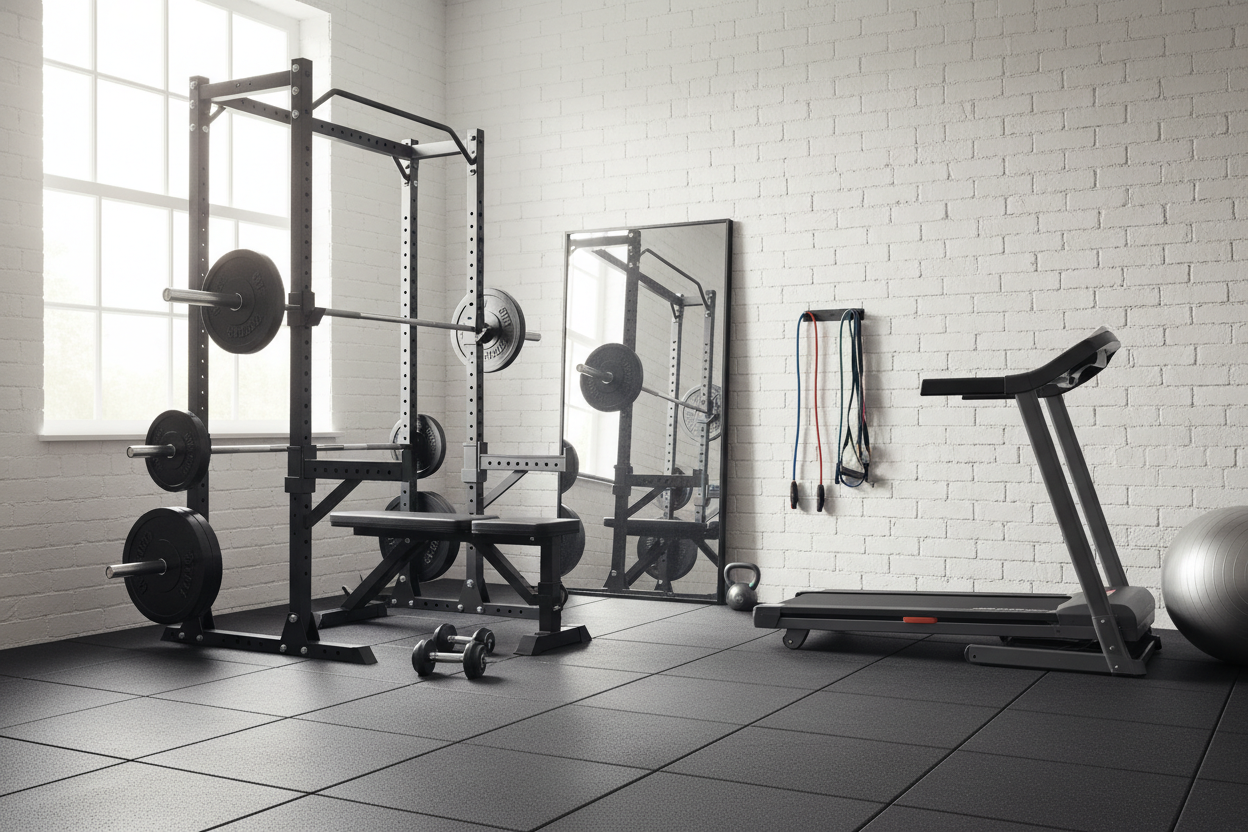
I remember the day my local commercial gym hiked their monthly fee to $80 without adding a single new plate. I went home, opened a dozen tabs, and realized that finding affordable gym equipment is a minefield of thin steel and plastic bolts. It is easy to get sucked in by a low price tag, only to have the gear arrive and feel like a toy.
- Check the shipping weight—heavy steel doesn't lie.
- Avoid complex pulleys on rock-bottom budgets.
- Prioritize 11 or 14-gauge steel for racks and benches.
- Look for powder coating over cheap paint to prevent rust.
Why Moving Parts Are the Enemy of a Low Budget
Complex mechanics are a trap when you are hunting for inexpensive exercise machines. When I look at exercise equipment for home, the first thing to fail is almost always the cable system or a plastic pulley wheel. Manufacturers save money by using thin aircraft cables that fray after six months of lat pulldowns.
If you are on a tight budget, stick to static iron. A simple squat stand or a flat bench doesn't have bearings that can seize up or cables that can snap mid-set. You want gear that stays put. If it has a hinge or a slider, and it costs less than a pair of decent shoes, stay away. I have seen too many 'budget' functional trainers turned into expensive coat racks because a proprietary pulley snapped and the company went out of business.
The Only Pieces of Iron You Can Skimp On
You do not need a competition-grade barbell to start a solid home gym. Standard cast iron plates are basically just heavy rocks. As long as they weigh within 2% of the number on the side, they work. You can find low cost workout equipment like basic iron plates or bolt-to-stud pull-up bars that will last a lifetime because there is nothing to break.
However, never skimp on the barbell itself. A cheap barbell will bend permanently if you leave it loaded with 225 lbs overnight. Stick to inexpensive exercise equipment for home that relies on gravity rather than tension. Cast iron kettlebells and hex dumbbells are also great 'budget' wins because a 50-lb hunk of iron is the same whether it costs $50 or $150.
Spotting the Red Flags in Online Listings
The 'shipping weight' is the ultimate truth-teller for affordable home fitness equipment. If a power rack claims a 1,000-lb capacity but only weighs 90 lbs in the box, the math does not add up. Physics is a jerk; thin steel cannot support heavy loads without wobbling like a leaf in the wind.
Look for 11-gauge or 14-gauge steel in the specs. Anything higher, like 16 or 18 gauge, belongs in a garden shed, not under a loaded bar. Also, look at the footprint. A rack with a 40x40 inch base is going to feel significantly less stable than one with a 48x48 inch base. If the listing doesn't specify the steel thickness, assume it is thin and move on.
Does Combining Stations Actually Save You Money?
Everyone wants that all in one exercise equipment for home setup to save space and cash. Sometimes it works, like a heavy-duty Smith machine home gym station that uses thick guide rods and integrated storage. These can actually be cheaper than buying a separate rack, bench, and cable crossover.
But be careful with cheap at home exercise equipment that tries to do ten things at once. If a machine offers a leg press, a chest fly, and a preacher curl all for $300, it will likely do all of them poorly. The range of motion is usually cramped, and the resistance curves feel 'off.' I usually recommend buying a solid power rack first and adding attachments as you can afford them.
Cardio Machines That Won't Drain Your Wallet
Cheap treadmills are usually garbage—the motors burn out if you run faster than a light jog. If you need conditioning on a budget, look for an affordable exercise machine like a foldable upright exercise bike. Magnetic resistance is quiet, requires zero maintenance, and has fewer parts to break than a motorized belt.
An air bike is another solid option for affordable fitness equipment. They are loud, sure, but the mechanism is simple. If you find cheap exercise equipment that works for cardio, it is usually because it relies on your own power rather than a low-end motor that overheats after twenty minutes. Stick to bikes or rowers if you want longevity under $500.
My Biggest Budget Blunder
Years ago, I bought a $110 adjustable bench from a 'no-name' brand. During a set of incline presses with 80-lb dumbbells, the locking pin sheared off. I ended up flat on my back with 160 lbs of iron hovering over my face. I learned my lesson: never trust your safety to a piece of equipment that uses 2-inch bolts and thin-wall tubing. Now, I check every weld before I even think about laying down on a bench.
FAQ
Is 14-gauge steel strong enough for a home gym?
Yes, for most lifters. A 14-gauge steel rack can easily handle 500-600 lbs. If you are squatting more than that, you probably aren't looking for budget gear anyway.
Why is shipping so expensive for gym gear?
Iron is heavy. Many 'cheap' listings hide the true cost in the shipping fee. Always look at the 'landed' price (item + shipping) before deciding if it's a deal.
Should I buy used equipment instead?
If you can find quality brands on the used market, go for it. But for new gear, sticking to reputable budget brands with solid warranties is often safer than buying someone else's rusted-out junk.
Share:
I Tested the Best Home Exercise Machines (And Most Are Terrible)
Why I Finally Started Doing the Calf Raise on Smith Machine