
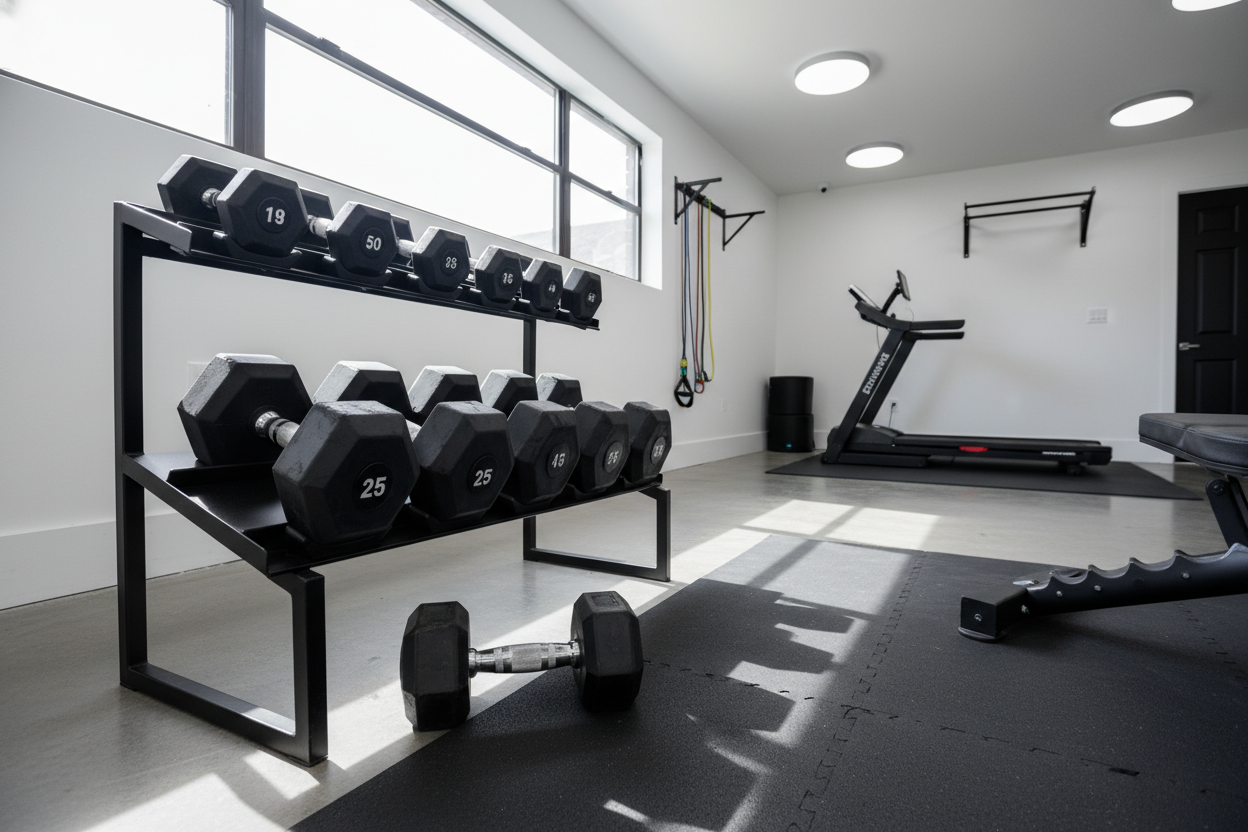
I’ve spent way too much time scrolling through marketplace listings at 2 AM, convinced that my progress was stalled because I didn’t have a full rack of 100-pounders. Then I realized my 50 lbs dumbbell set was actually doing 90% of the heavy lifting while the big boys just sat there looking pretty and taking up space.
Building a home gym is an exercise in restraint. If you buy like a commercial gym owner, you’ll end up with a crowded garage and a thin wallet. For the vast majority of us, 50 pounds is the ceiling where utility meets reality.
- Budget Friendly: You avoid the exponential cost of heavy shipping and heavy-duty storage racks.
- Space Efficiency: A 5-50 set fits on a single compact rack, leaving room for your rack or bench.
- Hypertrophy Sweet Spot: Most accessory movements and high-rep finishers never need to exceed 50 lbs.
- Resale Value: 50-lb sets are the most liquid asset in the used gym equipment market.
The Ego Trap: Why We Think We Need 100-Pounders
We’ve all been there. You see the massive pro-style racks in a CrossFit box or a powerhouse gym and think that’s the standard. You start looking at discount dumbbell sets that promise a full run up to 100 lbs for a 'steal.' Stop right there.
The ego tells you that you’ll be dumbbell pressing the century marks in six months. Reality says you’ll spend 95% of your time between the 15s and the 45s. For movements like lateral raises, curls, overhead extensions, and even most lunges, a 50-lb limit is plenty to trigger growth without turning your garage into a storage unit for unused iron.
What You Can Actually Build With a 50 lbs Dumbbell Set
If you think you’ve outgrown a 50-lb limit, you’re probably moving the weight too fast. By focusing on time under tension and unilateral movements, a 50 dumbbell set becomes an absolute torture device. Try doing Bulgarian split squats with 50s in each hand using a 3-second eccentric—you’ll realize very quickly that you don’t need more weight; you need better form.
You can cover every major muscle group with this range. Chest presses, rows, and shoulder work are staples, but the real magic happens when you stop trying to go heavy and start trying to go hard. If you're just starting, you can even save more by starting with just three core pairs before committing to the full run.
The Brutal Math of Space and Budget
Let’s talk numbers. A standard 5-50 lb set of rubber hex dumbbells is about 550 lbs of total iron. A 5-100 lb set is 2,100 lbs. That is a massive jump in floor loading requirements and shipping costs. When browsing full dumbbell collections, the price doesn't just double when you go to 100 lbs—it quadruples because of the heavy-duty racks and freight logistics involved.
In a standard 2-car garage, that extra rack space is the difference between having a dedicated deadlift platform or tripping over your equipment every time you try to do a burpee. Most home floors aren't designed to hold a ton of concentrated weight in a 6-foot span without some reinforcement.
Fixed Rubber Hex vs. Adjustables: What Wins at 50 Pounds?
If you have the floor space, a fixed rubber hex dumbbell set is the gold standard. They are durable, you can drop them (within reason), and there’s no mechanical failure to worry about. They feel balanced in the hand because, well, they’re one solid piece of metal and rubber.
However, if you’re training in a spare bedroom or a tight apartment, quick-change adjustable dumbbells are the smarter play. They condense that entire 5-50 lb range into the footprint of two shoes. Just know that you sacrifice some of that 'bombproof' feel for the sake of convenience. I personally prefer fixed weights for anything I'm going to be moving fast with, like snatches or cleans.
How to Know When You've Actually Outgrown 50 Pounds
Before you go buying 60s and 70s, run through this checklist. Can you do 15 perfect reps of a single-arm row with the 50? Is your tempo controlled, or are you yanking the weight? Can you do 20 reps of a weighted goblet squat with a 2-second pause at the bottom?
If the answer is yes to all of those, then sure, it’s time to upgrade. But for most of us, adding a few reps or slowing down the movement provides more than enough stimulus to keep making gains without needing to buy more gear.
My Personal Take: The Mistake I Made
I once bought a set of 80s because I felt like a 'serious' lifter needed them. They sat on the bottom shelf of my rack for two years. I used them maybe once a month for heavy rows, but the rest of the time they just gathered dust and cat hair. I eventually sold them to buy a better barbell, which was a way better investment. Don't buy for the lifter you want to be in five years; buy for the work you're doing today.
FAQ
Is a 50 lb dumbbell set enough for leg day?
Yes, if you move to unilateral work. High-rep goblet squats or heavy Bulgarian split squats with 50s will crush almost anyone. If you're a powerlifter, you should be using a barbell for legs anyway.
Should I get 5-lb increments or 10-lb?
Always go with 5-lb increments if you can afford it. Jumping from 30 to 40 lbs on a shoulder press is a 33% increase, which is a recipe for a plateau or an injury.
Are rubber hex dumbbells better than iron?
For home use, yes. They are quieter, they don't roll away on uneven garage floors, and the rubber coating protects your foundation when you set them down hard.
Share:
I Maxed Out That Viral 210 lbs Dumbbell Set in Exactly Three Weeks
Why I Sold My Silver Dumbbells After One Humid Summer