
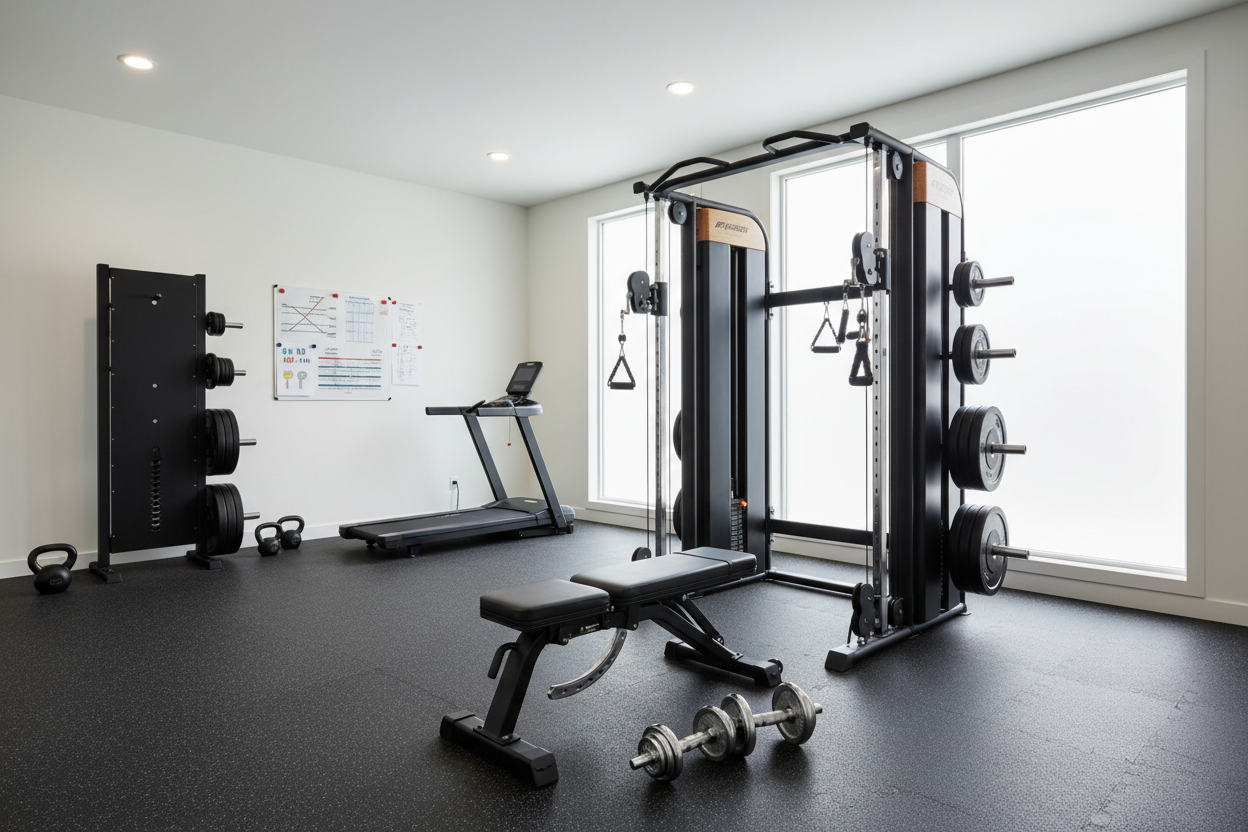
I remember the Tuesday my wife decided she wanted to start squatting. I was mid-set at 335 lbs, and she needed the bar at 65. I spent the next forty-five minutes stripping plates, moving J-cups, and recalibrating my brain instead of actually training. It was a logistical nightmare that turned a high-intensity session into a slow-motion chore. If you are tired of the constant plate-shuffling, it is time to look at a dedicated home gym machine that actually respects both of your strength levels.
- Selectorized weight stacks save roughly 15 minutes of plate-swapping per hour.
- Functional trainers allow for different height adjustments in seconds, not minutes.
- Guided movements provide safety for the less experienced partner without a constant spot.
- Compact footprints prevent the 'garage takeover' that leads to household tension.
The 10-Minute Plate Swapping Penalty
The friction of sharing a barbell is real. When one person is pulling 405 off the floor and the other is doing RDLs with 95, the workout momentum dies. Every set requires a full teardown and rebuild. I have seen couples give up on training together entirely because the 'rest periods' become ten-minute labor sessions moving 45-lb iron plates across the room.
This friction is a workout killer. By the time you get the bar back to your working weight, your heart rate has dropped and your focus is gone. You are no longer training; you are a professional plate-mover. A proper machine home gym eliminates this by using pins or quick-change mechanisms that let you pivot between strength levels in the time it takes to grab a sip of water.
Why Your Basic Setup Fails the 'Partner Test'
A standard rack and barbell setup is built for a single user at a time. It does not account for the fact that I am 6'1' and my partner is 5'4'. When we are building a functional home gym, we often forget about anthropometrics. If I set the pull-up bar or the cable pulley for my reach, she is literally jumping to reach it. If she sets it for hers, I am hitting my knees on the floor.
An in home gym machine solves this by offering multiple attachment points and adjustable heights that do not require a wrench or a prayer. You need a setup where the pulley slides up and down a rail effortlessly. If it takes more than five seconds to adjust the starting position, it is the wrong machine for a dual-user household.
Finding the Sweet Spot: Equipment That Actually Adapts
When shopping for a workout at home machine for two, you need to be ruthless about your criteria. First, look at the cable ratio. A 2:1 ratio is usually the sweet spot, providing enough travel for long-armed lifters while keeping the weight increments manageable for everyone. Second, check the footprint. If a machine takes up 50 square feet, you are going to hate it when you are trying to navigate around each other mid-circuit.
I personally look for machines with dual independent pulleys. This allows one person to do chest flies while the other does tricep extensions without interfering with the other's cable line. It turns a solo piece of equipment into a two-person station.
The Magic of Selectorized Weight Stacks
Plate-loaded machines are cheaper, sure, but selectorized stacks are relationship savers. I can finish a 200-lb lat pulldown, pull the pin, and my partner can immediately hit a 50-lb set. There are no plates cluttering the floor and no pinched fingers. If you have the budget, always go selectorized for a shared space. The time you save over a year is worth every extra penny.
Guided Barbell Movements for Unequal Strength Levels
Safety is the elephant in the room. If I am pushing for a PR and my partner is not physically capable of spotting a 300-lb miss, we have a problem. A Smith machine home gym station provides a fixed plane of motion and built-in safety catches. This means she can lift to failure safely while I am across the garage doing rows, and I can do the same without worrying about her having to deadlift a bar off my chest.
Adding Low-Impact Options for Active Recovery
Not every day is a heavy iron day. Sometimes one partner wants a brutal leg session while the other needs mobility work. Adding something like a foldable Pilates reformer machine into the mix gives you a dedicated recovery zone. It bridges the gap between 'gym' and 'wellness' without eating up the floor space needed for your main lifts.
I have found that having a low-impact option prevents the 'I do not feel like lifting' excuse from turning into a 'I am not going to the gym' reality. It keeps both people in the habit of using the space, even on off days.
The Solo Lifter Caveat
I will be honest: if you are a lone wolf who never lets anyone else touch your knurling, your priorities change. You do not need the quick-adjust features or the safety catches as much as you need raw durability and specific bar feel. In many cases, the best at home gym machine is built for solo lifters who want to customize every single variable to their own body. But if you share your life, you have to share your gym—and that means buying for two.
FAQ
Is a cable machine better than a power rack for couples?
For sheer versatility and speed of adjustment, yes. A cable machine allows two people of vastly different strength levels to swap exercises in seconds. A rack is better for raw strength but slower for partner training.
How much space do we actually need for two people?
Do not try to cram two people into a 4x4 space. You need at least an 8x10 area to move safely without bumping into each other or the equipment. Floor markings help define 'zones' so you are not constantly apologizing for being in the way.
What is the most important spec to look at?
Weight increments. If a machine only has 20-lb jumps, the lighter lifter will get stuck between weights quickly. Look for stacks that have 5-lb or 10-lb increments, or include 'adder weights' for micro-loading.
Share:
I Wasted $3K Finding the Best Weight Equipment for Home Gym Setups
I Tested Bodytech Gym Equipment to See if EMS Actually Works