
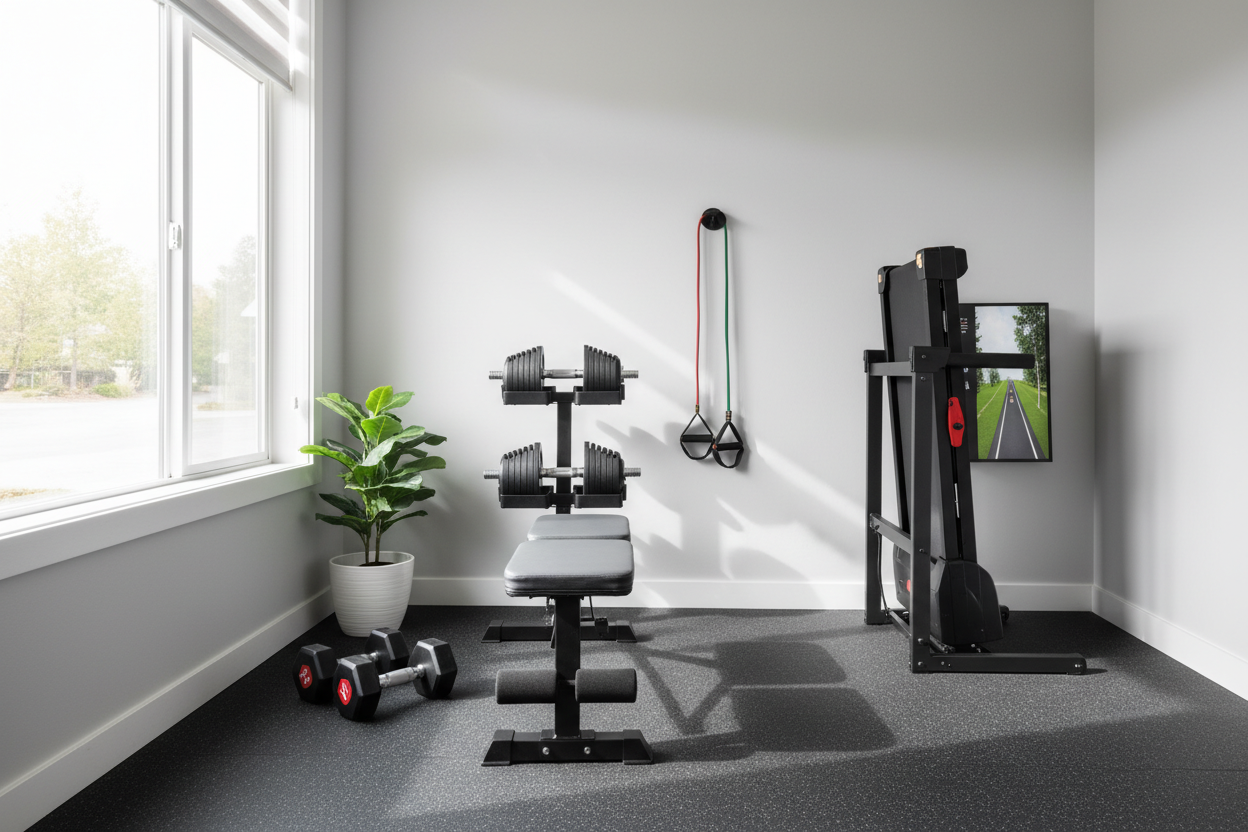
I remember staring at my 10x10 spare room, wondering if I was destined to spend the rest of my life paying $80 a month to wait for a squat rack. The internet told me I needed a 600-square-foot garage. I didn't have that. I had a bed, a desk, and a dream of a home gym small enough to not get me evicted.
Quick Takeaways
- Vertical storage is your best friend; if it can hang on a wall, it should.
- Folding racks are the only way to squat heavy in a bedroom.
- Adjustable dumbbells replace 15 pairs of fixed weights in 2 square feet.
- Flooring is non-negotiable for noise and floor protection.
The Brutal Reality of Apartment Lifting
Most fitness advice assumes you have a massive two-car garage or a basement with 12-foot ceilings. For those of us living in the real world—apartments, condos, or small houses—that advice is useless. You see a rack that looks great, then realize it requires a footprint larger than your kitchen. Trying to build a small at home gym often feels like a series of compromises where you end up with a couple of flimsy bands and a door-frame pull-up bar.
But I refused to settle for a 'toning' circuit. I wanted to move heavy weight. The dream of a dedicated home gym is usually killed by the fear of clutter, but if you're smart about your layout, you can fit a 1,000-lb total into a corner. You don't need a warehouse; you need a strategy that prioritizes iron over ego. A small space home gym isn't about having less; it's about having exactly what you need and nothing else.
Ditch the Single-Use Machines
Single-use machines are the enemy. In a commercial gym, a dedicated leg extension machine is fine. In a home gym for small space, that machine is just an expensive place to hang your laundry. Every piece of gear you bring into a 10x10 room must earn its keep by serving at least three distinct exercises. This is the golden rule of home gym space saving.
Instead of a chest press machine, you buy a high-quality adjustable bench. Instead of a dedicated cable crossover, you look at wall-mounted pulley systems that stick out less than 10 inches from the drywall. I’ve seen guys try to cram a full functional trainer into a studio apartment. It’s a nightmare. You can’t move, you can’t breathe, and you eventually stop training because the room feels like a storage unit. Focus on the 'big three' movements and build outward only when you have the floor space to spare.
The Non-Negotiable Gear for a Micro Setup
If you are building a mini gym for home use, your first purchase shouldn't be a treadmill. It should be a folding wall rack. These things are engineering marvels. I use one with 11-gauge steel uprights that folds flat against the wall when I'm done. It takes up about 4 inches of depth when closed. When open, I’m squatting 405 lbs with zero wobble. That is how you maximize a home gym for small room footprints.
Next, get a pair of heavy adjustable dumbbells. I’m talking about the ones that go up to 80 or 90 lbs. A full rack of dumbbells would require a 6-foot long storage stand. These take up the space of two shoeboxes. Pair that with a flat-to-incline bench that has a small footprint, and you've already covered 90% of your hypertrophy needs. This is the foundation of a home mini gym that actually produces results rather than just collecting dust.
How to Actually Train Legs in a 10x10 Room
Leg day is where most at home gym small space setups fail. You can only do so many Bulgarian split squats before your soul leaves your body. You need volume, and you need load. But a standard leg press is 8 feet long and weighs as much as a Honda Civic. It’s not happening in a bedroom. I spent months looking for a workaround that didn't involve just 'doing more lunges.'
The solution is combo machines. I eventually cleared out a corner for a compact 30 degree leg press which combines a hack squat and a leg press into one footprint. It’s about 47 inches wide. That’s roughly the size of a large armchair. By using a 30-degree angle instead of the standard 45, the machine stays short enough to fit in a room without feeling like it’s swallowing the space. It allowed me to keep my leg strength up without needing a commercial-grade power rack and 500 lbs of loose plates scattered on the floor.
Should You Just Buy a Portable System Instead?
I get the appeal of the mini at home gym systems that fit in a backpack. They use bands, collapsible bars, and 'smart' resistance. They look great in Instagram ads. But if you've ever felt the difference between a 45-lb iron plate and a heavy rubber band, you know there is no comparison. Bands have their place for accessory work, but they fail to provide the consistent mechanical tension needed for real growth.
I’ve debated this with plenty of lifters who swear by travel rigs. I even looked into whether a portable fit home gym could replace my rack. The verdict? Only if you're traveling. If you are at home, buy the iron. You can't simulate the stability of a barbell with a plastic board and some bungee cords. A small room with high-quality, compact iron will always beat a 'smart' gym that folds under your bed.
Personal Experience: The Weight Capacity Mistake
When I first started, I bought a cheap, 'compact' rack from a big-box store. It was rated for 300 lbs. The first time I racked 225 lbs after a set of squats, the whole thing swayed so hard I thought it was going through the drywall. It was terrifying. I ended up selling it for half what I paid and buying a real 3x3-inch steel rack. The lesson: small space doesn't mean small weights. Buy gear that is over-engineered for your current strength so you don't have to buy it twice.
FAQ
How much floor space do I actually need?
You can get a full workout in an 8x8 area, but 10x10 is the 'sweet spot.' This allows for a 7-foot barbell and enough room to load plates on the sides without hitting the walls.
Is a small gym too noisy for an apartment?
It can be. Use 3/4-inch rubber stall mats and avoid dropping your deadlifts. If you're on a second floor, look into 'crash pads' to dampen the vibration of heavy lifts.
Can I use a standard 7-foot barbell in a small room?
It’s tight. If your room is 10 feet wide, a 7-foot bar leaves only 1.5 feet on each side. If that’s too close for comfort, look for a 'shorty' bar which keeps the standard sleeve distance but narrows the shaft.
Share:
Why Your Planet Fitness Exercise Routines for Weight Loss Aren't Working
How to Pick the Best Home Resistance Gym for Serious Lifting