
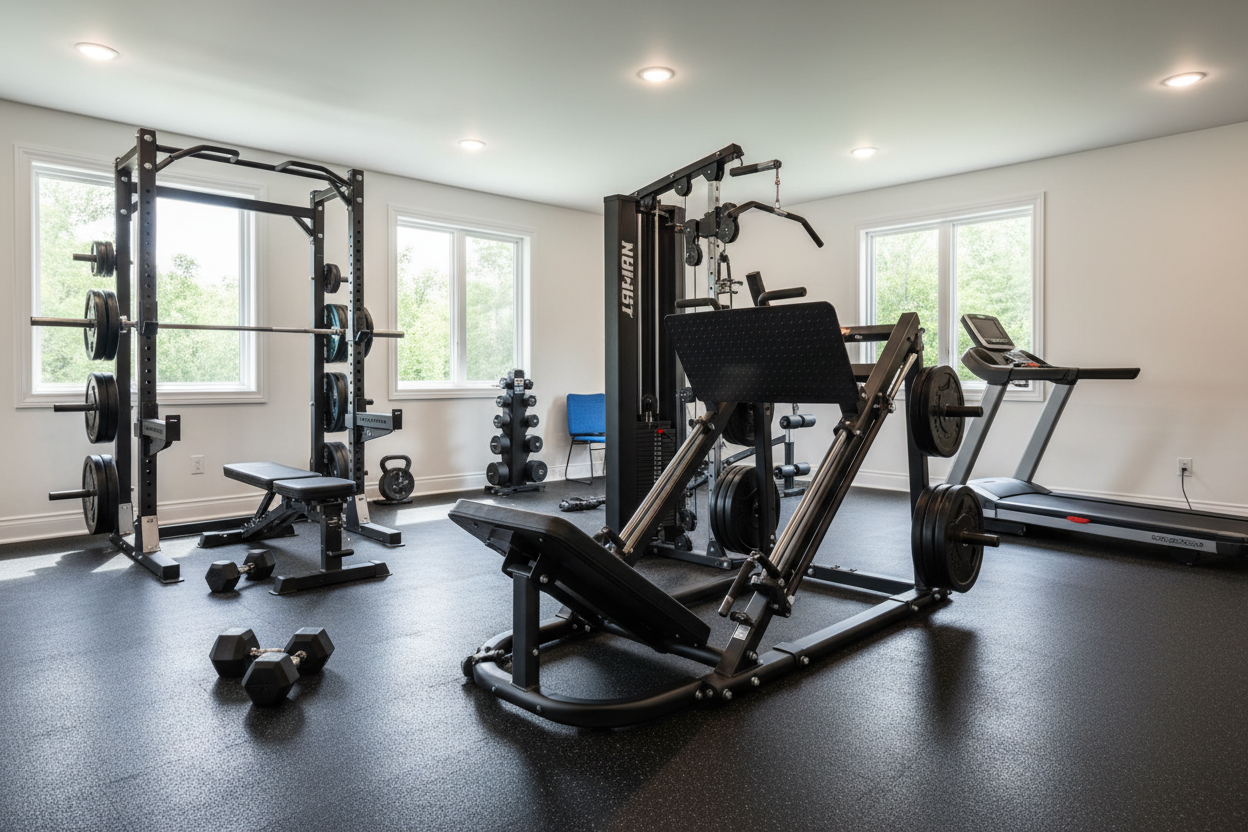
I remember the day I realized my 'total body' machine was actually just a chest press with a footrest. I was staring at a flimsy cable attachment while my quads were begging for a real stimulus. Finding a legitimate all in one home gym with leg press that doesn't feel like a toy is the white whale of home fitness equipment. Most of these machines are designed by people who clearly haven't done a heavy set of squats since high school.
- Most leg press attachments on multi-gyms have terrible leverage and low weight caps.
- Look for a 1:1 pulley ratio or a stack that exceeds 300 pounds.
- Adjustable footplates are mandatory for long-term knee health.
- Stability at the bottom of the rep separates the serious machines from the scrap metal.
Why Most Multi-Gyms Completely Ruin Leg Day
The fitness equipment industry has a dirty secret: they think you only care about your chest and biceps. Most unified systems are built around a central stack that powers a decent bench press and a mediocre lat pulldown, leaving the lower body as an afterthought. You usually end up with a multi gym leg extension that tops out at 100 pounds. That is fine for a light pump, but it is not going to build real slabs of muscle.
I spent months testing an all in one home gym and realized that the main issue is the frame. Leg presses require massive structural integrity because the forces involved are significantly higher than a seated row. If the machine does not have a dedicated sled or a heavy-duty press plate that locks into a steel frame, you are basically just playing with a glorified resistance band. You cannot build massive legs on extensions alone; you need to move heavy weight through a deep range of motion.
The Mechanics of a Leg Press That Doesn't Suck
When you are shopping for a universal home gym with leg press, you have to look at the friction. Cheap machines use plastic bushings that catch and stutter. You want linear bearings and chrome-plated guide rods. If the movement is not smooth, you will find yourself avoiding leg day because the 'jerkiness' ruins your mind-muscle connection and puts weird shear force on your patellar tendon.
Then there is the physics of the pulley. Many home units use a 2:1 ratio, meaning that 200-pound stack only feels like 100 pounds on your feet. That is a joke. For a leg press to be effective, it needs to offer enough resistance to actually challenge your posterior chain. The footplate angle is the final dealbreaker. If the plate is fixed at a flat 90-degree angle, your ankles will likely run out of mobility before your quads get a full stretch.
My 3 Ironclad Rules for the Best Home Gym for Legs
Rule 1: The Resistance Ratio. If the machine uses a pulley system for the leg press, it must be a 1:1 ratio. If it is 2:1, the weight stack needs to be at least 400 pounds to keep a strong lifter busy. Anything less and you will be maxing out the machine within the first three months.
Rule 2: Footplate Adjustability. Everyone has different hip mechanics. A high-quality best home gym for legs allows you to tilt the footplate. This lets you shift the focus from your quads to your glutes and hams without blowing out your lower back.
Rule 3: Frame Stability. The sled should not wobble. I have found that a Smith machine home gym station often provides the best foundation for a leg press. Because the press plate usually attaches directly to the heavy Smith carriage, it utilizes the thickest steel in the entire rig. This eliminates that annoying side-to-side play you feel on standalone pulley-based leg presses.
Should You Just Buy a Standalone Machine Instead?
Space is the ultimate currency in a garage gym. If you are working with a standard 20x20 two-car garage, you might have the luxury of floor space. In that case, a standalone hack squat and leg press combo is a beast of a machine that provides a commercial-grade feel. It is dedicated, heavy, and takes up about 30 square feet.
However, for most of us living in a 10x12 spare room or a cramped corner of the basement, that is not an option. The all in one home gym with leg press wins on the 'spatial math.' By integrating the press into the existing footprint of your rack or cable system, you save roughly 20 square feet. That is enough room for a dumbbell rack or a cardio piece. You just have to ensure the combo unit you pick does not compromise on the steel gauge.
The Final Verdict on Saving Garage Space
You should never sacrifice your lower body gains just to save a few square feet. If the machine feels like it is going to tip over when you load three plates, it is garbage. I have learned the hard way that buying cheap equipment means buying it twice. If you are serious about upgrading your home gym, invest in a unit that uses heavy-duty guide rods and a thick gauge steel frame. A legitimate leg press setup is the difference between a 'fitness room' and a real sanctuary for growth.
FAQ
Is a 200lb weight stack enough for a leg press?
Usually no. Because the legs are so much stronger than the upper body, you will outgrow a 200lb stack quickly, especially if the machine has a 2:1 pulley ratio that cuts the effective weight in half.
Can I do calf raises on these machines?
Yes, provided the footplate is large enough to let your heels hang off the bottom edge. Look for a plate with a non-slip texture so your feet don't slide when you're at peak contraction.
How much ceiling height do I need?
Most all-in-one units sit between 80 and 84 inches tall. Always measure your ceiling twice, especially if you have low-hanging ductwork or a garage door opener in the way.
Share:
Does the Body-Solid Series 7 Smith Machine Belong in a Garage Gym?
Why Your Multi Function Weight Bench Feels Like a Cheap Swiss Army Knife