
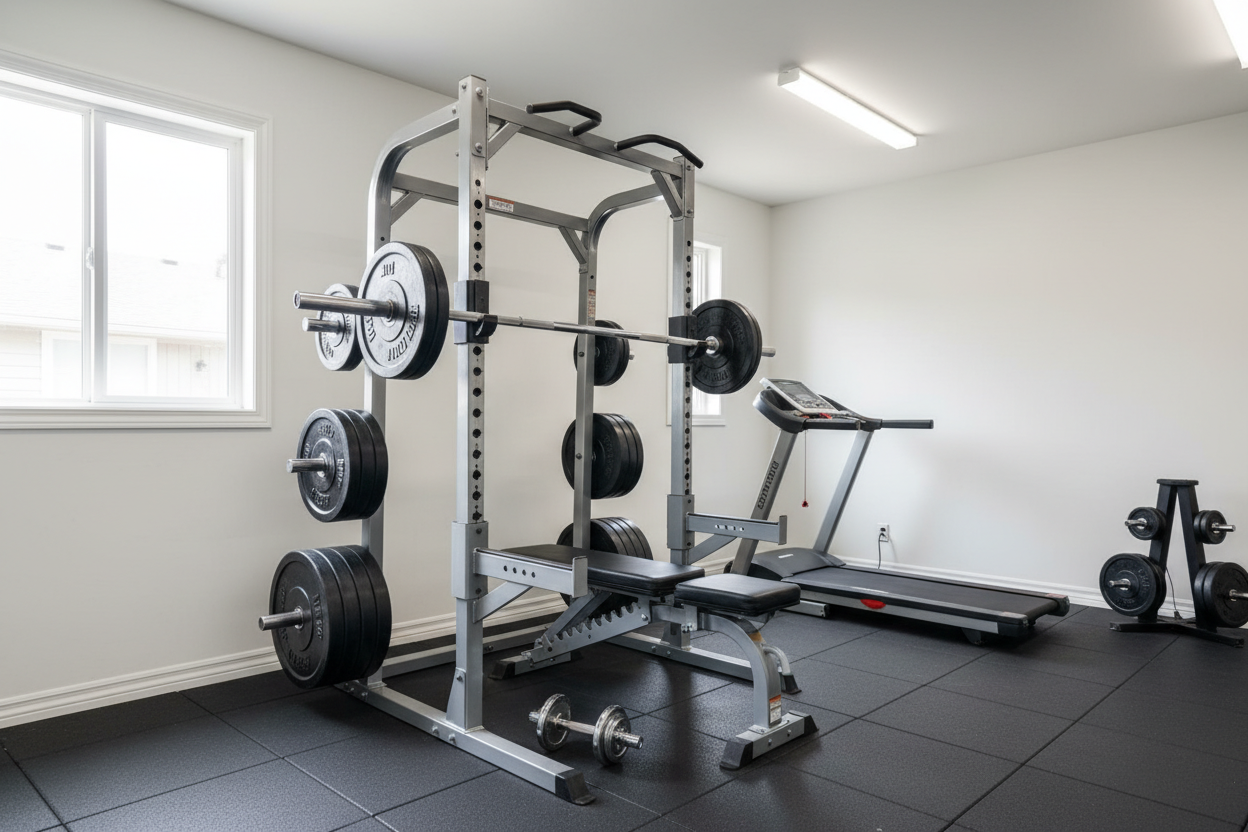
I spent years being a barbell snob. I thought the Smith machine was just a high-priced coat rack for people who were too lazy to stabilize a real bar. Then I tweaked my lower back trying to ego-lift 405 on a standard rack, and suddenly, those fixed rails didn't look so bad. But my first session was a disaster because I tried to move exactly like I did with free weights.
If you're trying to figure out how to properly squat on a smith machine, you have to throw your traditional powerlifting manual out the window. The mechanics are different, the friction is different, and if you don't adjust your stance, your knees will let you know about it by the third set. Here is the reality of training on a fixed track.
Quick Takeaways
- Never put your feet directly under the bar; you need a forward offset.
- Lean your weight back into the bar to engage the quads and save your spine.
- Pay attention to the rail angle—most home units have a 7-degree slant.
- Always set your safety stoppers before you even think about adding plates.
Why You Can't Treat This Like a Traditional Barbell
The biggest mistake people make when learning how to do a squat on a smith machine is trying to keep their feet directly under their hips. In a free-weight squat, the bar moves in a natural, slight S-curve. A Smith Machine forces a perfectly vertical or slightly angled straight line. If you try to use standard mechanics, the machine will force your body into positions that create massive shear force on your knees and lumbar spine.
I learned this the hard way after a week of 'traditional' Smith squats left me with a dull ache in my patellar tendons. The fixed track removes the need for stabilizer muscles, which is a double-edged sword. It allows for more weight and better isolation, but it also means there is zero 'give' if your form is off. You aren't moving the bar; the bar is moving you.
The Setup Checklist: How to Properly Squat on a Smith Machine
Before you unrack, you need to find your center of gravity. Most home gym Smith machines use a 1-inch or 2-inch plate peg system and have a starting bar weight of about 15 to 25 lbs. Don't assume it's a standard 45-lb bar. Position the bar across your traps—slightly lower than a high-bar squat—and ensure your hands are gripping firmly to help pull the bar into your shelf.
Unlocking the bar usually requires a flick of the wrist. Practice this empty first. There is nothing worse than hitting failure at the bottom of a rep and realizing you can't rotate the hooks back into place because your forearms are gassed. Set those safety pins at a height just below your parallel depth. They are there for a reason.
Mastering the Lean Back Squat on Smith Machine
The secret to proper squat smith machine technique is the foot placement. You want to walk your feet out about 6 to 12 inches in front of the bar. When you descend, you should feel like you are sitting back into a chair, leaning your torso against the bar for support. This is often called the lean back squat on smith machine.
This position shifts the load almost entirely onto your quadriceps and glutes while keeping your spine vertical. It actually feels very similar to a hack squat. In fact, if you're tight on space, this setup is the best way to handle No Room for a Leg Sled? My Hack Squat on Smith Machine Setup. By leaning back, you eliminate the forward knee travel that causes so much pain for lifters with long femurs.
Dialing In Proper Squat Form With Smith Machine Angles
Most modern Smith machines aren't perfectly vertical; they have a 7-degree slant. This is designed to mimic the natural path of a bench press or squat, but it confuses people. To maintain proper squat form with smith machine rigs, you need to decide which way to face. For a quad-dominant squat where you're leaning back, I prefer to face the direction the bar leans *away* from as it goes up. This allows the bar to travel 'with' the natural extension of your hips.
If you face the other way, you might find the bar pushing your chest forward into a 'good morning' position at the bottom of the rep. Experiment with both, but pay attention to your heels. If your heels are lifting off the floor, your feet aren't far enough forward. Keep your weight on your mid-foot and heels to drive through the floor.
When Is It Time to Upgrade to a Dedicated Leg Press?
The Smith machine is a versatile tool, but it has a ceiling. If you find that the fixed bar path is still bothering your shoulders or if you're chasing pure leg hypertrophy without the upper body fatigue of holding a bar, it might be time to look at specialized gear. For many home gym owners, a Compact 30 Degree Leg Press Hack Squat Combo Machine Lm L5 provides a much more stable platform for heavy leg days without the technical quirks of a Smith machine.
I still use the Smith machine for lunges and calf raises, but for my primary heavy movement, nothing beats a dedicated sled. It takes the balance and the 'lean' out of the equation entirely, letting you just focus on pushing weight until your quads give out.
My Personal Experience: The L5-S1 Lesson
I used to think the Smith machine was 'fake' lifting. Then I tried to do a 20-rep set of squats with 225 lbs on a Smith machine using the lean-back method. I couldn't walk for three days. The pump was better than any barbell squat I'd ever done. My mistake was trying to go too heavy too fast without adjusting my foot position. Once I moved my feet forward and embraced the 'lean,' my back pain vanished and my quads actually started growing again.
FAQ
Should I wear a belt on a Smith machine?
Yes, if you are going heavy. Even though the bar is stabilized, your core still needs to create internal pressure to protect your spine, especially since you are leaning back into the bar.
Can I do sumo squats on a Smith machine?
Absolutely. The Smith machine is actually great for sumo stances because you don't have to worry about the bar tipping as you widen your base. Just keep your feet slightly in front of the bar path.
Why does my lower back hurt after Smith squats?
You're likely standing too close to the bar. If your feet are directly under you, the machine forces your lower back to round at the bottom of the movement. Move your feet forward.
Share:
I Tested Every Smith Machine Weight Calculator (And They All Suck)
My Numbers Dropped: Is It Harder to Bench on a Smith Machine?