
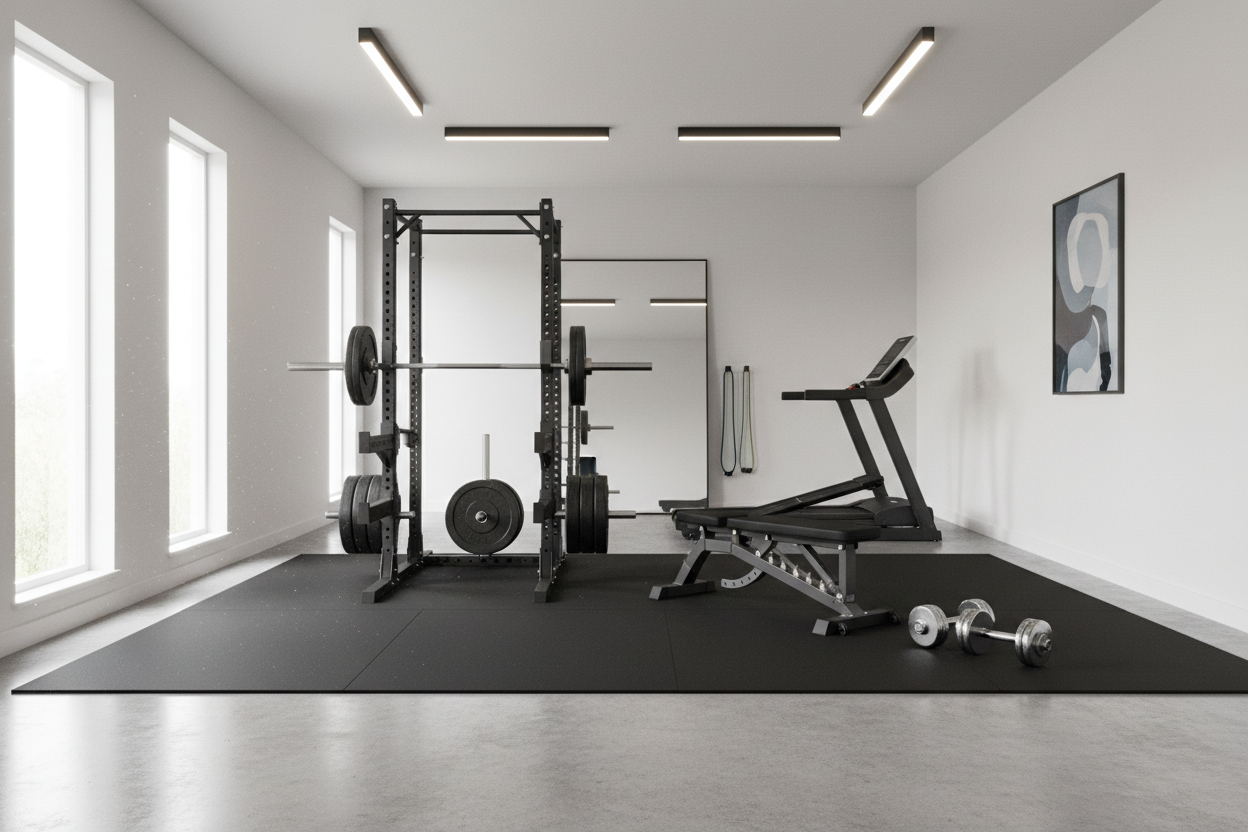
I remember the exact moment I realized I had a problem. I was trying to squeeze a lawnmower past a vertical leg press I hadn't used in six months, and I tripped over a pile of 10-pound bumper plates. The local commercial gym had just hiked their rates to eighty bucks a month, so I’d gone on a midnight shopping spree for gym equipment in home storage that I didn't actually have space for. I was gear-rich and movement-poor.
My garage looked like a fitness graveyard. I had specialized bars for movements I rarely performed and 'budget' machines that rattled every time I loaded more than two plates. I finally snapped and listed 80% of it on Marketplace. After the dust settled, I was left with a leaner, meaner setup that actually made me want to train. If you are currently looking at home gymnasium equipment and wondering why your space feels cluttered, it is time for a reality check.
- Versatility is the only metric that matters in a small space.
- Cheap home gyms equipment is more expensive in the long run when it breaks.
- If a machine only does one thing, it probably shouldn't be in your garage.
- Floor space is your most valuable asset—don't trade it for a gimmick.
The Trap of the 'Instagram Perfect' Garage Setup
We have all seen those social media posts: a 1,000-square-foot climate-controlled garage with custom-colored racks and every single attachment known to man. It is easy to get sucked into the idea that you need a specialized machine for every muscle group. This leads to the most common mistake: buying cheap gym equipment for homes just to fill up the floor. You think you are building a 'complete' gym, but you are actually just creating an obstacle course.
When I started, I thought I needed a dedicated leg extension machine, a preacher curl bench, and a calf raise block. I spent thousands on this workout equipment for home gym 'completeness.' In reality, I spent more time moving gear around than actually lifting it. To build a functional home gym, you have to prioritize the 90%. That means focusing on the big compound movements that drive 90% of your results. If a piece of gear doesn't allow you to squat, hinge, press, or pull heavy, it’s probably fluff. I realized that my $400 'budget' cable crossover was so light it would tip over if I tried to do heavy chest flies. It was a waste of steel and a waste of my time.
The Core Essentials That Survived My Purge
When I stripped everything back, I looked for the absolute non-negotiable pieces of equipment gym home setups actually require to build real muscle. I stopped looking at 'features' and started looking at durability. I kept the stuff that could survive a nuclear winter—or at least me dropping a heavy deadlift at 6 AM. You don't need forty pairs of dumbbells; you need a few heavy hitters that can handle the load. I traded my rack of twenty fixed dumbbells for one high-quality adjustable set that goes up to 80 pounds. The footprint went from six feet of wall space to eighteen inches. That is the kind of math you need to do when selecting gym supplies for home use.
A Heavy-Duty Rack That Won't Flinch
The rack is the anchor of your entire training life. If your rack has 2x2-inch uprights made of thin 14-gauge steel, it’s going to wobble the second you try to rack a heavy squat. I upgraded to a 3x3-inch rack with 11-gauge steel because I wanted to feel safe when I was training alone. This is the one piece of home gyms equipment where 'good enough' isn't good enough. You want something with a 1,000-pound weight capacity, even if you only squat 300, because that overhead translates to stability.
For guys like me who train solo in a cramped garage, safety is the biggest concern. I actually found that a Smith machine home gym station was a better fit for my specific needs than a traditional power rack. It allowed me to push to absolute failure on bench and incline presses without needing a spotter, and the integrated storage kept my plates off the floor. It’s about finding the specific tool that fits your training style, not just what the internet says is 'hardcore.'
A Cable System (Because Free Weights Aren't Always Enough)
I’m a big believer in the barbell, but if you want to maximize hypertrophy, you need constant tension. Gravity only pulls down, but cables pull from wherever you want. After I sold my bulky leg press, I had enough room to actually fit a real functional trainer into a 4x5-foot corner. Having dual weight stacks changed everything for my accessory work. Suddenly, I could do face pulls, cable rows, and tricep pushdowns without having to rig up a sketchy resistance band to my pull-up bar.
If you don't have the three grand or the floor space for a full functional trainer, don't settle for those door-mounted pulley systems. They are trash. Instead, look for a dedicated lat pulldown and low row station. It gives you that heavy-duty cable feel for back and arm day but takes up half the space. I used one of these for three years before I upgraded, and it’s still the piece of gym equipment for at home use that I recommend most to people who want 'big gym' results in a small footprint.
The 'Must-Haves' That Turned Into Expensive Clothes Racks
Let's talk about the stuff I shouldn't have bought. First on the list: cheap cardio machines. I bought a $300 treadmill that sounded like a jet engine taking off and shook so hard I thought it would shatter my garage floor. If you aren't spending $2,000+ on a treadmill, just go for a run outside or buy a jump rope. Most cardio gym equipment for at home use is built with plastic internals that fail the moment you actually start sweating on them. It’s better to have an empty corner than a broken treadmill.
Then there was the 'specialty' home gym stuff. I had a sissy squat machine, a Roman chair, and a dedicated bicep curl station. Total floor space used? About 40 square feet. Total utility? Maybe 10 minutes of my workout. I realized I could do all those movements with a bench, a barbell, and some creativity. We often buy these things because we think they will motivate us to train, but motivation comes from progress, not from owning a piece of yellow-painted steel. If you are hoarding gym equipments for home workout routines that you haven't touched in a month, sell them. The mental clarity of a clean gym is worth more than a niche leg machine.
Stop Overcomplicating Your Space
My biggest mistake was thinking that more gear meant better workouts. It’s the opposite. When you have too much gym equipment at home, you spend your rest periods tripping over plates and your 'prep' time moving machines around just to find enough space to deadlift. I’ve seen guys build a pro setup with basic bodybuilding home gym equipment that fits in a single-car stall. They have a rack, a bar, a bench, and a cable stack. That is it.
Focus on the quality of the steel and the smoothness of the pulleys. If you are just starting out, buy the best barbell you can afford and a solid set of iron plates. You can add the fancy stuff later, but only if you have the square footage to support it. A minimalist gym forces you to focus on the movements that actually matter. I am stronger now with 20% of the gear than I ever was when my garage was overflowing with 'solutions' to problems I didn't have.
FAQ
How much space do I really need for a home gym?
You can get a world-class workout in an 8x8 foot space. That is enough for a standard power rack and a 7-foot Olympic barbell with a few feet of clearance on either side. If you have a 10x10 space, you have enough room to add a cable machine or a cardio piece.
Is it worth buying used gym equipment?
Absolutely, but be picky. Iron plates and steel racks are great used because they are almost impossible to break. Avoid used cardio machines or cable systems unless you can test the tension and check for frayed wires. If it’s rusted through, walk away.
Do I need specialized flooring?
Don't buy those 'puzzle piece' foam mats from big-box stores; they will compress and tear within a month. Go to a farm supply store and buy 3/4-inch thick rubber horse stall mats. They are heavy as hell, smell like a tire shop for a week, but they are indestructible and will protect your concrete from heavy drops.
Share:
Plate Math is a Trap: How Much Weight Does a Smith Machine Take Off?
I Scored a Total Sports America TSA-2000 Smith Machine. Worth It?