
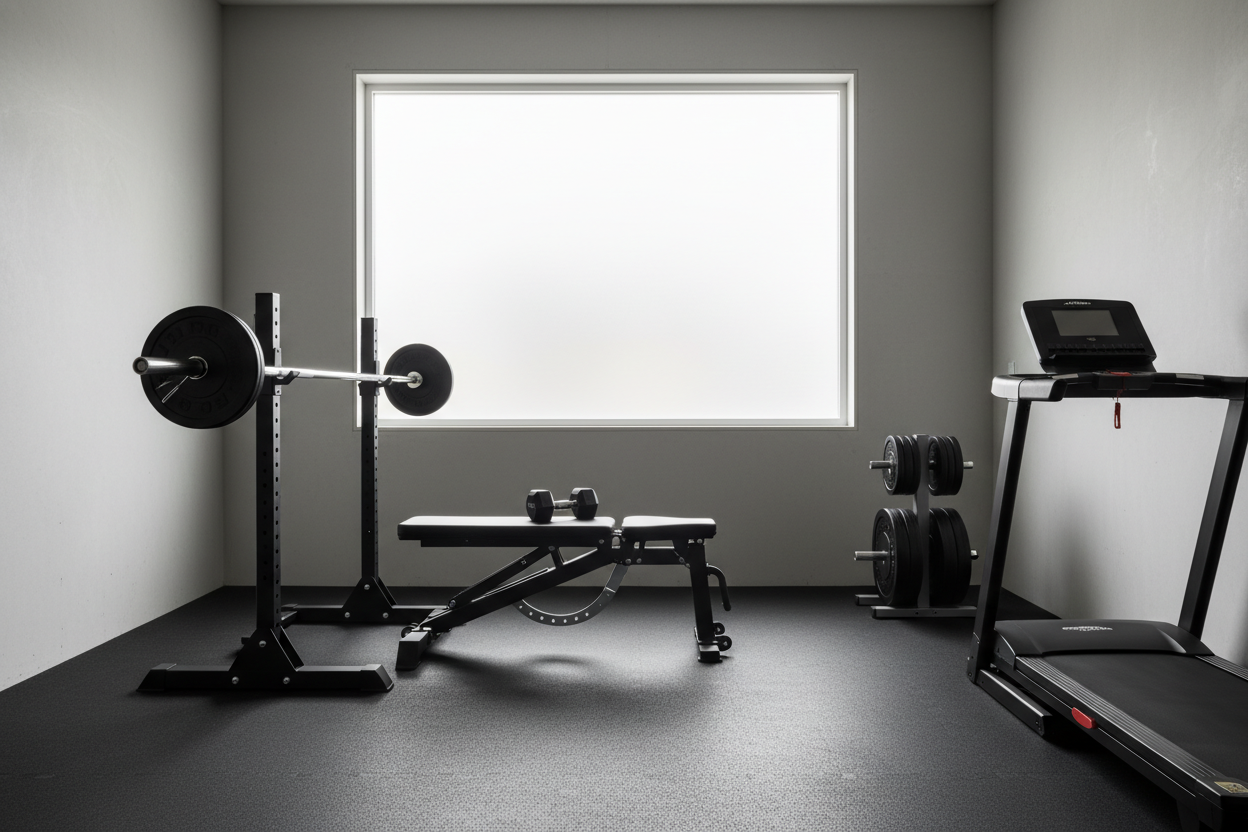
I spent years chasing the ultimate home gym. I had the six-post rack, the cable crossovers, and a mountain of specialty bars that I used maybe once a month. Then I realized I was spending more time tightening bolts and rearranging plates than actually lifting. One Tuesday, I listed it all on a local marketplace and went back to basics with a barbell and weight set. It was the best decision I ever made for my strength.
Quick Takeaways
- Racks provide safety, but floor-based lifting builds massive core stability and technical proficiency.
- You will become a master at the Power Clean by necessity if you want to press or squat.
- High-quality bumper plates are more important than a fancy rack when you are training on a flat mat.
- Minimalist training is not for the ego; your numbers will drop initially as you master floor-to-shoulder transitions.
The Day I Got Sick of Cluttered Garage Gyms
My garage was a 400-square-foot maze. Every time I wanted to deadlift, I had to move the rower. Every time I wanted to squat, I had to shimmy past a lat pulldown machine I barely used. The 'more is better' lie had turned my sanctuary into a storage unit. I was tripping over plyo boxes that had become glorified coffee tables and untangling resistance bands like Christmas lights. It was suffocating.
I finally hit a breaking point and stripped everything down to a barbell full set and two 4x6 rubber stall mats. The space felt massive. More importantly, my focus shifted. Without the distraction of twenty different attachments, it was just me and the iron. There is a psychological reset that happens when you clear the floor. You stop thinking about 'accessories' and start thinking about moving the weight from point A to point B. If you can't move it with a bar and some plates, you probably don't need to be doing it.
The empty mat forces you to be honest. You can't hide behind a machine's fixed path. Every wobble and every technical breakdown is yours to own. It turns out that a bar weights set and a little bit of open space is all you really need to get dangerously strong, provided you have the grit to handle the learning curve.
The Brutal Reality of Having No Squat Rack
When you don't have a rack, every single set starts with a clean. If you want to overhead press 185 lbs, you have to pull that bar weights set off the floor first. There is no 'unracking' at shoulder height. This forces a level of total-body coordination that rack-dwellers never develop. Your posterior chain has to be just as strong as your shoulders, or that bar isn't even getting to the starting position.
The downside? Your 'squat' weight is often capped by your 'clean' weight—unless you get creative with your movements. I found myself relying on a heavy-duty 20kg Olympic barbell that could handle being dumped when a heavy clean got out of front-rack position. When you are working with a weights barbell set on the floor, the bar takes a beating. You need sleeves that spin smoothly and a shaft that won't take a permanent bend if it hits the rubber hard from five feet up.
Training this way makes a standard 45-lb bar feel twice as heavy. You aren't just doing 3x5 squats; you're doing 3x5 cleans into squats. It is exhausting. Your heart rate stays spiked, and your grip strength will be the first thing to scream. But the functional carryover is insane. After three months of this, picking up a heavy box or a bag of salt feels like moving a feather because you're used to fighting the weight before the 'real' lift even begins.
My 4 Go-To Lifts With Just Iron and a Bar
You would be surprised how much you can do with a simple weight bar sets arrangement if you stop thinking like a commercial gym member. Here are the four staples that kept me growing without a rack:
- Floor Press: The original bench press. It kills your triceps and forces massive leg drive without the ego-driven arch. You just roll the bar over your hips and press.
- Zercher Squats: Hold the bar in the crooks of your elbows. It is miserable, it bruises your forearms, and it builds a back like a silverback gorilla. It is the most 'useful' squat variation for real-world strength.
- Barbell Hack Squats: The bar stays behind your legs. It is a quad-killer that mimics a leg press but requires way more balance.
- Pendlay Rows: Since you are already on the floor, these are a no-brainer. Explosive, strict, and perfect for building a thick upper back.
While exploring a specialty Olympic barbell collection can show you bars with different knurling or sleeve lengths, a solid multi-purpose bar is usually enough. I found that a bar with a 28.5mm diameter gave me the best balance between the whip I needed for cleans and the stiffness required for heavy floor presses. You don't need a dozen bars; you just need one that doesn't quit on you.
The beauty of these lifts is that they are self-limiting. You won't ego-lift 500 lbs on a Zercher squat if your core can't stabilize it. The floor and the bar act as your coach, providing immediate feedback on your form and your actual, usable power.
Should You Actually Buy a Pre-Packaged Bundle?
The temptation to grab a cheap barbell with weight set from a local big-box store is real. They are cheap, they are available, and they look fine in the box. But here is the truth: most of those 300-lb bundles are total garbage. The bars are usually rated for 300 lbs max, which sounds like a lot until you drop a loaded bar once and it develops a permanent smile. A bent bar is a useless bar.
I have seen why buying a barbell set with weights from mass retailers is a trap. The plates are often cast iron with massive weight variances. I have weighed '45-lb' plates that were actually 41 lbs and 48 lbs in the same box. When you are training without a rack, balance is everything. If one side of your bar is three pounds heavier than the other, your cleans are going to be dangerous and your floor presses will feel lopsided.
If you are going minimalist, do not go cheap. Buy a high-end bar and separate bumper plates. You want gear that survives a decade of being dropped on concrete, not something that cracks in six months. A quality barbell full set is an investment in your safety as much as your strength. Stick to reputable brands that publish their steel's tensile strength and plate weight tolerances.
The One Upgrade I Eventually Caved and Bought
After six months of the floor-only life, my chest development hit a wall. Floor presses are fantastic for lockout strength, but the limited range of motion eventually catches up to you. I missed the deep stretch at the bottom of a full bench press. I also got tired of the 'Steinborn lift'—manually tilting a bar onto my back for traditional squats—which is essentially a circus trick that gets risky as the weight climbs.
I didn't go back to the massive six-post cage, though. I picked up a compact weight bench with barbell rack. It kept the footprint small but allowed for those few 'luxury' movements that a floor-only setup lacks. It was the perfect compromise. I kept the open floor for my cleans and deadlifts but had a dedicated station for when I wanted to push my bench or squat without a death wish.
FAQ
How do you squat safely without a rack?
Stick to Zercher squats or front squats. If you must back squat, learn the Steinborn lift, but only if you have the mobility. Most people are better off sticking to high-volume Zerchers for leg growth.
Are bumper plates necessary for floor training?
Yes. If you are dropping weight from shoulder height or even just deadlifting heavy, iron plates will eventually crack your concrete or the plates themselves. Bumpers absorb the shock and save your floor.
Is the floor press a real substitute for benching?
It is a different animal. It builds more tricep power and explosive force from a dead stop, but it won't build the same chest mass as a full-range bench press because you lose the bottom third of the movement.
Share:
My DIY Gym Setup at Home Was a Disaster. Here's What to Buy.
Why Standard Racks Suck: The Best Home Gym for Tall Person