
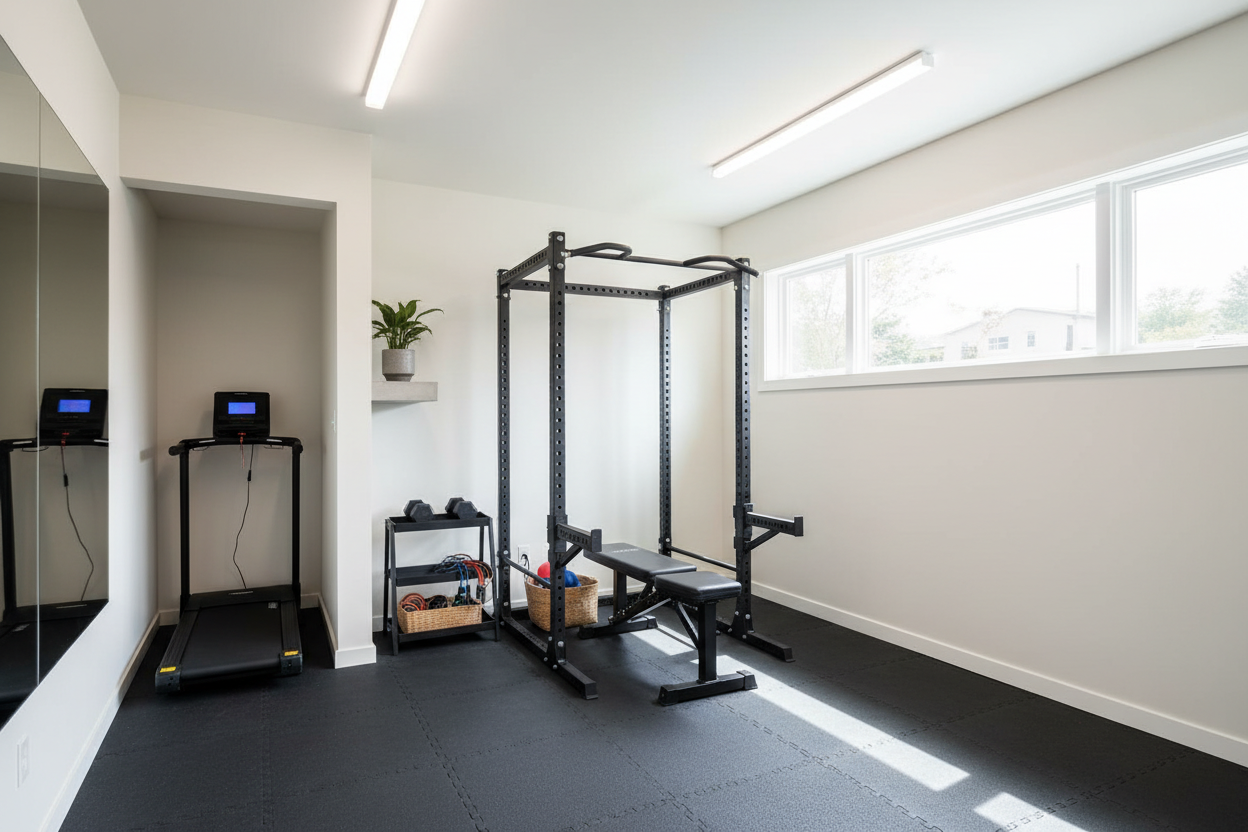
I remember the day I realized my gym membership was a scam. Not because of the $80 monthly fee, but because I spent 20 minutes of every hour waiting for a squat rack. I decided to reclaim my time in a 5x7 corner of my bedroom. Most people told me I’d be stuck doing air squats and using pink 5-lb dumbbells. They were wrong.
For two years, I lived and breathed home gym corner ideas that allowed me to train heavy without moving out of my apartment. It required a ruthless approach to gear and a total disregard for 'standard' gym layouts. If you’re tired of the commute and the crowds, here is how you build a powerhouse in a corner.
- Floor space is your most valuable currency—never waste it on storage.
- Horse stall mats are non-negotiable for floor protection.
- Verticality is the only way to fit a full rack in a bedroom.
- Adjustable gear beats a rack of fixed weights every single time.
The Harsh Reality of Lifting in a 5x7 Square
You don’t need a 2,000-square-foot garage. That’s the first lie you need to unlearn. A 5x7 space is roughly 35 square feet, which is plenty for a barbell and a bench if you’re smart about it. The shift is mental: you aren't building a 'facility,' you're building a workstation.
In a micro-gym, every piece of equipment must justify its existence. If it only does one thing, it’s probably trash. I spent my first six months tripping over a dedicated leg extension machine before I realized I could do the same work with a bench and a loading pin. Space-saving home gym corner setups thrive on versatility, not variety.
Ground Zero: Floor Protection That Actually Fits
If you drop a 45-lb plate on a hardwood floor or cheap carpet, you’re losing your security deposit. Forget those puzzle-piece foam mats you see at big-box stores. They compress under real weight and slide around like they’re on ice. You need 3/4-inch recycled rubber horse stall mats.
Buy a single 4x6 mat and cut it to fit your specific workout corner ideas. Pro tip: use a fresh utility knife and spray the blade with WD-40 or soapy water. It’ll slice through the rubber like butter. I wedged mine into the corner, and the weight of the rubber alone kept it from moving an inch. It deadens the sound and saves your subfloor from the inevitable drop.
Vertical Storage Will Save Your Sanity
The floor is for your feet and your bench. Everything else belongs on the wall. When I started, I had dumbbells scattered everywhere. It felt like walking through a minefield. The fix was a wall-mounted rack and vertical plate storage.
A folding wall-rack is the MVP here. It protrudes only 4-6 inches from the wall when tucked away. While looking for at home gym equipment ideas, I prioritized gear that could be hung on a heavy-duty pegboard. My belts, jump ropes, and even my change plates all went on the wall. If it’s off the ground, the room feels three times larger.
Can You Cram a Machine Into the Corner?
Usually, I’d tell you to stick to a barbell and call it a day. But if you’re a bodybuilder who needs guided paths for hypertrophy, a specialized Smith machine home gym station can actually be a space-saver. Some modern designs combine a Smith bar, a functional trainer, and a pull-up bar into a footprint barely larger than a standard power rack.
The key is the 'corner' design. Some units are built with a V-shaped back specifically to slide into a 90-degree corner. This utilizes the dead space that a rectangular rack leaves behind. Just measure twice. You need to account for plate loading on the sides, or you'll be banging your weights against the drywall every time you try to hit a PR.
Workout Corner Ideas to Stop Claustrophobia
Training in a corner can feel like lifting in a coffin if you don't manage the environment. First, buy the biggest mirror you can afford. Placing a 36x48-inch mirror on one wall of the corner creates an immediate illusion of depth. It’s not just for ego; it helps you check your form when you don't have a coach standing behind you.
Airflow is the second hurdle. In a small space, body heat builds up fast. I used a high-velocity pivot fan mounted near the ceiling. It keeps the air moving without taking up floor space. Also, stick to bright, cool-toned LED lighting. Dim yellow lights make a small corner feel dingy; bright white light keeps the energy up.
The Gear You Actually Need (And What to Skip)
If I had to do it all over again, I’d buy three things: a set of adjustable dumbbells (up to 80 lbs), a zero-gap adjustable bench, and a wall-mounted pull-up bar. Skip the cardio machines. If you want to run, go outside. A treadmill in a corner is just a $1,000 clothes rack.
Focus on a functional home gym setup that emphasizes compound movements. My biggest mistake was buying a cheap, 'all-in-one' home gym with plastic pulleys. The cables snapped within three months. Buy once, cry once. Get a solid barbell with decent knurling—it’s the one piece of gear you’ll touch every single workout.
How do I stop my gym from smelling in a small room?
Air circulation and cleaning. Use a charcoal bag to absorb odors and wipe down your bench after every session. Don't leave sweaty wraps or sleeves sitting in the corner; they are bacteria magnets.
Is it safe to deadlift in an upstairs apartment corner?
Only if you use crash pads or a dedicated silencer drop pad. Even with horse stall mats, the vibration will travel through the joists. Be a good neighbor and lift during the day.
Will a 5x7 space limit my gains?
Absolutely not. Intensity and consistency build muscle, not square footage. If you have enough room to extend your arms and a sturdy bar, you have everything you need to get strong.
Share:
Why I Tell Everyone to Overspend on Barbells for Home Gyms
The Barbell Math Secret to Small Home Gyms Design