
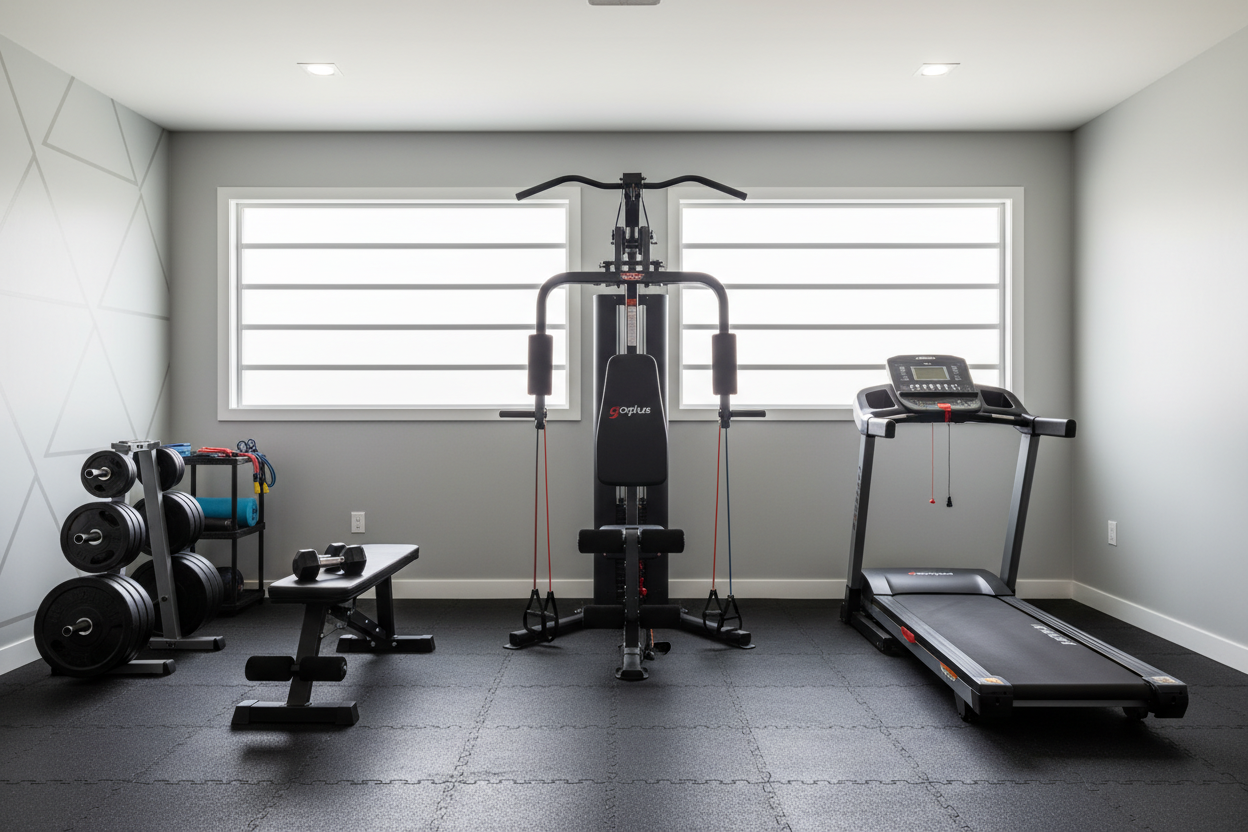
I was staring at my monthly commercial gym bill—which just hit $85—and realized I could buy an entire machine for the price of about six months of membership. That is how I ended up with a goplus home gym sitting in my garage, much to the amusement of my lifting buddies who swear by $2,000 racks.
We have all seen these budget machines on Amazon. They look decent in the photos, but you wonder if the steel is made of recycled soda cans. I spent 30 days punishing this unit to see if it belongs in a serious training space or the local scrapyard.
Quick Takeaways
- Surprisingly stable for the price point, provided you tighten every bolt until your knuckles turn white.
- The 100-lb to 150-lb weight stack (depending on the model) is plenty for accessory work but will feel light for heavy hitters.
- Assembly is a multi-hour test of your patience and soul.
- Cable friction is the biggest hurdle; you will need aftermarket lubricant immediately.
Let's Address the Elephant in the Room: The Price
Buying a budget machine usually feels like a gamble. You are essentially betting that the manufacturer didn't cut too many corners on the parts that actually keep the weight from falling on your face. I ordered the Goplus because I wanted to see if a sub-$500 machine could actually replace a gym membership for someone who isn't a competitive strongman.
Most 'hardcore' lifters will tell you that if it isn't 11-gauge steel, it is trash. But here is the reality: not everyone needs a tank in their spare bedroom. I wanted to see if the goplus home gym could handle high-volume hypertrophy work—the kind of stuff that builds muscle without requiring a 500-lb squat. I approached this with a healthy dose of skepticism, expecting shaky frames and snapping cables.
What I found was a machine that occupies a weird middle ground. It is not commercial grade, obviously, but it is also not the plastic toy I feared. It is a tool. And like any budget tool, it requires a bit of 'user refinement' to make it actually work well.
Assembly: Did I Need an Engineering Degree?
Unboxing this thing is an exercise in chaos. You are met with several heavy boxes and a hardware kit that looks like it was packed by someone who hates organization. Do not—under any circumstances—just start bolting things together. Lay everything out, group your washers, and prepare for a four-hour marathon.
One thing I learned the hard way: the footprint of this machine is small, which is great for space, but it concentrates all that weight into a few pressure points. If you are setting this up on bare concrete or thin carpet, you are going to have a bad time. I highly recommend laying down a solid 4x8 gym mat before you even think about touching the frame. It levels out the machine and prevents the steel base from chewing up your floor during heavy rows.
The instructions are mostly diagrams with very little text. If you have ever built IKEA furniture, you will be fine, but the tolerances are tight. If you tighten the bolts too early, the holes for the next piece won't line up. Keep everything loose until the entire skeleton is standing, then go back and torque it down. Your sanity depends on this.
30 Days of Abuse: What Survived and What Sucked
I didn't baby this thing. I ran a standard PPL (Push, Pull, Legs) split using only the Goplus for four weeks. For chest presses and lat pulldowns, the frame held up surprisingly well. There is a bit of 'frame flex' when you are nearing the end of the stack, but nothing that felt like an imminent structural failure.
The upholstery is where you see the budget cuts. The padding on the seat and backrest is thin. After 30 days, I can already see where my shoulder blades are starting to compress the foam permanently. It is not a dealbreaker, but it is a reminder that this isn't a $3,000 Life Fitness unit. The leg developer is also a bit cramped if you have long legs; I’m 6'1' and I had to find a very specific hip position to get a full range of motion on leg extensions.
The Cable Smoothness (Or Lack Thereof)
Out of the box, the cable action is... crunchy. That is the only way to describe it. The plastic pulleys are decent, but the friction between the weight plates and the guide rods is noticeable. It creates a 'stuttering' feel during the eccentric portion of the lift, which ruins your mind-muscle connection.
The fix? Buy a $7 can of dry silicone spray. I coated the guide rods and worked the weight stack up and down for five minutes. The difference was night and day. It went from feeling like a cheap garage sale find to feeling like a legitimate gym machine. If you don't lubricate the rods, you will wear out the cable coating within months.
Maxing Out the Weight Capacity
I am not a small human, and I like to move heavy weight on rows. When I pinned the entire 150-lb stack for seated rows, I expected the machine to tip toward me. To my surprise, the geometry is actually well-balanced. As long as your feet are firmly on the footplates, the machine stays planted.
However, the '150 lbs' on a pulley system doesn't feel like 150 lbs of free weights due to the mechanical advantage of the pulleys. It feels more like 110-120 lbs. If you are already rowing 250 lbs at the local powerhouse gym, you are going to outgrow this stack on day one. But for high-rep burnout sets? It gets the job done.
How It Stacks Up Against Garage Gym Staples
If you are trying to decide between this and a traditional free weight setup, you have to weigh convenience against ceiling. A power rack or smith machine offers significantly more versatility because you can swap bars, add attachments, and use standard plates. The Goplus is a closed system. What you see is what you get.
The footprint is the main selling point here. You can tuck this into a corner of a bedroom, whereas a full rack requires a dedicated zone and a barbell that is 7 feet wide. You are sacrificing the ability to do heavy squats and deadlifts for the convenience of a 10-second transition between chest presses and pulldowns. For a lot of people living in apartments or small homes, that is a trade-off worth making.
The resistance curve on a multi-gym like this is also fixed. You don't have to worry about stabilizing a barbell, which is great for isolation work but less effective for building raw, functional strength. I found myself using the Goplus for the 'pump' work and hitting the local park for pull-ups and dips to round things out.
The Final Verdict: Who Should Actually Buy This?
If you are a competitive lifter, keep walking. You will be frustrated by the weight stack limits and the slight seat wobble. But if you are someone looking for a starter home gym to get back into shape without the ego of a commercial weight room, this is a solid buy.
It is perfect for the 'consistent but not obsessed' lifter. It is for the person who wants to hit a quick 30-minute circuit before work without driving across town. It is a budget tool that, with a little bit of maintenance and a good floor mat, performs way above its price tag. Just remember: buy the silicone spray. Your elbows will thank you.
FAQ
Is the weight stack heavy enough for a man?
For accessory movements like tricep pushdowns, curls, and lateral raises, yes. For primary movements like chest press or rows, an experienced lifter will likely max it out quickly. It is better suited for hypertrophy (12-15 reps) than low-rep strength training.
How much floor space do I actually need?
You need about a 6x4 foot area for the machine itself, but give yourself an extra 2 feet of clearance in the front for leg extensions and rows. It is one of the most compact multi-stations on the market.
Can I add more weight to the stack?
Technically, people buy 'weight stack pins' to add plates, but I wouldn't recommend it. The cables and pulleys are rated for the factory stack. Overloading it is a fast track to a snapped cable and a trip to the dentist.
Share:
The Complete Smith Machine Workout Guide: Best Exercises, Routines & Programs
Why I Stopped Pretending the Gravitron Machine Is Cheating