
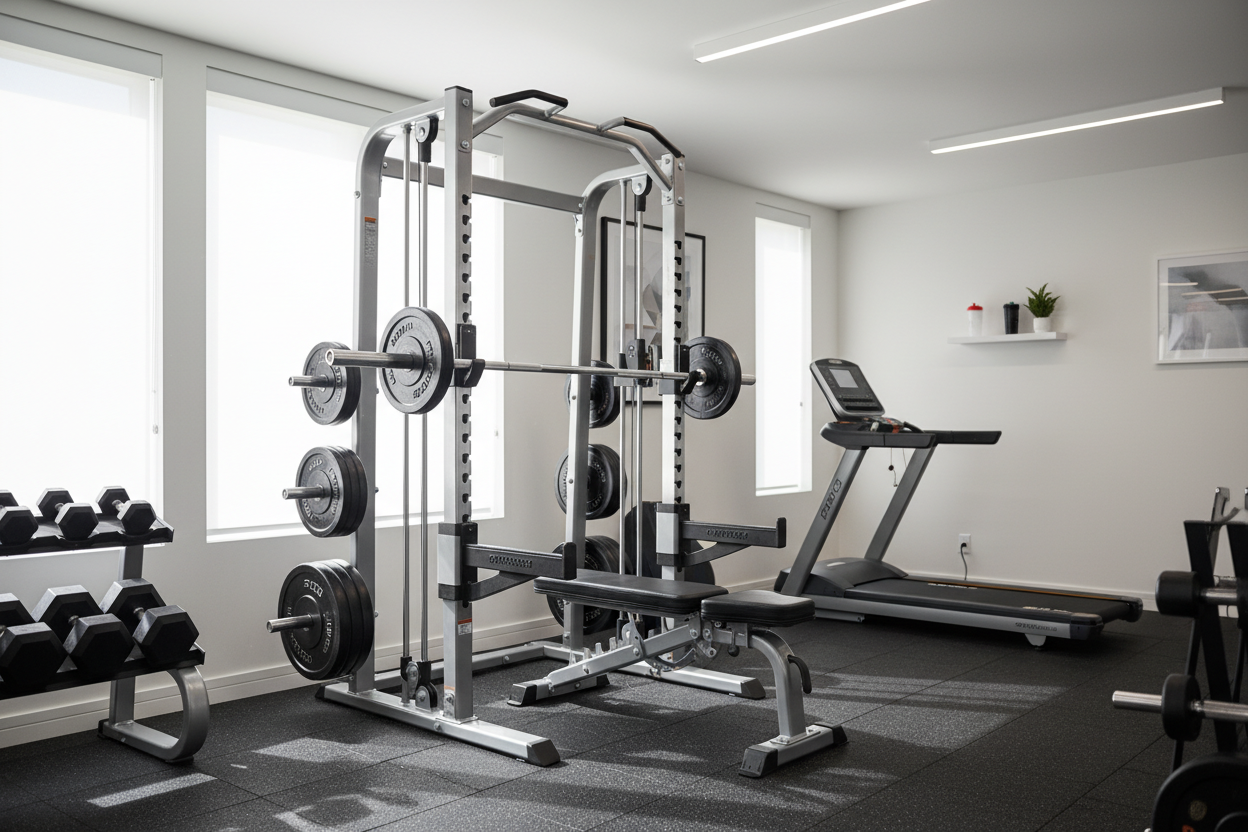
I spent a decade telling anyone who would listen that if you weren't using a free bar, you weren't really lifting. I was that guy in the corner of the gym, side-eyeing anyone using the guided racks while I ground out shaky reps on a squat stand. Then my lower back decided to stage a permanent protest every time I loaded more than three plates.
I found myself staring at a assisted barbell machine during a guest pass visit to a high-end commercial club. For the first time in my life, I didn't roll my eyes. I got under the bar, moved my feet six inches forward, and hit the deepest, most pain-free quad pump of my life. My ego took a hit, but my joints felt like they'd been on vacation.
Quick Takeaways
- Stability is handled for you, meaning 100% of your focus goes into muscle contraction.
- The counterbalance system on high-end units makes the starting weight feel weightless, which is vital for warm-ups and rehab.
- You can safely train to absolute failure without a spotter thanks to the quick-turn lockout hooks.
- It requires a significant footprint—usually about 7 feet of width and 5 feet of depth.
Confession Time: I Used to Hate Fixed-Path Racks
I was a barbell snob. I thought the only way to build 'real' strength was to fight the wobbles of a free-floating bar. I grew up on a diet of powerlifting forums that treated the Smith machine like a coat rack. I was wrong.
After years of heavy loading, the cumulative wear on my lumbar and shoulders became impossible to ignore. I wasn't getting weaker, but I was getting more beat up. I realized that my goal—hypertrophy and staying lean—didn't actually require the instability of a free bar. It required tension.
The shift happened when I realized I could push my legs to absolute failure on a hack squat-style movement without worrying about tipping over. Swallowing my pride was the best thing I ever did for my longevity. I sold my old power rack on Craigslist and made room for something that actually served my current goals.
What Actually Makes It an Assisted Barbell Machine?
When people talk about an assisted smith machine, they usually mean one of two things: linear bearings or bushings. If you buy a cheap residential unit from a big-box store, it’ll likely use bushings that feel like dragging a sled through wet sand. A real, high-quality machine uses industrial-grade linear bearings that glide on solid steel rods.
The 'assisted' part refers to the counterbalance. Most professional-grade units use a pulley and weight system hidden inside the frame. This offsets the weight of the bar—which is often beefier than a standard Olympic barbell—down to a starting weight of nearly zero. This is a massive advantage for high-rep burnout sets or working through a shoulder impingement where even 45 pounds feels like too much.
Don't confuse these with the angled racks you see in some gyms. I prefer a vertical path for most movements, but a 7-degree slant is common to mimic the natural bar path of a bench press. Either way, the goal is the same: eliminate the need for stabilizer muscles so the primary movers can do all the heavy lifting.
Saving My Lower Back With the Assisted Squat Bar
Squatting with an assisted squat bar changed my leg days from a chore into a highlight. In a traditional back squat, your center of gravity is dictated by the bar. If you have long femurs like me, you end up leaning forward, which puts a massive shear force on your lower back.
On this machine, I can walk my feet forward about 12 inches. This allows me to keep my torso completely upright, similar to a hack squat or a pendulum squat. I can sink into a deep, 'ass-to-grass' position that targets the teardrop of the quad without my lower back rounding or screaming in protest.
I’ve seen the arguments online about how this 'isn't a real squat.' Honestly, why barbell purists are dead wrong comes down to the fact that the muscle doesn't know if the bar is on a track or not. It only knows tension and mechanical disadvantage. My quads have grown more in the last six months of fixed-path training than they did in three years of traditional squatting.
How I Actually Program a Barbell Smith Machine
I don't just use this for squats. It’s the centerpiece of my entire upper body day too. I use the barbell smith machine for 'dead-stop' overhead presses and incline benching. Because the bar path is locked, I can set the safety catches just above chest level and explode upward, knowing the bar won't drift toward my face.
One of my favorite techniques is the 'rest-pause' set. I’ll pick a weight I can hit for 10 reps, go to failure, rack it for 15 seconds, and go again. You can't safely do that with a free bar unless you have a very attentive spotter. If you still want the option for traditional work, you can always keep a weight bench with barbell rack nearby for your accessory movements.
The key to programming this is to stop thinking like a powerlifter. I’m not trying to 'balance' the weight anymore. I’m trying to destroy the muscle. I use slower eccentrics—taking a full three seconds to lower the bar—and explosive concentrics. It’s a different kind of intensity that leaves me sore in the muscles, not the joints.
Does It Actually Belong in a Home Gym?
Let’s be real: these things are huge. Most stand about 80 to 84 inches tall and require a wide berth for plate loading. If you're working in a cramped one-car garage, you might feel the squeeze. You also have to consider the cost. A smooth, commercial-grade unit is going to run you significantly more than a basic squat stand.
However, if you train alone, the safety factor is worth every penny. No more 'roll of shame' when you miss a bench press rep. No more fearing for your knees on a heavy squat. For me, the trade-off was simple: I gave up the 'cool factor' of a power rack for a machine that allows me to train harder, more often, with zero pain.
I didn't buy this because I'm lazy. I bought it because I'm tired of being injured. If you're over thirty or just want to maximize muscle growth without the systemic fatigue of balancing a heavy bar, it’s time to stop listening to the purists.
FAQ
Is the bar weight different on a smith machine?
Yes. Because of the counterbalance and the friction of the bearings, the bar often feels lighter than a standard 45-lb bar. Always do a 'test lift' with an empty bar to see how much the internal weights are offsetting the load.
Can I do deadlifts on an assisted barbell machine?
You can do 'rack pulls' or Romanian deadlifts, but I wouldn't recommend traditional floor-to-hip deadlifts. The fixed vertical path doesn't allow for the slight natural curve a bar takes around your knees, which can feel awkward or even pull you out of position.
Does it take up more space than a power rack?
Width-wise, it's about the same because of the 7-foot Olympic bar. Depth-wise, it's often shallower than a full power cage but deeper than a slim wall-mount rack. The main concern is usually the height of the guide rods—check your ceiling clearance first.
Share:
How to Do Smith Machine Squats: Which Way to Face and Why
The Only Lifting Weight Equipment You Actually Need at Home