
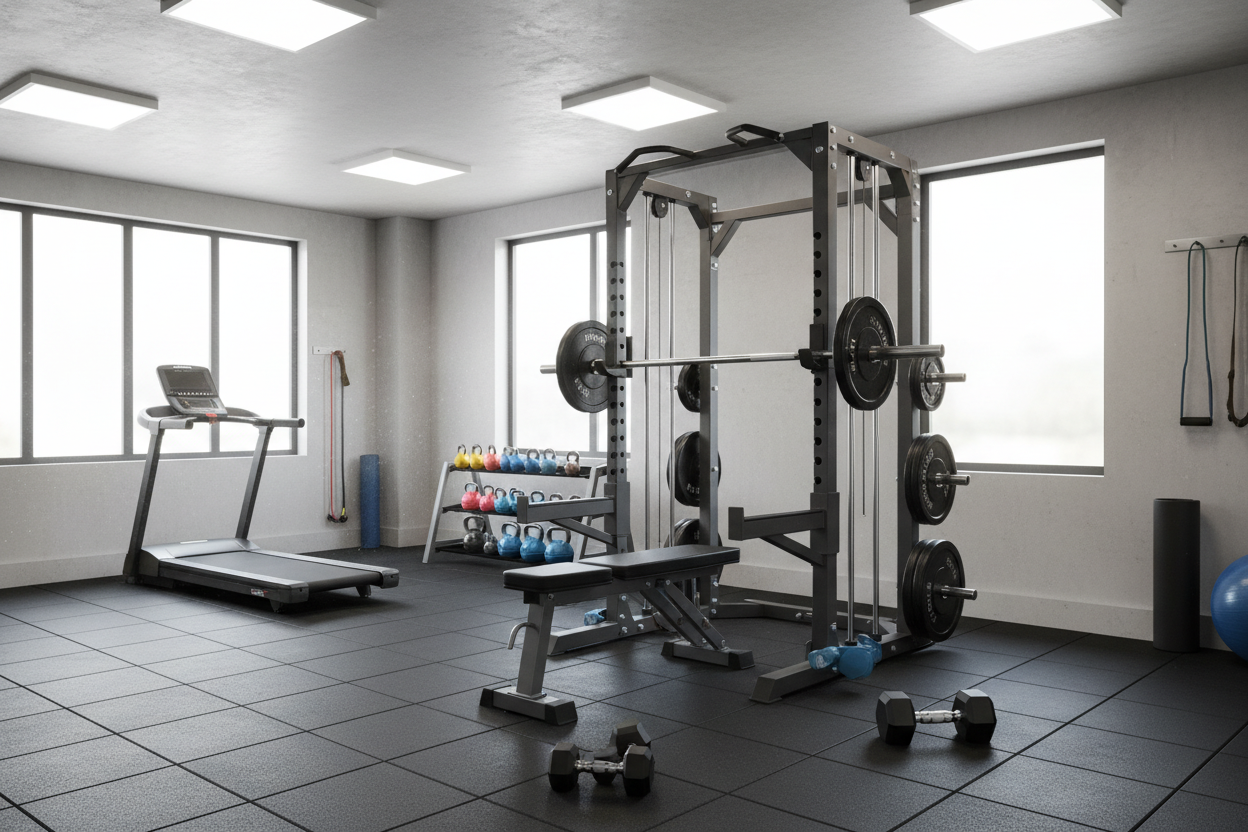
I have spent the last decade convinced that if a workout doesn't involve a rusty barbell and a squat rack that looks like it survived a war, it isn't real training. But my garage was getting crowded, and I was tired of tripping over loose 45-pound plates while trying to find my lawnmower. I decided to lock the rack and see if the best all-in-one home gym could actually hold up to heavy use or if it was just a glorified clothes hanger.
Quick Takeaways
- Cable transitions are significantly faster than stripping a barbell between sets.
- The footprint is the biggest win—you can fit a full commercial setup in about 35 square feet.
- You will miss the stabilizing challenge of free weights, but your joints will probably feel better.
- Assembly is a beast; clear an entire Saturday and keep your socket wrench handy.
The 30-Day Multi-Station Challenge
The experiment was simple: I moved my power rack to the corner, threw a tarp over my bumper plates, and committed to a single piece of equipment. I wanted to see if I could maintain my strength levels without the traditional Home Gym setup that currently takes up half my garage floor. Usually, my sessions involve dragging benches around and hunting for collars, which eats up about 15 minutes of every hour.
For 30 days, I lived on a single platform. No walking across the gym for a different attachment. No swapping out bars for deadlifts versus overhead press. I went in skeptical, thinking I would lose my mind (and my gains) without the 'raw' feel of iron. Instead, I found myself finishing high-volume workouts in 40 minutes because the equipment didn't require a scavenger hunt to use.
The biggest hurdle was mental. When you are used to the 'clank' of plates, the smooth slide of a weight stack feels almost too easy. But after the first week of hitting failure on cable chest presses, I realized the tension was more consistent than anything I’d felt with a dumbbell.
Biomechanics: How Your Big Lifts Will Change
Moving from a free-roaming barbell to a guided track is a massive shift for your central nervous system. When you squat in a rack, your core is working overtime to stop you from tipping over. On a Smith Machine Home Gym Station, that stability is provided for you. This allows you to focus entirely on the prime movers—your quads and glutes—without worrying about your path wobbling.
I found that I could actually go deeper on my squats because the fixed path removed the fear of falling forward. However, you have to be careful with your foot placement. Since the bar moves in a strictly vertical or slightly angled line, you can't shift your hips the same way you do with a free bar. I spent the first few days adjusting my stance to ensure my knees weren't taking the brunt of the load.
Pressing movements felt the most different. Bench pressing on a guided track removes the horizontal 'S-curve' that most powerlifters use. It’s a straight shot. This felt weird on my shoulders at first, but once I adjusted the bench back about two inches, I found a groove that allowed for a massive pump in the upper pecs. You aren't training for a powerlifting meet here; you're training for hypertrophy, and the guided track is exceptional for that.
Pushing the Cables to Their Absolute Limits
The heart of any high-end rig is the pulley system. I spent most of my 'back days' testing the All In One Smith Machine With Cable Crossover S1 V4 to see if the 2:1 ratio would actually provide enough resistance for heavy rows. If you're a guy who rows 300 pounds, a cheap cable system will feel like pulling air. This unit held up, though I had to get creative with my bracing during heavy lat pulldowns.
The cables are where the variety happens. I could go from a heavy low row directly into high-to-low crossovers just by moving a pin. The travel on the cables was surprisingly long—I never hit the 'top' of the stack during lunges or cable walks. The 2:1 ratio means the weight feels like half of what’s on the stack, but it results in a much smoother pull and more travel distance, which is a fair trade-off for home use.
What Separates the Best All In-One Gym from the Junk?
If you buy a cheap machine from a big-box store, you’ll regret it the second you try to do a heavy press. The difference lies in the bearings and the steel. A quality machine uses linear bearings that glide on solid chrome rods; cheap ones use plastic bushings that stutter and catch when the weight gets heavy. If the movement isn't smooth, you won't use it.
You also need to look at the gauge of the steel. A flimsy 14-gauge frame will wobble when you’re doing pull-ups or heavy dips. Look for 11-gauge or 12-gauge steel frames that weigh at least 400 pounds total. Stability is safety. Also, check the pulley material. Nylon is standard, but high-quality aluminum pulleys will last a lifetime and provide a much more 'connected' feel to the weight stack.
Don’t forget to measure your ceiling height. These rigs are often taller than they look in photos. Don't Buy the Best Home Gym All-In-One Until You Check These 3 Specs before you pull the trigger, because there is nothing worse than realizing your pull-up bar is unusable because it's touching the rafters. Check the footprint, the cable ratio, and the maximum weight capacity of the Smith bar.
The Verdict: Do I Miss My Free Weights?
After 30 days, I have a confession: I didn't hate it. In fact, I loved the efficiency. I realized that 80% of my training goals are about looking better and staying strong, not necessarily winning a weightlifting competition. The best all in-one gym provides enough versatility that I never felt limited in my exercise selection. I could hit rear delts, adductors, and triceps with a level of isolation that is simply impossible with just a barbell.
Do I miss the 'vibe' of a heavy deadlift off the floor? Yes. There is a psychological edge to free weights that a machine can't replicate. But for the average person trying to stay fit in a garage, the trade-off is worth it. I Tried The Best All In One Home Gym And Hate That I Love It because it removed all my excuses about 'not having enough time' to set up the rack.
I’m keeping the machine. I’ll still use my barbell for the occasional heavy squat day, but for the daily grind, the all-in-one rig is now my primary tool. It’s cleaner, faster, and honestly, more fun to use for accessory work.
FAQ
Is an all-in-one gym better than a power rack?
It depends on your goals. If you want to compete in powerlifting, you need a rack. If you want to maximize muscle growth and save space, the all-in-one rig is superior due to the pulley system and Smith machine versatility.
How long does it take to assemble?
Expect to spend 6 to 10 hours. These machines arrive in multiple heavy boxes with hundreds of bolts. Do yourself a favor and buy a set of real wrenches instead of using the flimsy ones included in the box.
Can I still do 'big' lifts like squats and deadlifts?
Yes, but they will be Smith-machine based or cable-based. You won't get the same stabilizer muscle activation, but you can still move significant weight and build serious strength.
Share:
Why Your Garage Doesn't Need a Universal Gym Weight Machine
Is Used Commercial Exercise Equipment Worth the Garage Space?