
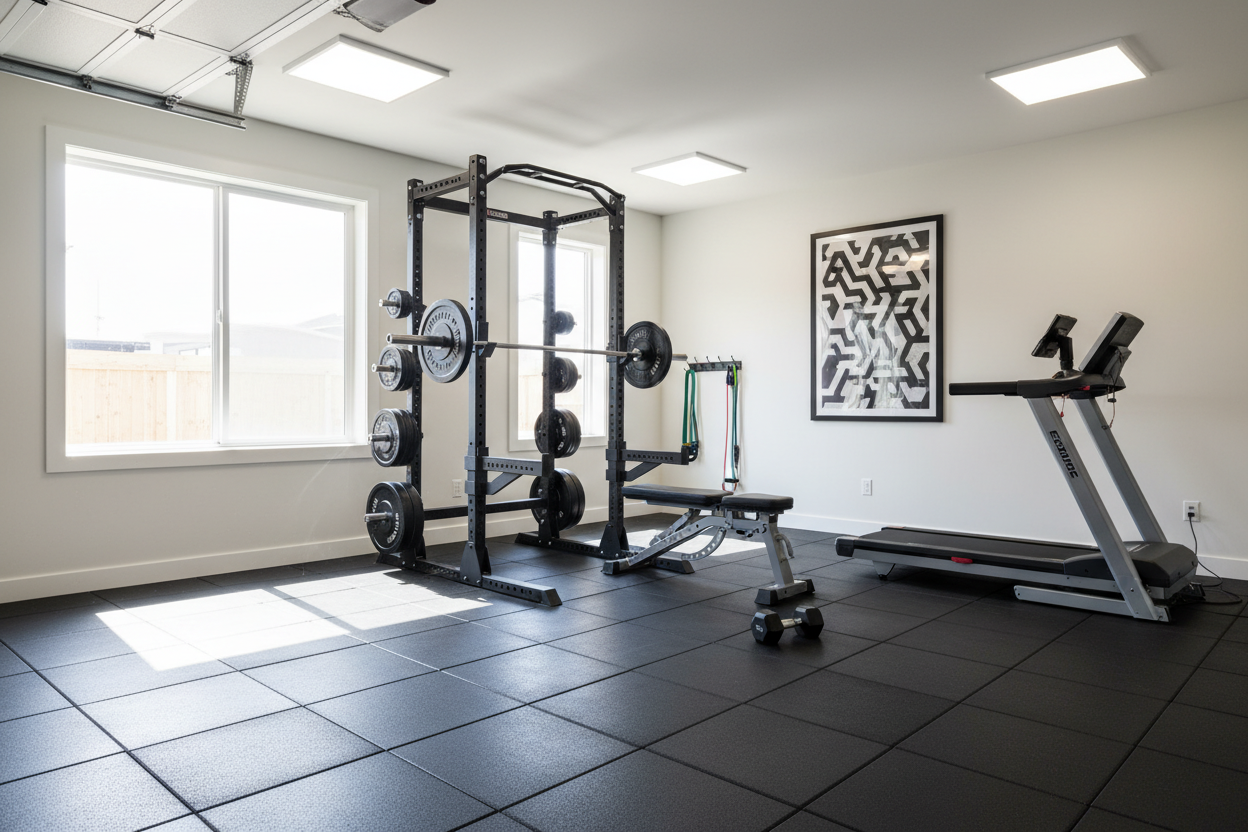
I remember staring at my credit card statement after a midnight shopping spree on a site that promised 'pro-grade' results. I had just ordered a 150-pound standalone preacher curl station that took up nearly a third of my usable floor space. At the time, I was convinced that high-end bodybuilder equipment was the missing link between my plateau and the physique I wanted, but all it really did was turn my garage into a cluttered graveyard of single-use steel.
- Isolation machines are space killers for 90% of home gym owners.
- Versatility beats specificity when your square footage is limited.
- Progressive overload doesn't care if your bench cost $200 or $2,000.
- Cables and Smith machines are the real MVPs for safe, solo hypertrophy.
The Trap of the 'Commercial Gym' Mindset
About three years into my lifting journey, I hit the wall. My delts weren't popping, and my leg growth stalled. Instead of looking at my recovery or volume, I blamed my gear. I thought I needed the exact equipment for bodybuilding found in Gold's Gym to see those same results. I started hunting for commercial-grade gear, thinking the 'pro' label would fix my programming.
My garage quickly became a maze of massive machines. I had a dedicated leg extension rig and a seated row station that weighed 400 pounds. I spent more time shimmying between equipment than actually lifting. I mistakenly thought that more machines equaled more muscle, but I was just buying overpriced paperweights that limited my range of motion and my floor space.
3 Pieces of Gear I Deeply Regret Buying
The first regret was the standalone preacher bench. It cost $450 and has exactly one job. Unless you are a competitive pro with a 2,000-square-foot facility, it is a total waste. You can get the same stimulus with a pair of dumbbells and an adjustable bench set to an incline. I also fell for the cheap leg extension/curl combos. Most of these home-grade units have terrible strength curves—meaning the weight feels heavy at the bottom and falls off at the top where you actually need the tension.
Third on the list? Any 'body build equipment' that uses 1-inch standard plates instead of 2-inch Olympics. I bought a cheap lat pulldown that used those skinny bars, and it shook like a leaf whenever I loaded more than 120 pounds. You are much better off investing in the lifting weight equipment you actually need like a heavy-duty power rack and a high-quality barbell that can handle 500+ pounds without permanent deformation.
The Core Bodybuilding Tools That Actually Build Mass
If I had to start over with a $2,000 budget, I’d spend it on three things: a set of heavy adjustable dumbbells, a commercial-grade adjustable bench, and a functional cable system. Adjustable dumbbells that go up to 80 or 90 pounds per handle are the ultimate bodybuilding tools. They allow for hundreds of variations of presses, rows, and flies without taking up a whole wall of your gym.
A bench that doesn't wobble when you're pressing 225 is non-negotiable. Look for something with a 1,000-lb capacity and minimal gap between the seat and backrest. Finally, a simple wall-mounted cable pulley gives you that constant tension for tricep pushdowns and face pulls that free weights just can't replicate. This is the foundation of building a functional home gym that actually drives hypertrophy without the clutter.
Why a Smith Machine Is Your Best Friend for Solo Hypertrophy
I used to be a free-weight purist until I realized I was leaving gains on the table because I didn't have a spotter. When you're training for muscle size, you need to push to absolute failure. Doing that on a free-weight squat is a recipe for a hospital visit. A Smith machine home gym station allows you to safely push your quads or chest to the limit because you can lock the bar with a flick of the wrist.
The fixed path of a Smith machine isn't 'cheating.' In fact, for bodybuilding, it's often superior because it removes the stability requirement. This lets you focus 100% of your mental energy on the muscle contraction rather than balancing the bar. It’s the safest way to perform hack squats or close-grip presses when you're training in a garage at 6:00 AM by yourself.
How to Program Like a Pro Without the Pro Footprint
You don't need a warehouse full of gym equipment bodybuilding units to look like you lift. A high-volume routine can be crushed using nothing but a rack and a cable system. Use your heavy compounds—squats, presses, and rows—to build the base. Then, use your cable attachments and dumbbells for the 'pump' work.
The key is progressive overload and mechanical tension, not having a different machine for every body part. I found that my physique actually improved when I sold off the junk and focused on mastering a few high-quality pieces of gear. Stop buying the marketing and start buying the iron that actually moves the needle.
FAQ
Is a Smith machine better than a power rack?
For pure hypertrophy and safety when training solo, the Smith machine is incredible. For raw strength and athletic carryover, the power rack wins. Most serious bodybuilders use both.
What is the most underrated bodybuilding tool?
A set of high-quality resistance bands. You can add them to your barbell lifts to create accommodating resistance, which keeps the muscle under tension through the entire range of motion.
How much space do I need for a home bodybuilding gym?
You can fit a world-class setup in a 10x10 foot area if you use a folding rack, adjustable dumbbells, and a wall-mounted cable station.
Share:
Stop Running: Are Weight Machines Good for Weight Loss?
Can the Best Smart Exercise Equipment Actually Replace Free Weights?