
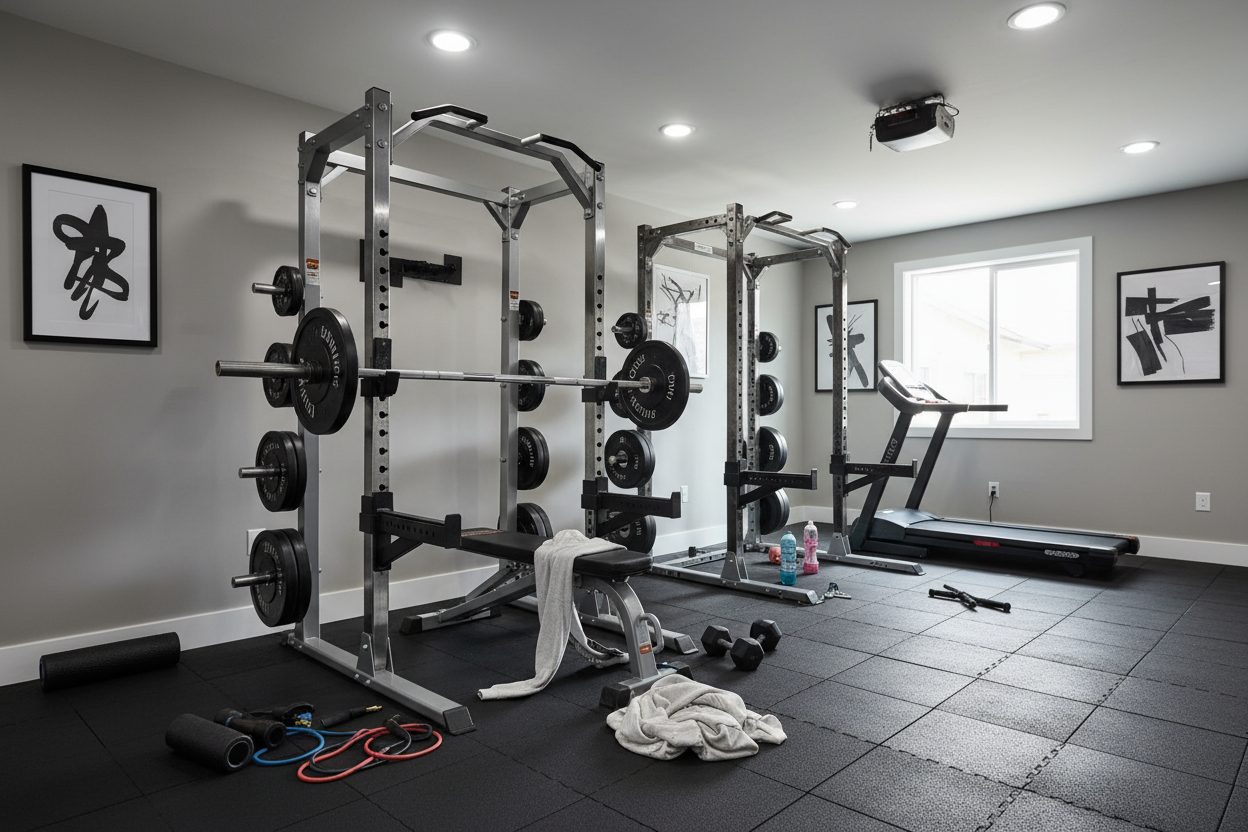
I have spent way too much time lately watching smith machine fails on social media. It usually starts the same way: a lifter loads up four plates per side, grinds through a shaky rep, and then panics when the bar won't click back into the hooks. Suddenly, they are folded like a lawn chair while the gym music keeps blaring in the background.
There is a specific kind of dread that comes with a smith machine fail. Unlike a barbell, which you can dump off your back or drop to the floor, the Smith machine locks you into a fixed vertical path. If you miss the hook, you are the only thing between that heavy steel bar and the floor. I have seen guys get pinned in ways that make me want to reach through the screen and set their safety stops for them.
Quick Takeaways
- The track is a guide, not a safety net.
- Never skip setting the manual safety stops at the bottom of the rack.
- Fatigue kills your ability to rotate the bar for a successful re-rack.
- High-quality linear bearings prevent the bar from 'stuttering' during a failed rep.
The Dangerous Illusion of Fixed-Path Safety
The biggest problem with the Smith machine is the false sense of security it provides. Because the bar is on a track, people think they can’t get hurt. They treat the machine like a magic shield that negates gravity. I have seen lifters attempt weights they would never touch on a free-weight rack because they assume they can just 'flick' the bar back into place if things go south.
This psychological trap leads to ego lifting. When you are not worried about balancing the weight, you focus entirely on moving it. But when your central nervous system redlines, that fixed track becomes a cage. If you haven't set your physical safety pins, you are relying entirely on your grip and wrist mobility to save your spine. That is a bad bet every single time.
Anatomy of the Classic Smith Machine Squat Fail
In a standard barbell squat, if you lose it, you can 'bail' by tossing the bar backward and jumping forward. In a smith machine squat fail, that option is off the table. The bar only moves up and down. If you hit a sticking point and can't drive back up, the weight forces your torso into a deep, unsupported forward lean.
Without a smart Smith machine workout routine that accounts for proper failure protocols, you end up pinned at the bottom of the 'hole.' Since the bar is fixed to the rails, it pushes you straight down into the floor. If you aren't flexible enough to survive that fold, you're looking at a serious hospital bill. The machine doesn't care about your anatomy; it only cares about the track.
The 'Wrist Flick' Trap Under Heavy Load
The most common fail point is the re-rack. To lock a Smith machine bar, you have to rotate your wrists to catch the pegs. When you are at absolute failure, your forearms are often too fried to make that rotation happen. I’ve seen lifters try to hook the bar, miss by a fraction of an inch, and have the weight come crashing back down because they couldn't complete the 'flick.' If you're using a bar with thick, cheap knurling or a sticky track, this becomes even harder.
How to Bulletproof Your Setup and Never Get Pinned
The solution is stupidly simple: use the safety stops. Every decent machine has them. These are the adjustable metal blocks or springs that sit on the rails. Before you even put a plate on the bar, get under it and find your lowest point of depth. Set the stops one inch below that point.
When you shop for home gym Smith machine stations, look for units with spring-loaded safeties. These act as shock absorbers. If you fail, you just let the bar go. It hits the springs, and you walk away with nothing but a bruised ego. I make it a rule to 'test' my stops every session. I literally drop the empty bar onto them once just to make sure they are locked in tight.
Yes, You Still Need a Spotter for 1-Rep Maxes
People laugh when they see someone spotting a Smith machine, but those people have never been pinned. A spotter on a Smith machine isn't there to balance the bar—they are there to ensure the hooks actually engage. Their job is to keep their hands near the bar and help you rotate it into the locked position if your wrists give out. If you are testing a true 1-rep max, having someone there to guide the bar into the teeth of the rack is the difference between a PR and a viral fail video.
Equipment Matters: Are Some Tracks Safer Than Others?
Not all machines are built the same. Cheap, bolt-together units often have 'catch-points' where the bar can stutter or jam if it's not perfectly level. That is a nightmare when you're struggling. Professional-grade rigs like the All In One Smith Machine With Cable Crossover S1 V4 use linear bearings and case-hardened rods. This ensures the bar slides like butter, making it way easier to rotate and lock even when you're shaking.
High-end machines also feature more 'hook' points. Cheaper models might only have a catch every 6 inches, which is a huge gap when you're sinking. Better machines have catches every 2 to 3 inches, giving you a much higher chance of bailing safely. Don't skimp on the steel that's supposed to be protecting you.
My Biggest Smith Machine Mistake
Years ago, I was doing heavy Smith machine shrugs. I figured since the range of motion was only four inches, I didn't need the stops. I reached failure, tried to hook the bar, and my sweaty palm slipped. The bar dropped, caught the edge of a peg, and flipped the entire machine forward because it wasn't bolted down. I didn't get hurt, but I felt like an idiot. Now, I don't care if I'm doing calf raises or squats—the stops stay on.
FAQ
Is the Smith machine safer than free weights?
Only if you use the safety stops. If you don't use the stops, it is actually more dangerous because you cannot 'dump' the bar away from your body if you fail.
Why do people fail so often on Smith machine squats?
Mainly because the fixed path allows for 'ego lifting'—moving more weight than your stabilizers can actually handle. When the primary muscles give out, the lifter gets trapped in a fixed position.
Can you use a Smith machine alone?
Yes, provided you have set the safety stoppers at a height that allows you to crawl out from under the bar if you can't re-rack it. Never lift to failure alone without those stops in place.
Share:
Why the Best Exercises Equipment for Weight Loss Isn't Cardio
Why Lifting on Hydraulic Exercise Equipment Feels Completely Alien