
I remember the first time I fell for the 'budget' trap. I was scrolling through Amazon at 1 AM, tired of my local commercial gym raising prices for the third time in a year, and I saw it: a shiny, multi-functional rack for under $300. It had pulleys, a pull-up bar, and promised a 1,000-lb weight capacity. When it arrived, the box was so light I thought they’d forgotten half the parts. It wasn't steel; it was basically heavy-duty tinfoil. Finding decent home gym gym equipment shouldn't feel like a gamble, but most of what you see in targeted ads is absolute garbage designed to look good in a render and fail in your garage.
- 11-gauge steel is the non-negotiable standard for safety.
- Avoid 'all-in-one' systems that weigh less than 150 lbs total.
- Static weight ratings are often marketing lies; look for dynamic stability.
- Invest in a modular foundation you can grow into over time.
The Allure of the 'All-In-One' Trap
Beginners love the idea of a home-gym system that claims to do fifty different exercises in a four-foot footprint. It sounds like a space-saving miracle. You see these massive bundles with weights, cables, and benches all connected into one spider-like contraption. Here is the mechanical reality: when a manufacturer tries to cram that much 'versatility' into a low price point, they cut corners on the pivot points and the frame thickness. Most of these machines use thin, tubular steel that flexes the moment you load more than two plates on the bar.
I have seen these frames literally warp during a standard bench press session. The pulleys are usually cheap plastic that drags against the cable, ruining the resistance curve of your lift. This is why most compact gym for home setups snap under any kind of serious load. If the machine feels like it is going to tip over when you do a pull-up, it has no business being in your house. You aren't saving money if you have to replace the entire unit in six months because the welds are cracking.
Tubing, Welds, and Weight Capacities (What Actually Matters)
If you are shopping for a full home gym, you need to learn how to read a spec sheet like a pro. Manufacturers love to brag about a '1,000-lb capacity,' but that is usually a static rating—meaning the rack can hold that weight if it never moves. The moment you drop a 300-lb barbell onto the J-cups, the force is much higher. If that rack is made of 14-gauge steel (which is thin enough to bend with a pair of pliers), you are asking for a hospital visit. You want 11-gauge steel. Period. It is thicker, heavier, and provides the 'tank-like' feel you need to lift with confidence.
Check the hardware size, too. Serious racks use 5/8-inch or 1-inch bolts. If you see tiny M10 bolts holding a rack together, run away. I have personally tested 4 cheap home weight machines from big-box retailers, and I ended up sending every single one back. One wobbled so much during squats that I had to bolt it to a plywood platform just to feel safe, and even then, the uprights were visibly bowing. A real home weight gym should feel like an extension of the floor, not a swaying kite.
A Better Approach: Building a Foundation That Lasts
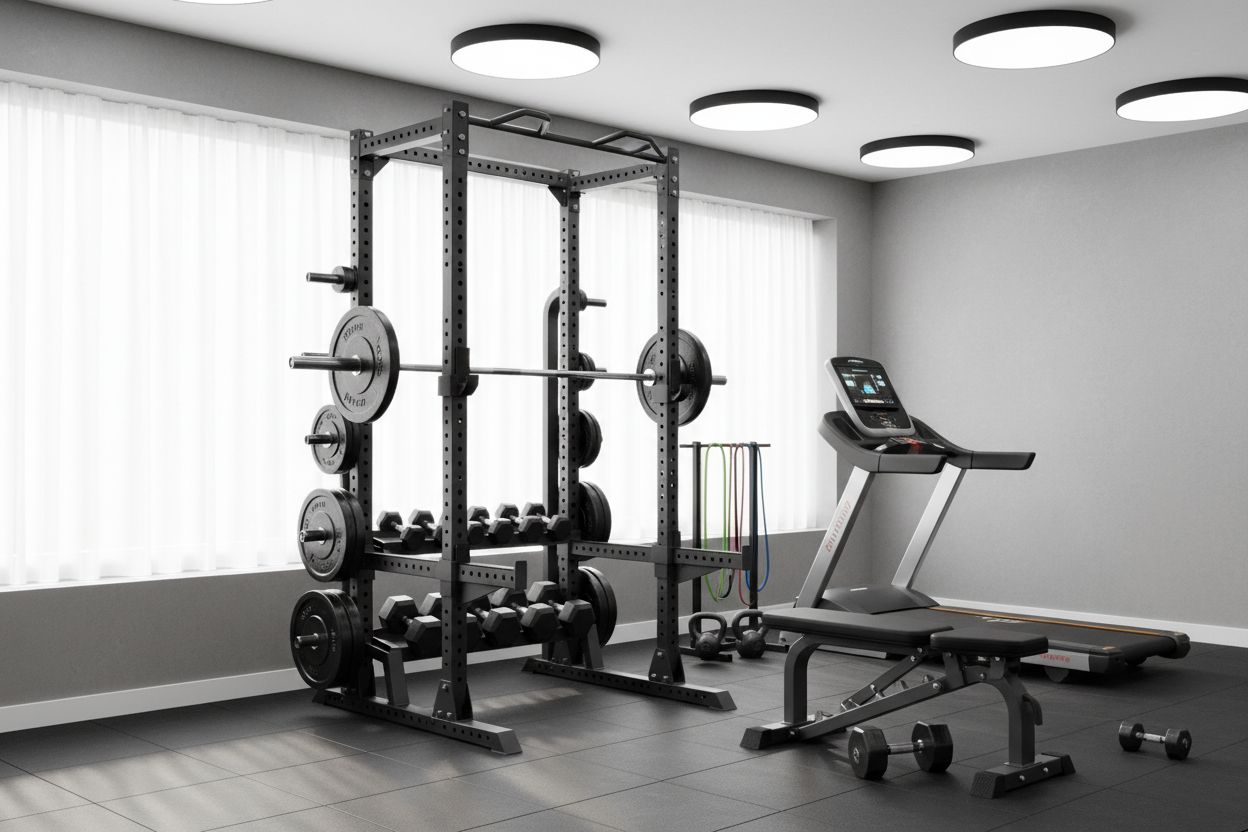
Instead of buying a flimsy multi-station, prioritize a high-quality home gym and weights setup that focuses on the 'Big Three' lifts. You don't need a leg extension attachment that feels like it’s made of plastic. You need a rock-solid place to squat, bench, and press. This usually starts with a heavy-duty power rack or a high-end weight bench with barbell rack. This setup allows you to use free weights, which provide better muscle activation and won't break because a cable snapped.
A modular setup is always superior to a closed-system machine. If you buy a quality bench and rack, you can add plate-loaded lat pulldowns or spotter arms later. You are building an ecosystem, not buying a toy. When I finally switched from a cheap 'all-in-one' to a real 3x3 steel rack, my strength exploded because I wasn't subconsciously holding back out of fear that the equipment would collapse. If you are serious about training, your home gym with weights should be able to outlive you.
Upgrading Without Wasting Money
Once you have your foundation, you can start looking at specialized pieces to round out your home weight gym. Maybe you want the safety of a fixed path for certain movements. That is where a Smith machine home gym station makes sense—but only if it is built with linear bearings and solid steel guide rods. Don't buy the cheap version with nylon bushings that get 'sticky' after three weeks of use.
The goal is to stop the cycle of buying and selling junk. It is better to have three pieces of gear you trust than ten pieces of gear that frustrate you. By focusing on 11-gauge steel, thick hardware, and reputable brands, you are building a reliable home gym that actually adds value to your life and your home. Buy once, cry once. Your joints (and your wallet) will thank you in the long run.
How can I tell if a rack is 11-gauge steel if it's not listed?
Look at the shipping weight. If a full-size power rack weighs less than 150 lbs, it is almost certainly thin 14-gauge or 16-gauge steel. A real 11-gauge rack will usually start at 200 lbs and go up from there.
Are 'renewed' or 'used' weights worth it?
Absolutely. Iron is iron. As long as the holes aren't rusted shut and the plates aren't cracked, buying used plates is the best way to save money for a better rack or barbell.
What is the first thing I should upgrade in a budget kit?
The barbell. Most 'kit' bars have terrible knurling and use bushings that don't spin. A quality 20kg Olympic bar with needle bearings will save your wrists and make every lift feel 10% smoother.
Share:
Why Your Leg Exercises Machine Workout Isn't Building Any Mass
Votre appareil de musculation détruit vos gains (Voici la solution)