
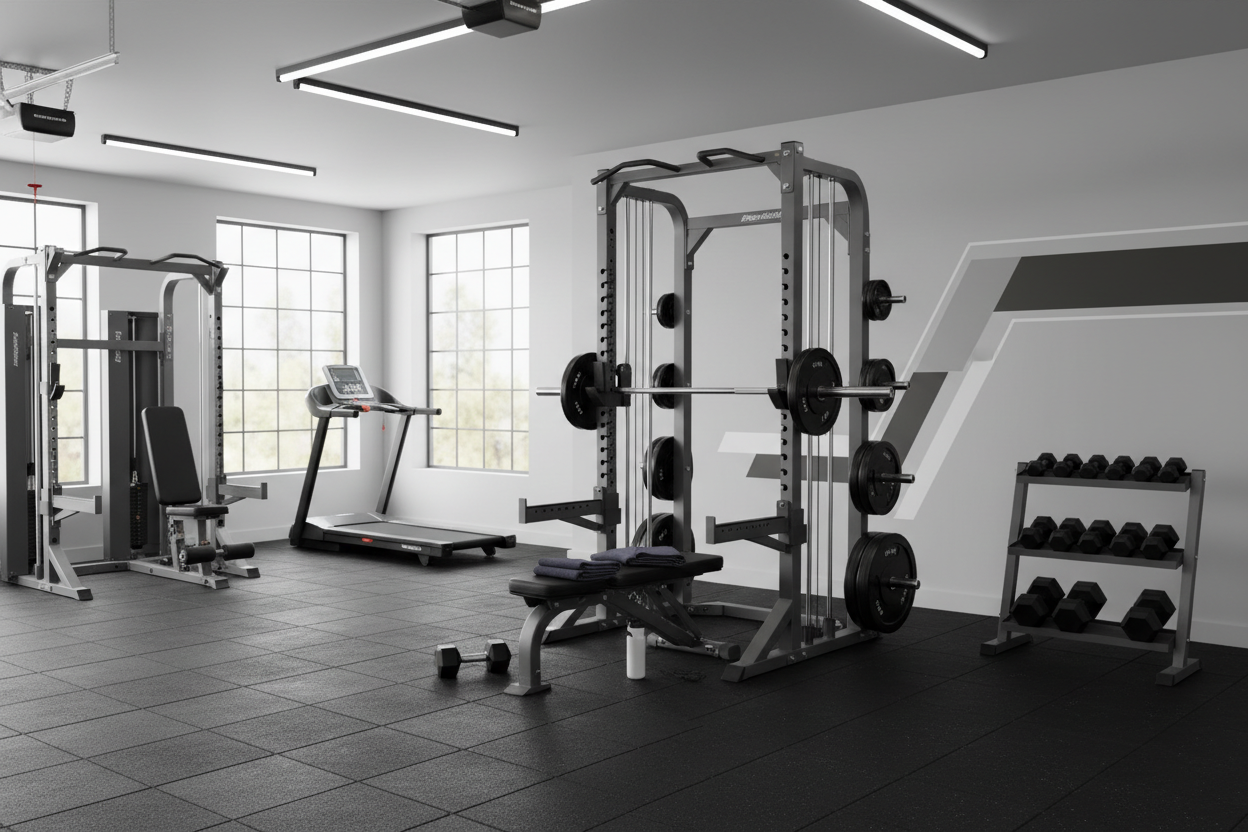
I spent years being a total free-weight snob. If it wasn't a raw barbell and a power rack, I didn't want it in my garage. But as the years go by and the joints start talking back, you realize that a body solid smith machine isn't just for commercial gyms or people who don't want to balance a bar. It is a tool for hypertrophy and safety when you are training solo and pushing to failure.
Body-Solid has a reputation for building gear that looks like it belongs in a 1990s YMCA. It is not always the prettiest, but it is built to survive a nuclear winter. I finally decided to swap out a secondary squat stand to see if their smith machine body solid builds could actually handle heavy incline presses and hack squats without that annoying stick-slip friction you find on cheap Amazon rigs.
Quick Takeaways
- Build Quality: Heavy-gauge steel that does not wobble, even when re-racking 315 lbs.
- Smoothness: The linear bearing models are night-and-day better than the bushing versions.
- Safety: The lockout points are spaced well, making it easy to bail during a heavy set.
- Assembly: Plan for a long afternoon; the manual is decent, but there are a lot of bolts.
Why I Finally Put a Body-Solid Rig in My Garage
Let's be real: the biggest hurdle for most of us is the 'ego' factor. We think a Smith machine is cheating. But after a shoulder tweak last year, I realized that having a fixed path for isolation movements allowed me to keep training heavy while taking the stabilizer stress off the joint. Body-Solid caught my eye because they do not over-engineer things. They use heavy steel and simple mechanics.
I was skeptical about the footprint. These things look massive in photos. However, the brand's reputation for home gym durability made it worth the gamble. I needed something that wouldn't feel like it was going to tip over if I racked the bar a little too aggressively. After three months of heavy use, the frame hasn't budged an inch.
Linear Bearings vs. Nylon Bushings: The Glide Test
If you take nothing else away from this, remember this: do not cheap out on the bearings. A lower-end body-solid smith machine might use nylon bushings. They are okay for light weights, but once you stack three plates on each side, they start to grab. It feels jerky, like you are fighting the machine instead of the weight.
The higher-end models use true linear bearings. These are metal balls encased in a sleeve that roll along the guide rods. When I tested the glide under a 400-lb load, the difference was immediate. It felt consistent from the bottom of the rep to the top. If you want that 'commercial gym' feel where the bar practically disappears, you have to go with the linear bearing system.
The Powerline vs. Series 7 Debate
Choosing between the body-solid powerline smith machine and the Series 7 is the most common crossroads for buyers. The Powerline is the budget-friendly sibling. It is vertical, compact, and uses a simpler carriage. It is great for small spaces, but it feels a bit more 'home-grade' than the heavy-duty stuff.
The Series 7 is a different animal. It features a 7-degree slanted pitch. This mimics the natural path of your body during a bench press or squat. It feels much more natural for your biomechanics. The Series 7 also has a higher weight capacity and usually comes with integrated storage pegs. If you have the extra few hundred bucks and the ceiling height, the Series 7 is the superior pick for a serious lifter.
The Elephant in the Room: The Starting Weight
One thing that drives me nuts is people assuming the bar on a Smith machine weighs 45 lbs. It doesn't. Because of the carriage assembly, the guide rods, and the bearings, the starting resistance is often lighter or heavier than a standard Olympic bar. On many of these rigs, the bar might only feel like 25 lbs because of the way it is counterbalanced or guided.
Don't guess your numbers. I spent a morning with a scale and a set of straps to get the truth. You can find the data in my guide on The Exact Body-Solid Smith Machine Bar Weight (I Measured It). Knowing your true starting weight is the only way to track progressive overload accurately without lying to yourself on your training log.
Footprint Reality Check: Do You Have the Room?
A smith machine body solid setup requires more than just the dimensions listed on the box. You have to account for the bar width. Most of these bars are 84 inches wide. If you are tucked into a corner, you need at least 12 to 18 inches of clearance on each side just to slide the plates on without hitting a wall.
I recommend mapping out a 7x7 foot area on your floor with painter's tape before buying. You also need to consider where your bench will sit. If you are doing seated overhead presses, you need depth. When you are measuring your floor space for various types of Smith Machine setups, don't forget the vertical clearance. Some of these units stand over 80 inches tall, which can get dicey if you have a low basement ceiling or a garage door opener in the way.
Should You Buy One, or Upgrade to a Functional Trainer?
If you just want to squat and press, a standalone Smith is great. But many lifters eventually realize they also want cables for face pulls, crossovers, and lat pulldowns. Body-Solid makes great standalone units, but if you are tight on space, you might regret not getting a hybrid machine.
I often tell people that if they have the budget, they should look at an All In One Smith Machine With Cable Crossover S1 V4. It combines the Smith track with a dual cable system. You lose a bit of that 'pure' Smith machine stability, but you gain about 50 different exercises in the same 4x6 footprint. For a garage gym, versatility is usually king.
Personal Experience: My 'Oh No' Moment
I’ll be honest: I messed up the assembly on my first try. I tightened all the bolts on the frame before I had the guide rods aligned. When I tried to slide the bar, it bound up halfway. I had to go back and loosen every single frame bolt, slide the carriage up and down to let the rods find their natural 'center,' and then re-tighten. It took an extra hour. Do yourself a favor and leave the frame bolts finger-tight until the guide rods and carriage are perfectly seated.
FAQ
Do Body-Solid Smith machines require maintenance?
Yes. You should wipe down the guide rods every few months with a lint-free cloth and apply a thin layer of silicone-based lubricant. Avoid WD-40; it attracts dust and will eventually gum up your bearings.
Can I use my own Olympic bar with these?
No. The bar is integrated into the carriage and guide rod system. You cannot swap it out for a standard barbell, which is why the quality of the integrated bar and its knurling matters so much.
Is the 7-degree slant better than a vertical track?
For most people, yes. A vertical track is fine for shrugs or calf raises, but for pressing and squatting, the 7-degree angle more closely follows your natural bar path, which is easier on the shoulders and knees.
Share:
Is a Used Impex Smith Machine Actually Worth Your Money?
I Put the Sunhome Smith Machine Through a Month of Hell