
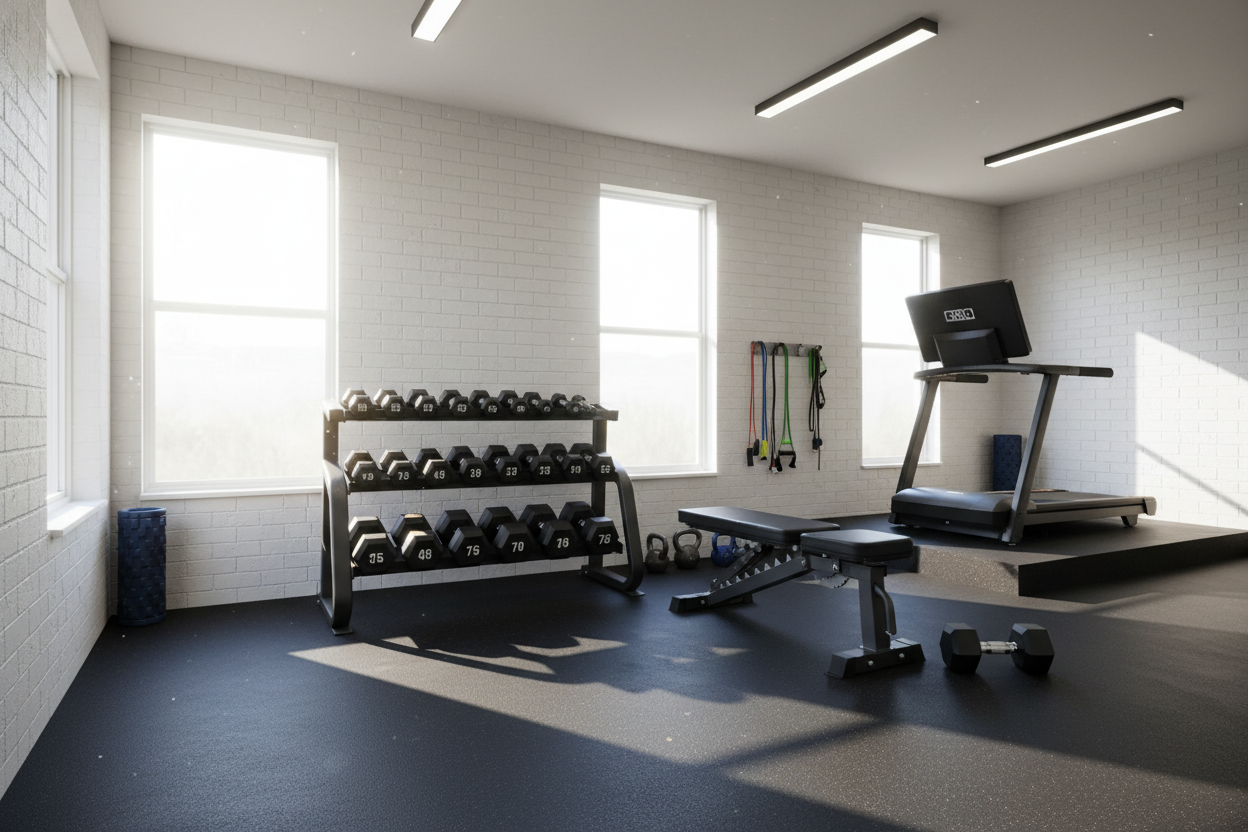
I remember standing in my driveway with a tape measure, trying to figure out how a 5-to-100-pound run of iron would fit next to my power rack. It’s a seductive dream. We’ve all spent late nights scrolling through marketplace listings, imagining that perfectly lined-up row of chrome and rubber. But after testing and tossing more gear than I care to admit, I’ve realized that buying a massive dumbbell set for gym use is often the fastest way to kill your floor space.
The reality of training in a garage or spare room is that every square foot is a premium. You don’t have a 5,000-square-foot commercial floor to play with. You have a corner, maybe half a stall mat, and a budget that shouldn’t be set on fire for weights you’ll only use once a month for lateral raises.
- A full 5-100lb set requires at least 8 to 12 feet of horizontal wall space.
- The 25-75lb range is where 90% of your actual progress happens.
- Round dumbbells are a nightmare for renegade rows and floor presses.
- Heavy-duty racks often have a footprint that prevents you from even parking a car or opening a door properly.
The Illusion of the Commercial Layout
We all want that professional look. There is something mentally satisfying about walking up to a tiered rack and grabbing exactly what you need. But when you start shopping for a reliable dumbbells gym set, you have to look at the footprint first. A standard three-tier rack can easily eat up 60 inches of length and 24 inches of depth.
I’ve seen guys realize too late why massive racks waste space when they can't perform a simple overhead press because the rack is in the way. Unless you are training 3-4 people at the same time, you don't need every weight increments of five. You need the weights you actually lift.
Why a Dumbbell Set 25-75 Usually Hits the Sweet Spot
If you’re an intermediate lifter, the 25 to 75-pound range is your bread and butter. Think about your programming. Your heavy presses, rows, and split squats almost always land in this bracket. A dumbbell set 25-75 gives you the progressive overload jumps you need without the 'fluff' weights that just collect dust.
By skipping the 80s, 90s, and 100s, you save hundreds of dollars and several feet of rack space. If you eventually outgrow the 75s, you can buy a single pair of 85s and keep them on the floor. Don't pay for the storage of weight you haven't earned the right to lift yet.
Handling the Lighter Weights (5s to 20s)
Warm-ups and rehab work are essential, but dedicating prime rack real estate to 10-pound iron chunks is a mistake. I personally use a reliable pair of adjustable dumbbells for anything under 25 pounds. They take up the space of one pair of shoes and handle all my lateral raises and face pulls perfectly.
The Trap of the Round Dumbbell Set With Rack
Round dumbbells look incredible. They’re the gold standard in big-box gyms because they’re easy to clean and look 'pro.' But in a home gym, a round dumbbell set with rack is often a liability. If your floor has even a slight slope—which most garages do—those things are going for a ride the second you set them down between sets.
I much prefer a rubber hex dumbbell set for home use. The flat edges mean they stay exactly where you put them. More importantly, if you do any 'man-makers' or renegade rows, you won't snap your wrist when a round head decides to roll outward. Plus, hex weights are generally cheaper per pound.
How to Actually Plan Your Floor Space
Before you hit 'buy,' take some blue painter's tape and mark out the dimensions of the rack on your floor. Leave at least 3 feet of clearance in front of the rack so you can actually pull the weights off without hitting your bench. If you're tight on width, look at A-frame racks; they grow vertically rather than horizontally, though they usually top out at about 50-lb pairs.
Personal Experience: My Rack Regret
Early on, I bought a massive 10-pair pro-style rack. It was beautiful. It also meant I had to move my squat rack so close to the wall that I couldn't load plates on the left side without doing a weird shimmy. I eventually sold the big rack and went back to a compact 2-tier setup. My advice? Start small. You can always add more weight, but you can't easily add more floor space.
FAQ
Do I need rubber-coated dumbbells?
Yes. Raw iron or chrome is fine for a climate-controlled basement, but in a garage, they will rust. Rubber coating also keeps the noise down so you don't wake up the whole house during a 6 AM session.
Is a 2-tier or 3-tier rack better?
Go with a 3-tier rack if you have the height. It keeps the footprint narrow while holding more weight. Just make sure the bottom tier has enough clearance for your fingers when you're grabbing the heavy 70+ lb bells.
Should I buy a full set or individual pairs?
Buying the full set usually saves you 10-15% on the price per pound and often includes a 'free' rack. If you know you'll use the 25-75 range, buy the set. If you only need a few specific weights, buy them individually and save the cash.
Share:
Is There Actually a Single Best Exercise Machine for Home?
Stop Buying Specialty Steel: You Just Need a Multi Purpose Bar