
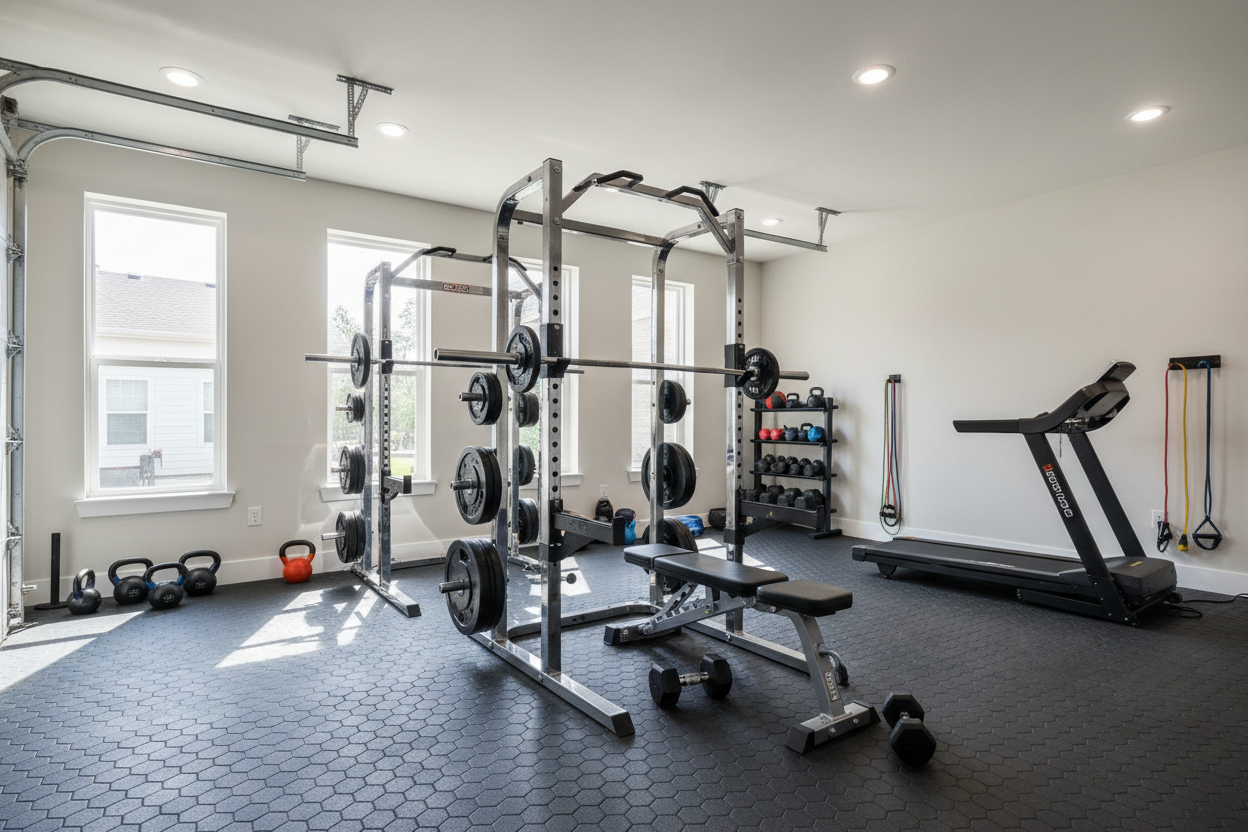
I remember the first time I watched Jeff Cavaliere's video on why machines are 'killing your gains.' I was sitting in my garage, looking at my brand-new rack, wondering if I had just wasted a grand on a glorified towel rack. The athlean-x smith machine warning is legendary in the fitness community for a reason—Jeff is a physical therapist who sees the wreckage of bad lifting habits every day, and his logic is hard to ignore when your shoulders start clicking.
- Jeff's main gripe is the fixed bar path forcing your joints into unnatural, rigid positions.
- He is spot-on regarding the risks of traditional squats and upright rows on a vertical track.
- Stability is actually a massive benefit for hypertrophy if you know how to align your joints.
- Modern 7-degree angled tracks solve many of the biomechanical traps mentioned in his videos.
The Famous Warning: Why Does Athlean-X Hate Fixed Tracks?
Jeff Cavaliere's core argument against the Smith machine boils down to one word: 'non-negotiable.' In his view, your body has a natural path it wants to follow during a press or a squat. When you use a barbell, the bar moves in a slight J-curve or a subtle arc. When you lock yourself into a machine, you are forced to move in a perfectly straight line.
If your body wants to move in a curve but the machine forces a line, your joints become the shock absorbers. This is especially true for the shoulders. During a bench press, your elbows and shoulders need to find their own path to stay safe. On a fixed track, if your setup is off by even an inch, you are grinding your rotator cuff against a rigid steel rail. Jeff argues that this lack of 'freedom of movement' is a recipe for chronic inflammation and eventual injury.
It is not just about the path, though. It is about the 'missing' stabilizers. Because the machine balances the weight for you, your smaller stabilizing muscles take the day off. Over time, this creates a massive strength imbalance between your prime movers (like your chest) and your stabilizers. When you eventually go back to free weights, you might have the strength to lift the weight, but not the stability to control it.
Where the Physical Therapist is 100% Right
I have tested dozens of racks, and I can tell you from experience: squatting on a vertical Smith machine feels like garbage. Jeff is absolutely right here. In a free-weight squat, your hips move back and your torso leans forward to keep the center of gravity over your mid-foot. On a vertical track, you cannot do that. You either have to lean your back against the bar—shifting all the shear force to your spine—or push your knees way past your toes, which is a nightmare for your patellar tendons.
Then there is the upright row. This is arguably the most dangerous exercise you can do on a fixed track. To pull a bar straight up your torso without any horizontal play forces the shoulder into extreme internal rotation. It is the exact position physical therapists use to test for impingement. Doing it with 100 pounds of resistance is just asking for a surgery date.
Jeff also correctly points out the 'false sense of security.' Because you have a self-spotting mechanism, people tend to load the bar with weight they have no business lifting. I have seen guys with 405 lbs on a Smith machine whose joints are screaming, but they keep going because the machine makes it feel 'easier.' That ego-lifting is exactly what leads to the injuries Jeff warns about in his videos.
The Hypertrophy Loophole: Where the Warning Falls Short
Here is where I disagree with the 'machines are evil' dogma. For pure muscle growth, stability is king. When you don't have to balance the weight, your brain allows your nervous system to fire your prime movers much harder. If you're following The Complete Smith Machine Workout Guide Best Exercises Routines Programs, you know that by adjusting your foot position, you can actually isolate the quads or chest better than a free-weight equivalent ever could.
The trick is understanding that the machine isn't a barbell replacement; it is a different tool entirely. By moving your feet forward on a Smith squat, you turn it into a hack squat variation. This removes the lower back from the equation and hammers the quads. Jeff's warning assumes you are trying to mimic a barbell squat perfectly, but if you treat it as a specialized isolation tool, the 'fixed path' becomes an advantage for keeping tension on the target muscle.
I have found that for high-rep hypertrophy work, the Smith machine is actually safer for my joints than free weights—provided the setup is perfect. When I am fatigued at the end of a workout, I don't want to worry about a 225-lb barbell crushing my windpipe. I want to push to failure with zero stability requirements. That is where the 'Athlean-X' logic misses the mark for bodybuilders.
How to Hack Your Setup for Joint-Friendly Lifts
The secret to ignoring the Athlean-X warning without ending up in physical therapy is the '7-degree slant.' Most high-end home units aren't perfectly vertical. This slight angle mimics the natural bar path of a press or a squat. If you set up your Smith Machine Home Gym Station correctly, you can align the track with your joint's natural arc rather than fighting against it.
Don't just center your bench and hope for the best. Lie down on the bench, perform a few reps with an empty bar, and see where your elbows want to go. If the bar is pulling your shoulders out of position, move the bench. You have to move your body to match the machine, not the other way around. For squats, always keep your feet at least 6 to 10 inches in front of the bar. This allows your hips to hinge naturally without crushing your knees.
Another pro tip: never use a 'suicide grip' on a Smith machine. Even though it feels stable, the bar can still rotate and unhook. Use a full grip and keep your wrists stacked. I also recommend using the machine primarily for 'assisted' movements—think Bulgarian split squats or incline presses—where the stability allows you to focus entirely on the mind-muscle connection rather than survival.
Does a Guided Rack Actually Belong in Your Garage?
The 'fixed track' argument is getting a bit dusty because of modern engineering. We aren't just buying 1980s commercial units with rusty bearings anymore. A modern Full Body Multi Training Station Smith Machine Dm01 gives you the fixed track for heavy isolation but adds dual cable pulleys for the free-moving, functional movements Jeff Cavaliere loves. It solves the rigid-path problem by offering variety.
I used to be a total free-weight snob. I thought machines were for people who didn't want to work hard. Then I hit 35 and realized that my joints don't recover like they used to. I once tried to max out on a Smith machine bench press without checking my bench alignment. I felt a sharp pop in my left pec because the fixed track forced me into a weird internal rotation. It took me six months of rehab to get back to normal. That wasn't the machine's fault; it was my lazy setup.
If you have limited space and want to train for hypertrophy (muscle size), a Smith machine is a powerhouse. It allows you to train to absolute failure safely. Just don't treat it like a barbell. Respect the biomechanics, adjust your body to the track, and ignore the 'functional' purists who say you're wasting your time. Your joints will tell you if you're doing it right.
Is the Smith machine bad for your knees?
Only if you keep your feet directly under the bar like a traditional squat. If you step your feet forward about 6-12 inches, you actually reduce the shear force on the knees and turn it into a quad-dominant movement that is very easy on the joints.
Can I build as much muscle as I would with a barbell?
For hypertrophy, yes. Some studies suggest that because you don't have to stabilize the weight, you can actually recruit more motor units in the target muscle. It isn't 'cheating'; it is just more efficient isolation.
Is Jeff Cavaliere wrong?
He isn't wrong; he's cautious. As a physical therapist, his job is to minimize risk. If you are a beginner with zero body awareness, the Smith machine can be dangerous. If you are an experienced lifter who knows how to setup your bench and feet, the risk is minimal.
Share:
Most Beginner Gym Equipment Is Overpriced Junk (Buy This Instead)
Why the Best Dumbbell Set Is Probably Only 3 Pairs