
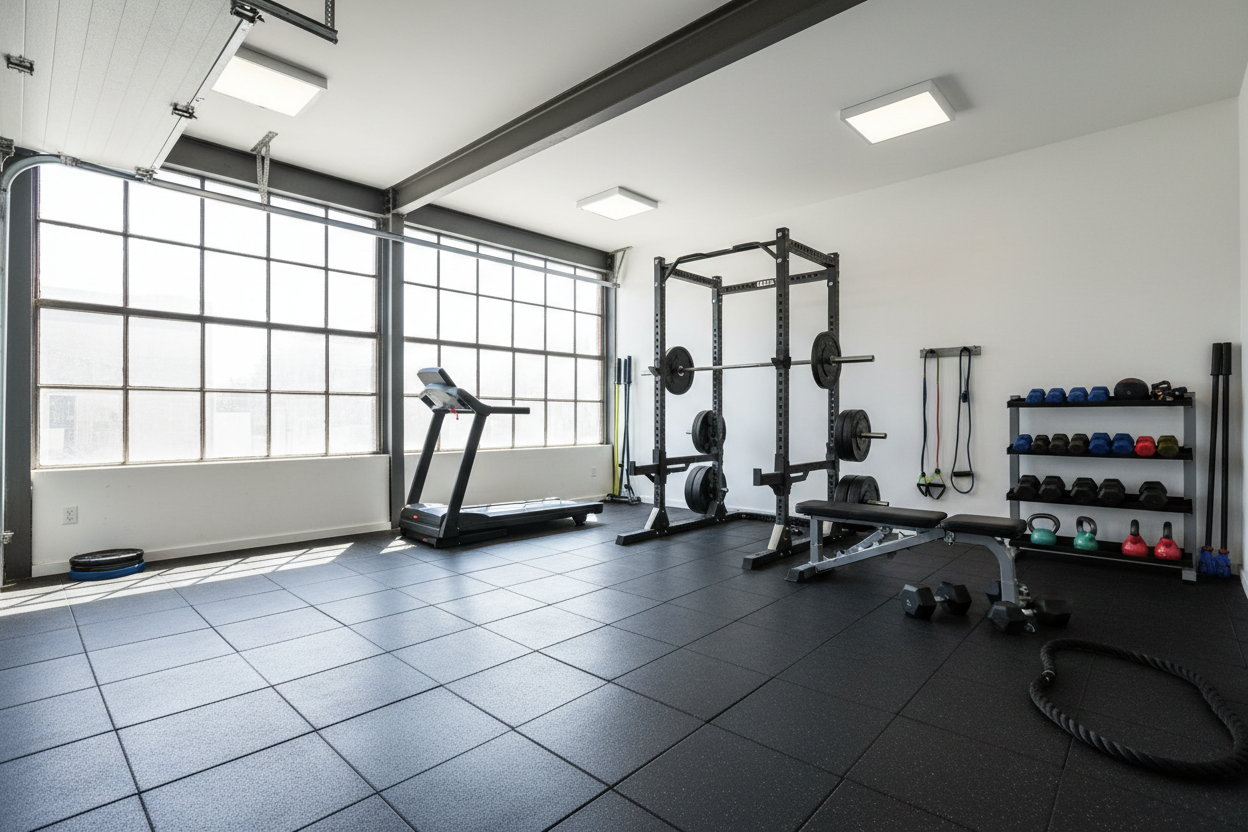
I remember the night I finally quit my big-box gym. I was tired of the commute and the guy scrolling on his phone while sitting on the only power rack. I went home, cleared out a corner of the garage, and started doing air squats and mountain climbers. Two weeks later, I was bored, soft, and nowhere near my goals. That’s when I realized most home workouts that work don't look like a HIIT class on YouTube.
- Sweat is not a metric for muscle growth.
- Mechanical tension requires external resistance (iron).
- Stability allows you to push harder than balancing on a ball.
- A structured plan beats a random 'WOD' every single time.
The 'Sweat Equals Progress' Lie
We’ve been conditioned to think that if we aren't gasping for air in a puddle of our own making, it wasn't a good workout at home. That’s a lie. If your goal is to build a physique that actually looks like you lift, panting through 50 burpees isn't the primary driver. Muscle grows through mechanical tension—essentially, putting a muscle under a heavy load through a full range of motion.
High-rep bodyweight circuits are basically just cardio disguised as strength training. You might get better at moving your own body weight, but you won't see the hypertrophy that comes from high-tension sets. To get a great home workout, you need to stop chasing the 'burn' and start chasing the weight. If you can do 30 reps of an exercise, it’s a conditioning tool, not a strength builder.
The 3 Rules of a Great Home Workout
The best in home workouts aren't accidents. They follow the same physiological laws as the ones performed in a $50,000-a-year pro facility. First, you need progressive overload. If you did 10 reps at 135 lbs last week, you need 11 reps or 140 lbs this week. Without a way to increase difficulty, your progress will flatline faster than a cheap treadmill.
Second, you need stability. You cannot produce maximum force if you are wobbling. This is why workouts at home gym setups often fail when people try to do everything on one leg or on a foam pad. Third, your daily at home workouts need a specific intent. Are you training for strength, size, or just to move? If you don't have a map, you’re just driving in circles in your driveway.
You Have to Add Iron Eventually
Bodyweight squats are great for the first three weeks. By month two, they are a warm-up. To maintain the best home exercise routine, you eventually have to add external resistance. Whether it’s a set of adjustable dumbbells or a full Olympic barbell set, your central nervous system needs a reason to adapt. Gravity alone isn't enough once you've mastered the basic mechanics of your own frame.
Ditch the Unstable Gimmicks
Stop buying gear that looks like it belongs in a circus. Balancing on a BOSU ball while doing bicep curls doesn't make it a 'core workout'—it just makes it a bad bicep workout. A great workout at home happens when you have a solid floor and heavy-duty gear that allows you to focus 100% of your effort on the muscle group you're targeting, not on trying not to fall over.
Gear That Actually Supports Heavy Lifting
If you're serious about moving away from 'fitness-lite' and into actual training, you have to invest in a real Home Gym. This doesn't mean you need a 3,000-square-foot warehouse. It means you need a rack that won't tip over when you rack a heavy squat and a bench that doesn't feel like a wet noodle. I’ve seen guys try to build a good at home exercise routine using plastic-coated weights and folding chairs. It’s dangerous and it limits your ceiling.
Look for 11-gauge steel and at least a 2x3 frame for your power rack. You want something with a weight capacity that exceeds your goals by at least 200 lbs. If you're short on space, a folding wall-mount rack is a lifesaver. Pair that with a solid barbell and a few hundred pounds of iron, and you have everything you need for the best home workout possible. No monthly fees, no waiting for the squat rack, and no 'no-chalk' policies.
A Sample Iron-Based Routine for Serious Lifters
For those looking for the best home workouts, I always recommend a Push/Pull/Legs split. It’s simple, effective, and fits perfectly into a garage gym setting. On your Push day, focus on heavy overhead presses and bench variations. To really round out your triceps and chest, adding a Seated Dip Machine Upper Body Workouts Dm01 is a massive upgrade over basic floor dips. It provides the stability you need to actually reach failure without your shoulders screaming for mercy.
Pull days should center around rows and pull-ups. If you have a rack, use it for rack pulls to build that thick back. For legs, nothing beats the back squat, but don't sleep on Bulgarian split squats if you're limited on plates. This is how you create good fitness routines at home—by picking movements that allow for heavy loading and clear progression. At home workout ideas don't have to be 'creative' to be effective; they just have to be hard.
Stop Searching for the Perfect Program
The biggest hurdle to a good home workout isn't the gear; it's the 'analysis paralysis' of looking for the perfect routine. People spend more time looking for the top workout at home on Pinterest than they do actually lifting. The truth is, the best way to workout from home is to pick a proven template and stick to it for six months. Effort and consistency will always beat a 'perfect' program executed with 50% intensity.
Don't wait until your garage looks like a commercial facility to start. Start with what you have, but keep the goal of adding real resistance in mind. As I've said before, The 'Best At Home Gym' Doesn't Exist (But This Comes Close) because the best gym is the one you actually use every morning before the rest of the world wakes up.
Personal Experience: The Wobbly Rack Lesson
I once bought a 'budget' power rack off a clearance site because I thought a 1-inch frame would be fine for my 250-lb squats. The first time I re-racked a heavy set, the whole thing shifted six inches and nearly tipped. I learned the hard way that when it comes to fitness training at home, you buy once and cry once. I sold that tin-can rack for forty bucks on Craigslist and bought a real 3x3 steel beast. My lifts went up immediately because I wasn't scared for my life every time I approached the bar.
FAQ
What are good at home workouts for beginners?
Start with the basics: push-ups, goblet squats with a single kettlebell or dumbbell, and pull-ups. Focus on form first, then start adding weight as soon as you can do 12 clean reps.
What is the best workout at home for fat loss?
Strength training combined with a slight caloric deficit. Building muscle increases your basal metabolic rate, meaning you burn more calories just sitting on the couch watching Netflix.
How often should I do daily at home workouts?
You don't need to train every day. 3 to 5 sessions per week is the sweet spot for most people. Recovery is where the actual muscle growth happens, so don't skip your rest days.
Share:
Is Working Out With Machines Only Actually a Bad Idea?
Does It Really Matter Which Barbell for Weights You Buy?