
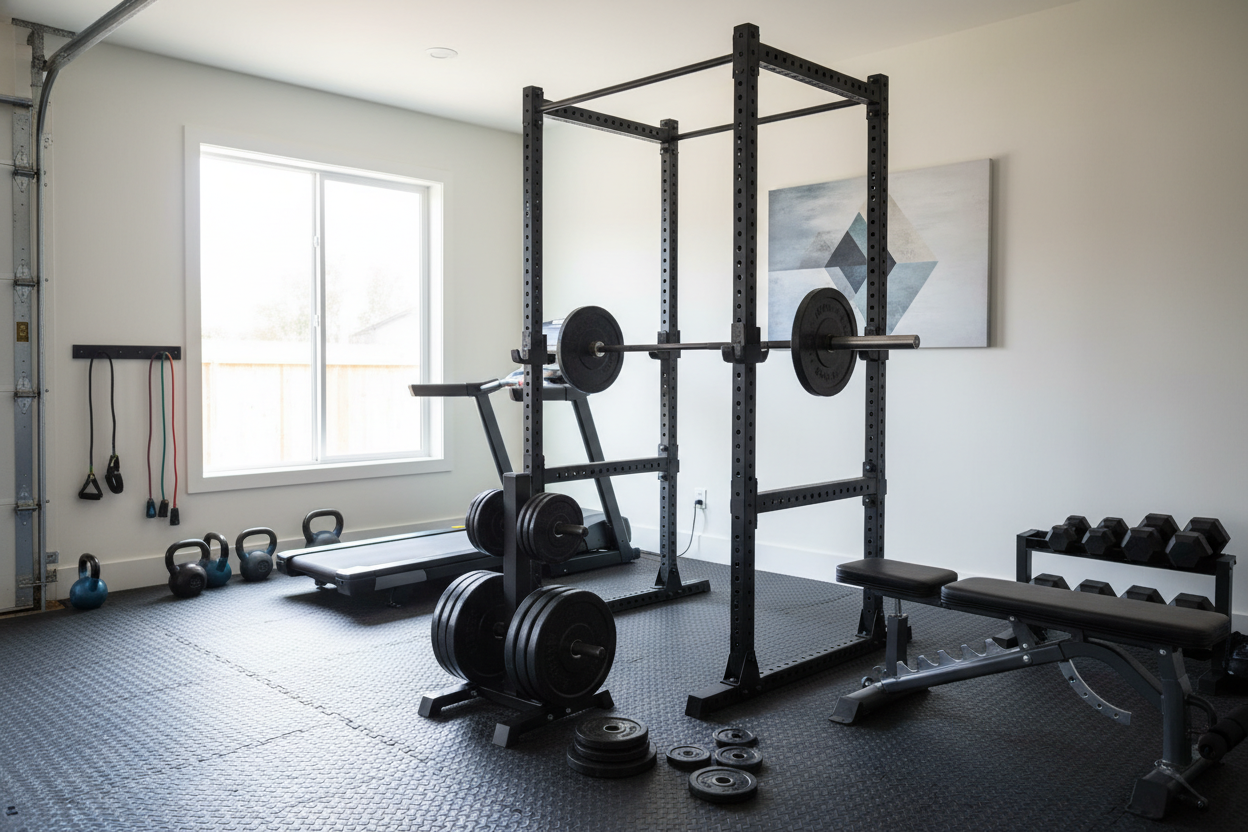
We have all been there. You walk into a commercial gym, phone in hand, looking at a PDF program that tells you to find a 'Lat Pulldown.' You look around and see five different towers with handles and cables. You end up sitting at a row machine, feeling like an idiot because you didn't know the proper exercise equipment and names. It is a rite of passage, but it is also a waste of your time.
Understanding fitness gym equipment names is not just about sounding like a pro at the water fountain. It is about safety and efficiency. If you are trying to buy gear for a garage setup, knowing the difference between a 'Power Rack' and a 'Half Rack' can save you $500 and a lot of floor space. I have spent a decade building gyms, and I still see people buying the wrong stuff because they confused a 'Smith Machine' with a 'Squat Rack.'
Quick Takeaways
- Barbells vs. Dumbbells: Barbells are for heavy, compound movements; dumbbells allow for a greater range of motion and unilateral work.
- Cables: These provide constant tension, unlike free weights where gravity makes the 'easy' part of the lift too easy.
- Selectorized vs. Plate-Loaded: Selectorized uses a pin; plate-loaded requires you to manually add iron.
- Safety First: Knowing the name of a machine usually helps you find the safety pins or adjustment levers faster.
Stop Pointing at Machines and Calling Them 'Thingamajigs'
Calling a piece of gear 'that leg thing' is a fast track to a mediocre workout. When you know the specific gym apparatus names, you can actually follow a program as it was written. Programmers choose a 'Hack Squat' over a 'Leg Press' for very specific biomechanical reasons. If you swap them because you think they are the same, you are missing the point of the session.
Precision in gym equipment and names also matters when you are troubleshooting. If your cable cross is sticking, you need to know if it is a bushing issue or a pulley issue. If you are looking for gym workout equipment names to search on YouTube for form cues, 'back machine' is going to give you a thousand useless results. 'Seated Cable Row' gets you exactly what you need.
The Free Weight Zone: More Than Just Heavy Metal
This is where the real work happens. The foundational names of fitness equipment start with the Olympic Barbell. If it is 7 feet long and weighs 45 lbs (20kg), that is your standard. Don't confuse it with a 'Standard Bar,' which is usually thin, light, and frankly, garbage for anyone lifting over 100 lbs. When you are scouting for your own Home Gym, the barbell is your first 'real' purchase.
Then you have your gym workout machine names for storage, like the Power Rack or Squat Stand. A Power Rack is a four-post cage that lets you fail a lift safely. A Squat Stand is two posts and a prayer. For dumbbells, you will see 'Hex' (six-sided) or 'Round' (pro-style). Hex dumbbells are great because they don't roll away when you drop them during a heavy set of rows. Kettlebells are those cannonballs with handles, perfect for swings and carries, but don't buy the plastic-coated ones—they get slippery the second you start sweating.
Untangling the Cable Machines
Cable machines are the most misunderstood fitness machine names in the building. A 'Functional Trainer' is that big unit with two adjustable pulleys. It is the Swiss Army knife of the gym. The magic here is constant tension. When you do a bicep curl with a dumbbell, there is no tension at the bottom or top. With a cable, the weight is pulling against you through the entire arc.
But here is the catch: 100 lbs on a cable machine is rarely 100 lbs of actual resistance. Between the friction of the pulleys and the mechanical advantage of the cable routing, the weight stack is often 'lying' to you. This is Why the Numbers on Your Gym Machine Weight Plate Are a Lie. If you move from a Life Fitness cable tower to a Rogue functional trainer, don't be surprised if your 'usual weight' feels twice as heavy.
Plate-Loaded vs. Selectorized: Navigating the Fixed-Path Floor
If you see a machine name in gym settings, it usually falls into two camps. Selectorized machines have a weight stack with a magnetic pin. These are great for 'drop sets' because you can change the weight in two seconds. Plate-loaded machines, like the classic 45-degree Leg Press, require you to manually slide iron plates onto pegs. They are usually more durable and have a higher weight ceiling.
Take the chest press, for example. A selectorized chest press is a vertical seat where you push forward. A plate-loaded version, like the Weight Bench Chest Press Machine Independent Arms Z1 Pro, often uses a lever arm. The lever arm mimics the natural arc of a human press better than a linear sliding stack. If you are serious about hypertrophy, you want machines that allow for 'independent arms' (unilateral movement) so your strong side doesn't do all the work.
The Misunderstood Smith Machine
The Smith Machine is the squat machine name that everyone loves to hate. It is a barbell fixed within steel rails, allowing only vertical (or slightly angled) movement. Purists say it is 'cheating' because you don't have to balance the weight. They are wrong. It is a tool. For high-volume leg work or incline pressing, it is one of the best gym exercise machine names to have in your arsenal because it acts as its own spotter.
If you are training in a garage alone, a Smith Machine Home Gym Station can be a literal lifesaver. You can rack the bar at any point with a quick flick of the wrist. I have used them for everything from 'reverse lunges' to 'shrugs.' Don't let the 'free weight only' crowd talk you out of a piece of gear that allows you to train to absolute failure without a partner.
How to Actually Use Your New Gym Vocabulary
Now that you know the names of machines in gym environments, use them. When the gym is packed and you need the row machine name to ask someone how many sets they have left, say 'Are you using the Low Row?' instead of pointing vaguely at the floor. It shows you know the space.
More importantly, this vocabulary helps you win on the used market. Searching for 'exercise instruments' on Facebook Marketplace returns junk. Searching for 'Olympic Bumper Plates' or 'Adjustable Bench' returns the gold. Knowing the gym item names is the difference between buying a 'weight machine' that ends up as a clothes rack and buying a piece of kit that actually changes your physique.
My Personal Experience: The 'Cheap Bar' Mistake
When I started my first home gym, I didn't know the name of equipment in gym catalogs mattered. I bought a 'Weight Lifting Set' from a big-box retailer. It was a 1-inch standard bar with plastic-coated plates. The first time I tried to deadlift 225 lbs, the bar bent like a noodle. I didn't know the weight training machine names or specs for an 'Olympic Power Bar.' I spent $150 on trash and had to buy the right gym workout machines names anyway two months later. Buy once, cry once.
FAQ
What is the 'running machine' actually called?
It is a Treadmill. If it has a curved base and no motor, it is a Manual Treadmill. If it looks like a giant set of stairs, that is a Stairmill or Step Mill (often called a StairMaster).
What is the difference between a Lat Pulldown and a Cable Row?
A Lat Pulldown is a vertical pull (pulling down toward your chest). A Cable Row is a horizontal pull (pulling toward your stomach). Both use cables, but they hit your back from different angles.
Is a 'Leg Press' the same as a 'Squat Machine'?
Not quite. A Leg Press usually has you sitting or lying down, pushing a platform away. A Squat Machine (like a Hack Squat or V-Squat) has you standing up with the weight on your shoulders, mimicking a traditional squat movement.
Share:
Stop Guessing Your Hack Squat Machine Unloaded Weight
Can a Mini Leg Press Machine Actually Handle Heavy Weights?