
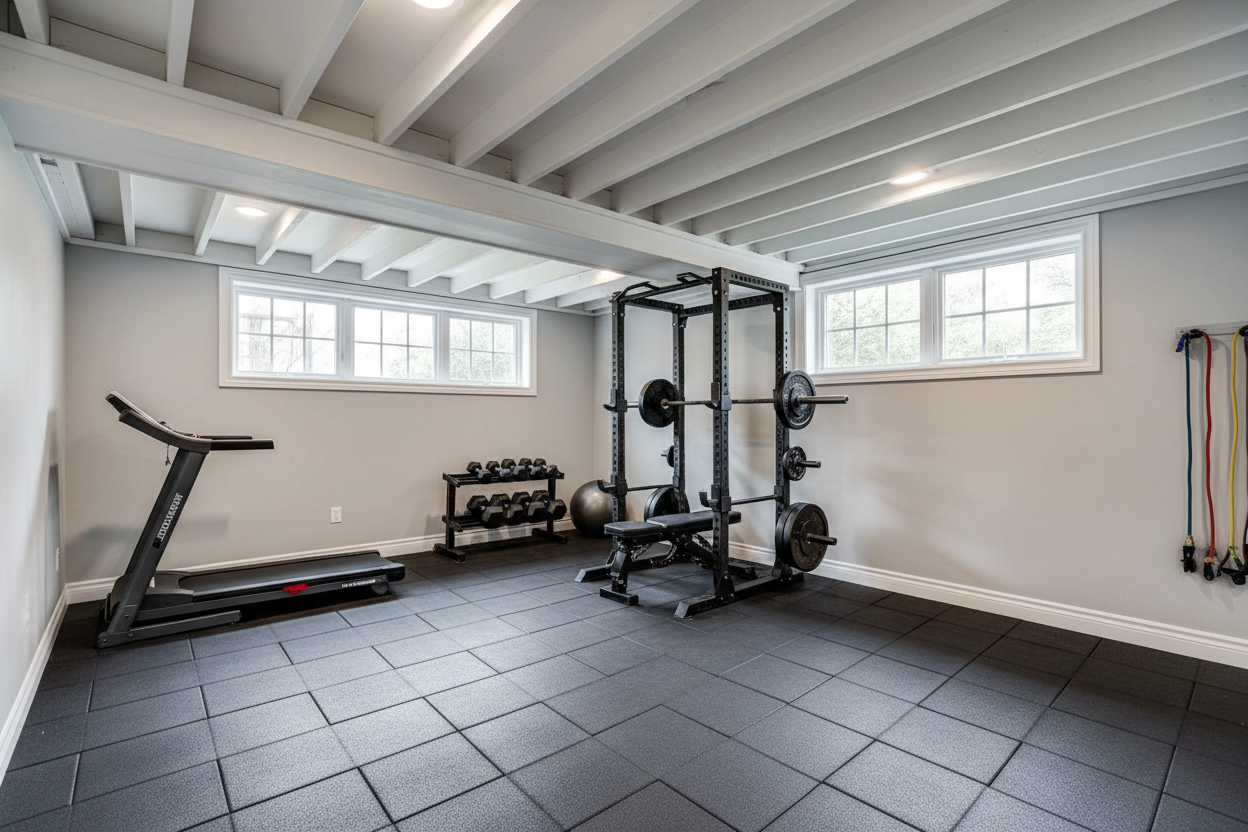
There is no sound more soul-crushing than the 'clink' of a barbell collar hitting a structural joist mid-rep. I spent three years training in a basement with 82 inches of clearance and a maze of ductwork that seemed designed to decapitate me. Building the best home gym for low ceilings isn't just about finding smaller gear; it is about finding heavy-duty equipment that doesn't compromise your gains just because your ceiling is low.
Quick Takeaways
- Measure your floor-to-ceiling height in three different spots—basement floors are rarely level.
- Target racks between 72 and 80 inches to allow for floor mat thickness.
- The Z-press is your new best friend for overhead strength.
- Prioritize plate-loaded cable machines over selectorized towers to save vertical inches.
The 84-Inch Curse: Why Standard Gear Will Break Your Heart
Most commercial-grade racks are 90 to 94 inches tall. In a standard garage, that is fine. In a basement with 84-inch ceilings, that rack is a giant metal paperweight. You have to account for more than just the height of the uprights. If you buy an 82-inch rack for an 84-inch room, you have exactly two inches to slide the pull-up bar into place and zero room to actually put your head above the bar.
Before you start buying heavy-duty home gym essentials, you need to map out the 'dead zones.' Measure where the low-hanging pipes and HVAC ducts live. I’ve seen guys buy beautiful 3x3 racks only to realize they can't fit a single 45-pound plate on the bar because a water pipe is blocking the sleeve. Every inch counts when you are working in a subterranean hobbit hole.
Finding the Right Rack for a Home Gym Under 7 Feet Tall
The core of any setup is the rack, and for a home gym under 7 feet tall, you are looking for 'short' or 'mini' variations. You want a rack that stands around 72 to 80 inches. A 72-inch squat stand is often the safest bet because it gives you plenty of 'air' above the uprights for plate loading and pull-ups (if you're okay with tucking your knees).
While we often see tall lifters dealing with standard racks and complaining about head clearance, the low-ceiling lifter has it worse. You can't just 'duck' under a ceiling. You need a rack with a flat foot base—no bolt-down required if you want to avoid drilling into your basement slab—and a high weight capacity. Just because it is short doesn't mean it should be flimsy. Look for 11-gauge steel and at least 2x3 or 3x3 tubing.
Embrace the Z-Press (Because Standing Overhead Work is Dead)
Let's be real: unless you are 5-foot-nothing, you aren't doing standing overhead presses in a 7-foot basement. You will smash your knuckles, the plates, or both. The workaround isn't just sitting on a bench, which can lead to back arching and cheating. Instead, master the Z-press.
Sit flat on the floor with your legs straight out in front of you and press from your shoulders. It forces your core to stabilize the weight and prevents you from using leg drive or excessive leaning. It is a humbling movement that builds massive shoulder power without requiring a single extra inch of ceiling height. If you must use a bench, keep it at a slight 75-degree incline to save your head from the joists.
How to Get Your Cable Fix Without Smashing the Ceiling
Standard functional trainers are towering monsters. Most sit at 84 to 90 inches, which is an immediate 'no' for most basements. To get your accessory work in, look for a dedicated lat pulldown and low row station designed with a compact footprint. These often top out at 80-82 inches, fitting perfectly between standard 8-foot joists.
If you want more versatility, some compact Smith machine stations offer integrated pulleys that sit lower than standalone towers. The key is checking the 'maximum pulley height.' If the top pulley is 83 inches and your ceiling is 84, you are going to have a bad time during assembly. Plate-loaded options are usually shorter than weight-stack versions, making them the superior choice for tight vertical spaces.
Steal These Low Ceiling Basement Gym Ideas
The biggest mistake I see is people building a massive 3-inch thick wooden lifting platform. In a low-ceiling room, you just sacrificed three inches of precious overhead space. Use 3/4-inch high-density rubber stall mats instead. You get the protection you need for your floor without losing the height you need for your lift.
Another pro-tip: Position your rack so the 'path' of the barbell goes between the joists rather than directly under one. This 'joist-surfing' technique can buy you an extra 8 to 10 inches of clearance for pull-ups or overhead movements. It takes some planning and a flashlight, but it is the best way to build a highly functional setup in tight quarters.
My Basement Blunder
I once bought a 'short' power rack that was advertised at 82 inches. My ceiling was 83 inches. I thought I was a genius. What I forgot was that the bolts on top of the rack added another inch, and my floor mats added nearly an inch. I ended up having to dig two small trenches in my basement floor just to get the uprights to stand up. It was a nightmare. Measure the floor, the mats, and the bolts—not just the uprights.
FAQ
Can I do pull-ups in a 7-foot basement?
Yes, but you will need to perform them with your knees tucked or your legs in an L-sit. Alternatively, mount a pull-up bar directly to the side of a floor joist to maximize every millimeter of space.
What is the best bar for a low ceiling?
A standard 7-foot Olympic bar is fine, but if your room is also narrow, a 6-foot 'shorty' bar with a standard-width shaft will save you from hitting the walls while still fitting in your rack.
Will a short rack be less stable?
Not necessarily. Stability comes from the gauge of the steel and the footprint of the base. A short rack with a wide base and 11-gauge steel is often more stable than a cheap, tall rack from a big-box store.
Share:
Why I Stopped Hating the Planet Fitness Smith Machine
My Unpopular Opinion on the Best Workout Machine at Home