
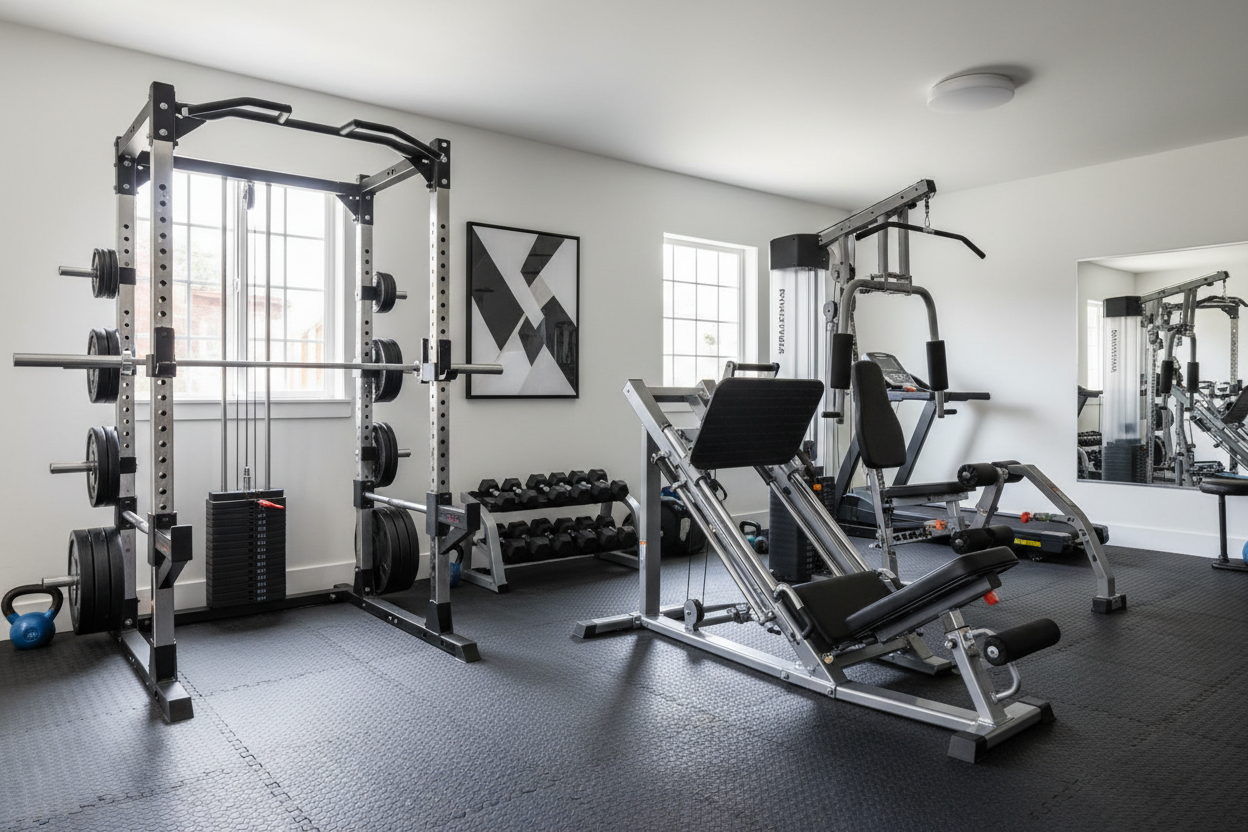
You know that feeling when you walk into a commercial gym and see the squat rack guys grunting like they are giving birth? It is intimidating as hell. I spent my first six months in a local fitness club just walking on the treadmill because I did not want to drop a dumbbell on my foot or, worse, look like I had no clue what I was doing. If you are currently standing in the middle of the turf area feeling like a deer in headlights, beginner gym workout machines are your secret weapon.
They are not 'cheating.' They are the most efficient way to build a strength base without needing a spotter or a degree in biomechanics. Most people give up because they feel awkward; machines remove the awkwardness and replace it with a fixed path of motion.
- Machines provide stability, allowing you to push your muscles to failure without the risk of dropping weights.
- You can quickly adjust weights with a simple pin, keeping your heart rate up and your workout efficient.
- Most machines have instructional placards right on the frame that show you exactly which muscles you are hitting.
- They are the perfect bridge to build the mind-muscle connection before transitioning to complex barbell movements.
Don't Let Free Weight Snobs Shame You (Why Machines Rule)
There is this weird elitism in the fitness industry that says if you are not doing 'big rocks' like the barbell squat or deadlift, you are not really training. That is total nonsense. For a novice, workouts using machines are actually superior for one specific reason: isolation. When you do not have to worry about falling over or balancing a heavy bar on your back, you can actually focus on the muscle you are trying to grow.
I have seen guys try to bench 135 lbs with zero stability, shaking like a leaf. They are not getting stronger; they are just surviving. Machines isolate the target area. If you are on a seated row, your lats are doing the work, not your lower back trying to keep you from face-planting. This allows you to push closer to failure safely, which is where the actual muscle growth happens. It is about working the muscle, not just moving the weight.
The Push/Pull Starter Pack for Your Upper Body
To get the best gym machine workouts going, you only need two main movements for your upper body: a horizontal push and a vertical pull. Start with the chest press. Most commercial gyms have a selectorized version where you just sit and push. It mimics the bench press but keeps your shoulders in a much safer, guided track.
If you are looking for something that feels more like a real bench press without the risk, I am a big fan of the Weight Bench Chest Press Machine Independent Arms Z1 Pro. Modern machines like this use converging axes. Instead of just pushing straight out, the handles move toward each other at the top of the rep. This mimics the natural movement of your pecs and gives a much better contraction than a standard flat barbell bench press ever could.
For the pull, go straight to the lat pulldown. It is the king of back builders. It teaches you how to drive with your elbows—a skill that is mandatory before you ever attempt a pull-up. Keep your chest up, pull the bar to your upper chest, and feel your lats flare out. Between these two, you have covered 80 percent of your upper body needs.
Leg Day Without the Squat Rack Panic
Leg day should not feel like a life-or-death situation. While the internet loves to post videos of 500-lb squats, a beginner machine workout male or a beginner gym machine workout female can get incredible results with the 'Big Three' of leg machines: the leg press, the hamstring curl, and the leg extension. These three hits every major muscle group in your lower body without putting 200 pounds of steel on your spine.
The leg press is your heavy hitter. It allows you to load up weight and drive through your heels without compressing your vertebrae. Follow that up with the seated hamstring curl. Most people have weak hamstrings because we sit all day; this machine forces them to wake up. Finally, hit the leg extension for that quad pump. It is simple, effective, and you will not need a chiropractor afterward. You can walk out of the gym with a 'pump' instead of a limp.
Putting It Together: A Total Body Gym Machine Workout
You do not need a complex 6-day split that leaves you living at the gym. A total body gym machine workout performed three times a week is plenty for the first six months. Aim for 3 sets of 10-12 reps on each machine. This rep range is the sweet spot for hypertrophy and gives you enough practice with the movement to get comfortable.
Let's address the elephant in the room: toning machine exercises. 'Toning' is just a marketing word for building muscle while losing body fat. You cannot actually tone a muscle; you can only make it bigger or smaller. These machines do the 'making it bigger' part, which gives you that firm, defined look once your diet is on point. If you want the exact breakdown of how to sequence these for maximum impact, check out The Only Beginner Gym Machine Workout You Actually Need. It covers everything from rest periods to how much weight you should actually be clicking into the stack.
Taking It to the Garage: Home Weight Machine Workouts
Eventually, you might get tired of the commercial gym crowds. I did. I realized I was spending 20 minutes a day just waiting for the leg press to open up. Transitioning to home weight machine workouts does not mean buying 15 different units. You can get most of this functionality in one footprint if you are smart about your equipment choices.
The ultimate bridge for a home setup is a Smith Machine Home Gym Station. It gives you the safety of a guided track—much like the machines at the local club—but allows you to perform 'free weight' style movements like squats and presses. It is the perfect middle ground. You get the stability of a machine with the versatility of a rack, and it fits in a standard 10x10 garage corner. It is the one piece I wish I had bought years ago instead of a cheap, wobbly bench and plastic-coated weights.
My Personal Experience: The Day I Swallowed My Pride
I used to be a free-weight purist. I thought machines were for people who were not serious. Then I blew out my lower back trying to ego-lift a 315-lb squat with terrible form because I wanted to look cool in front of a bunch of strangers. I could not walk right for a week. It was embarrassing and entirely avoidable.
During my rehab, I was forced to use the hack squat and leg press. I realized my legs were actually getting bigger because I could finally push to failure without my back giving out first. It was a humbling lesson. Now, my training is a mix of both. Do not make my mistake—use the tools that let you train hard without breaking your body. Machines are tools, not crutches.
FAQ
Are machines as good as free weights for building muscle?
For pure muscle growth, absolutely. Your muscles do not know if you are holding a dumbbell or pushing a lever; they only know tension. Machines actually make it easier to maintain high tension throughout the entire range of motion, which is great for growth.
How do I know what weight to start with?
Start lighter than you think. Pick a weight where you can do 12 reps with perfect control. If the last two reps feel like a struggle but your form does not break, you have found the right spot. If you are swinging your body to move the weight, it is too heavy.
Can I lose weight just using gym machines?
Weight loss happens in the kitchen, but a workout routine with equipment helps you keep the muscle you have while the fat comes off. More muscle also means a higher resting metabolism, which makes staying lean much easier in the long run.
Share:
Why I Actually Use 17.5 lb Dumbbells More Than My 20s
The Only 4 Items That Are Absolutely Essential for Home Gym Training