
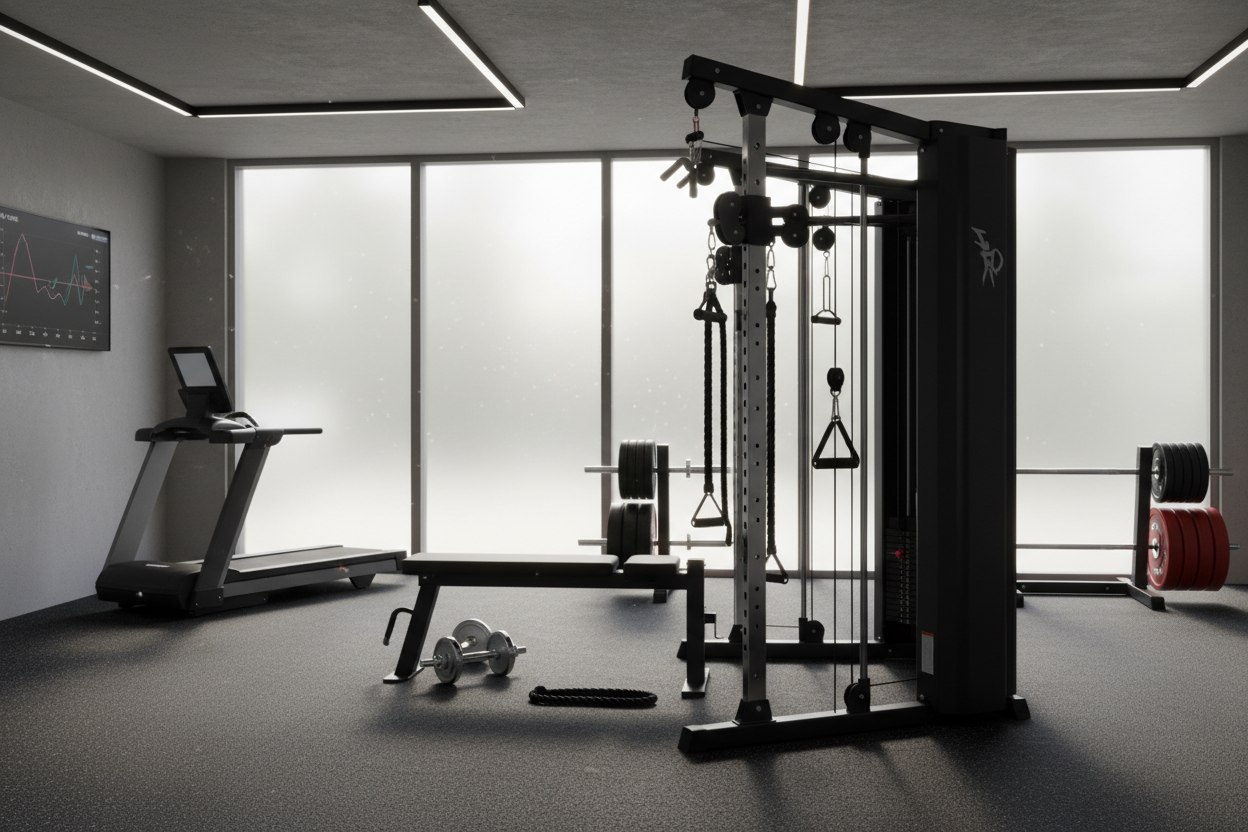
I remember the day I ditched my commercial gym membership and bought my first multi weight machine. I was convinced I could just port my powerlifting numbers over to the cable stack and keep the gains coming. I spent three weeks trying to 'max out' the lat pulldown like it was a heavy deadlift before my elbows started screaming and the cables started humming in a way that sounded like a warning.
The truth is, a multi workout station is a different beast entirely. It’s not a replacement for a barbell; it’s a specialized tool for hypertrophy and isolation. If you try to force a square peg into a round hole by running a 5/3/1 program on a cable rig, you’re going to stall out and likely end up in a physical therapist's office. You have to respect the mechanics of the machine if you want it to respect your joints.
- Machines offer constant tension that barbells simply cannot match.
- Pulley ratios mean the number on the stack is rarely the 'real' weight you are lifting.
- Focus on high-volume hypertrophy (12-20 reps) over low-rep strength.
- Adjustable benches are the secret weapon for unlocking better cable angles.
The Problem With 'Barbell Brain'
Most lifters suffer from what I call 'Barbell Brain.' We’re conditioned to believe that if we aren't adding five pounds to the bar every single week, we aren't growing. When you move to a machine, that logic fails. A machine has a fixed path of motion. It doesn't care about your natural biomechanics or how your scapula needs to rotate during a press.
Trying to grind out a heavy 5x5 set on a chest press machine is a great way to wreck your rotator cuffs. Because you can't micro-adjust the bar's path to avoid a 'ping' in your shoulder, the machine forces your joints to follow its track. Instead of chasing weight, you need to chase the pump. Machines are built for isolation, not for moving the maximum amount of mass possible through space. If you want to move 500 lbs, buy a rack. If you want to grow your chest, use the machine.
Why Your Multi Weight Machine Feels So Different
The physics of a cable system are completely different from a plate-loaded bar. Most home units use a 2:1 or even a 4:1 pulley ratio. This means if you have 200 lbs on the stack, you're actually only moving 100 lbs or 50 lbs of actual resistance. Don't let your ego get bruised when the numbers don't align with your gym PRs. It's about the tension on the muscle, not the number on the pin.
Furthermore, a massive corner multi-gym often has a fixed pivot point that might not align with your limb length. If you're 6'2' or 5'4', the 'sweet spot' for a chest press might be totally off. You have to learn to adjust your body to the machine, rather than expecting the machine to move for you. This is why I prefer machines with adjustable cable columns over those with fixed-arm handles that lock you into one specific arc.
Stop Forcing Awkward Squats and Deadlifts
I see it all the time: someone standing on the base of their machine, trying to do a cable deadlift. It looks awkward because it is. The resistance curve on a cable is linear, whereas a barbell deadlift is hardest at the floor and easiest at the lockout. When you deadlift on a cable, the tension is constant, which sounds good in theory but feels like garbage on your lower back because the cable is constantly trying to pull you forward.
Stop trying to make your multi workout station do things it wasn't designed for. If you want to hit legs, use the low pulley for cable pull-throughs or high-rep Romanian Deadlifts. If you want to squat, do a goblet squat with a heavy dumbbell or use the machine for high-volume split squats. Forcing a 'big three' movement onto a cable rig is a waste of your training economy and a fast track to a lower back tweak.
The Right Way to Program a Multi Workout Station
To get the most out of your rig, you need to shift your mindset toward hypertrophy. I like to use machines for 'finishing' movements or high-rep isolation work. For example, using an independent arms chest press allows you to work each side of your chest separately. This is huge for fixing the strength imbalances that a standard barbell bench press usually hides behind the stronger side.
Program your machine work in the 12-15 rep range. Focus on a three-second eccentric (lowering) phase and a hard one-second squeeze at the peak of the contraction. You can also utilize 'rest-pause' sets or dropsets—techniques that are incredibly dangerous with a heavy barbell but perfectly safe on a machine stack. This is how you actually build muscle on a rig without burning out your central nervous system or your joints.
The Missing Piece to Your Machine Setup
Most home multi-gyms come with a built-in seat that is, frankly, an afterthought. It’s usually bolted in place and offers limited adjustment. If you really want to unlock the potential of your cable columns, you need to move that seat out of the way. I almost always recommend pairing your setup with a versatile weight bench that you can wheel in and out of the cable path.
Having a standalone bench allows you to perform seated rows at different angles, incline cable flyes, and even supported 1-arm rows. It turns a basic two-dimensional machine into a three-dimensional training hub. If your machine's seat doesn't pop out easily, you might be stuck with the factory movements, which limits your growth potential significantly. A good bench is the bridge between a mediocre workout and a professional-grade session.
Can I build a pro-level physique with just a machine?
You absolutely can. Many pro bodybuilders rely heavily on machines because they allow for better muscle isolation and less systemic fatigue. You just have to be willing to train to absolute failure on those high-rep sets. The machine doesn't care how you get to failure, as long as you get there.
How do I make the weight feel heavier if I max out the stack?
Slow down. If the stack is too light, stop using momentum to 'cheat' the weight up. A five-second negative will make 50 lbs feel like 150 lbs very quickly. You can also add 'gym pins' to add small external plates to the stack, but always check your cable's weight rating before you go overboard.
Are these machines noisy for apartment living?
Most modern units use nylon-coated cables and plastic bushings, which are fairly quiet. However, the 'clink' of the plates hitting each other can travel through floors. I always recommend putting the unit on 3/4-inch rubber stall mats to dampen the vibration and keep your neighbors happy.
Share:
Why I Stopped Buying Top of the-Line Fitness Equipment for My Garage
I Finally Learned Which of the Gym Machines Are Worth Using