
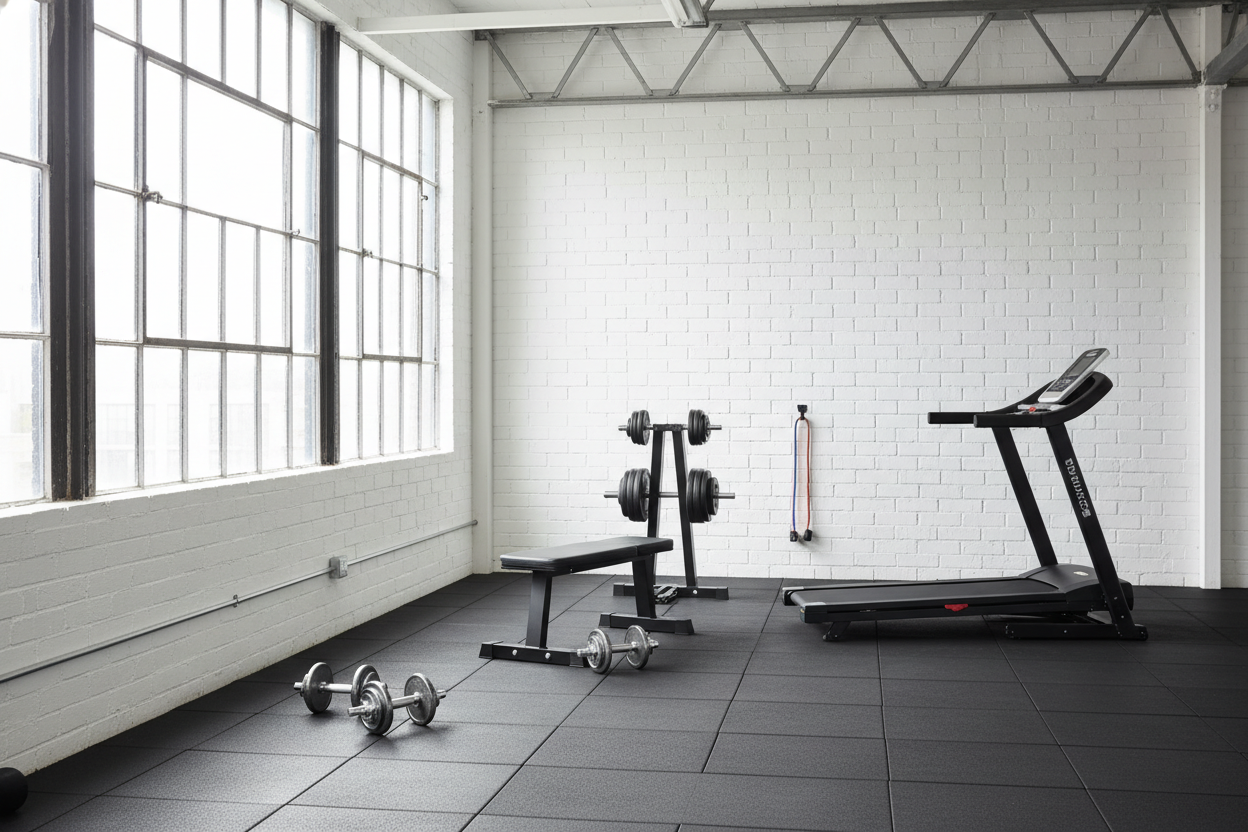
I remember staring at a spare bedroom filled with half-assembled machines that smelled like cheap rubber and regret. Most people think they need a commercial-grade setup to see results, but that is just effective marketing from companies trying to sell you a $3,000 subscription-based mirror. If you want to actually get strong without turning your house into a cluttered obstacle course, you only need three things.
Building a minimalist setup starts with ignoring the hype. I have seen too many guys drop five grand on a massive rack and plate set only to realize they do not have the floor space to actually move. Choosing the right basic exercise equipment for home is about maximizing utility per square foot.
Quick Takeaways
- Adjustable dumbbells replace an entire rack of fixed weights.
- A high-capacity bench is the foundation of your heavy lifts.
- Pulling movements are the most neglected part of home training.
- You do not need a massive treadmill for effective conditioning.
The Clutter Trap: Why Less is Actually More
The biggest mistake beginners make is buying for the person they want to be in six months rather than the space they have today. They buy the ab-roller, the thigh-master, and the weird vibrating plate. I have tested 50 pieces of exercise equipment and I can tell you that 90% of it is junk designed to solve a problem that does not exist. This stuff usually ends up as a high-end laundry rack.
When you limit yourself to a few heavy-duty basics, you are forced to master the movements that actually matter: presses, rows, squats, and lunges. Consistency is built on simplicity. If you have to move three different machines just to get to your weights, you are going to skip your workout. Period.
Piece #1: Adjustable Dumbbells (The Core of Basic Home Workout Equipment)
If you are looking for basic home workout equipment, a solid pair of adjustable dumbbells is the undisputed king. A standard set that goes from 5 to 52.5 lbs replaces 15 pairs of fixed dumbbells. That is roughly 30 square feet of floor space saved. I prefer the ones with a metal internal cradle; the plastic-heavy versions tend to rattle when you are doing heavy overhead presses, which is annoying and feels sketchy.
Look for a pair with a flat head. If the ends of the dumbbells are rounded or have protruding pins, you cannot rest them on your thighs before kicking them back for a chest press. It sounds like a small detail until you are trying to handle 50 lbs and realize you have nowhere to set them down safely.
Piece #2: A Bench That Won't Collapse Under You
Do not buy a $50 bench from a big-box store. I made that mistake once and felt the frame flex while I was holding 60-lb dumbbells over my face. It is a terrifying way to train. For simple exercise equipment for home, you want a bench with at least a 600-lb total weight capacity. That accounts for your body weight plus whatever you are lifting.
An adjustable bench (FID: Flat, Incline, Decline) unlocks about 80% of the movements you need. You can do incline presses for upper chest, seated rows, and even use it as a box for step-ups. Look for a bench with minimal 'pad gap'—the space between the seat and the backrest. If that gap is too wide, it will dig into your lower back every time you lie down.
Piece #3: Something to Pull Your Own Weight
The biggest flaw in most simple home exercise equipment setups is the total lack of back training. People buy dumbbells and a bench, then spend six months only doing 'mirror muscles'—chest, shoulders, and arms. You need to pull. If you have a sturdy door frame, a removable pull-up bar is the cheapest way to build a thick back.
If pull-ups are not in your wheelhouse yet, suspension straps are the better move. You can anchor them to a door and perform bodyweight rows. This balances out all the pushing you are doing on the bench and keeps your shoulders from rounding forward like a caveman. It is a 2-lb piece of gear that does more for your posture than any 'ergonomic' chair ever will.
What About Cardio? (Hint: You Don't Need a $2,000 Treadmill)
You do not need a motorized treadmill that takes up half the living room. If you have the space for a 6-foot yoga mat, you have the space for cardio. High-intensity intervals with your dumbbells or even basic burpees will get your heart rate higher than a casual stroll on a belt ever could. However, if you really want a dedicated machine, keep it small.
A foldable upright exercise bike is my go-to recommendation for small spaces. It has a tiny footprint, you can tuck it into a closet when you are done, and it provides enough resistance for a solid sweat session without the maintenance headaches of a treadmill motor.
When You're Ready to Outgrow Simple Home Workout Equipment
There comes a day when the 50-lb dumbbells feel light. That is a great day. It means you have stayed consistent. When you reach that point, you have two choices: buy heavier individual dumbbells (which gets expensive fast) or start expanding your home gym with a more permanent solution.
If you have a dedicated garage space, a power rack is the next logical step. But if you are still training in a spare room or basement with low ceilings, a Smith machine home gym station is a smart upgrade. It provides the stability of a fixed track, which is great for training to failure safely when you do not have a human spotter around.
My Personal Experience
I spent years thinking I needed a full commercial rack to get 'real' results. I bought a cheap multi-gym that used sand-filled weights and plastic pulleys. The cables felt like they were rubbing against sandpaper, and the leg extension hit my shins at the wrong angle. It was a total waste of $400. I eventually sold it for $50 on Craigslist and bought a pair of used 10-50lb adjustable dumbbells. My strength exploded because I could finally focus on the lift instead of the janky equipment.
FAQ
Is basic equipment enough to build muscle?
Yes. Your muscles do not know if you are holding a $5,000 gold-plated barbell or a $50 dumbbell. They only respond to tension and progressive overload. If you keep lifting heavier weights over time, you will grow.
How much space do I really need?
For the three pieces listed here, a 6x8 ft area is plenty. That gives you enough room to lay the bench down and have a 'safety zone' around you so you do not swing a dumbbell into your TV.
Should I buy used gear?
For dumbbells and benches, absolutely. Iron doesn't expire. Just check for rust on the adjustment mechanisms and make sure the bench padding isn't cracked or rotting. Avoid used cardio machines with motors, as those are usually one broken belt away from the junkyard.
Share:
Why Lifting on Hydraulic Exercise Equipment Feels Completely Alien
How to Decode Exercise Equipment Price Without Getting Ripped Off