
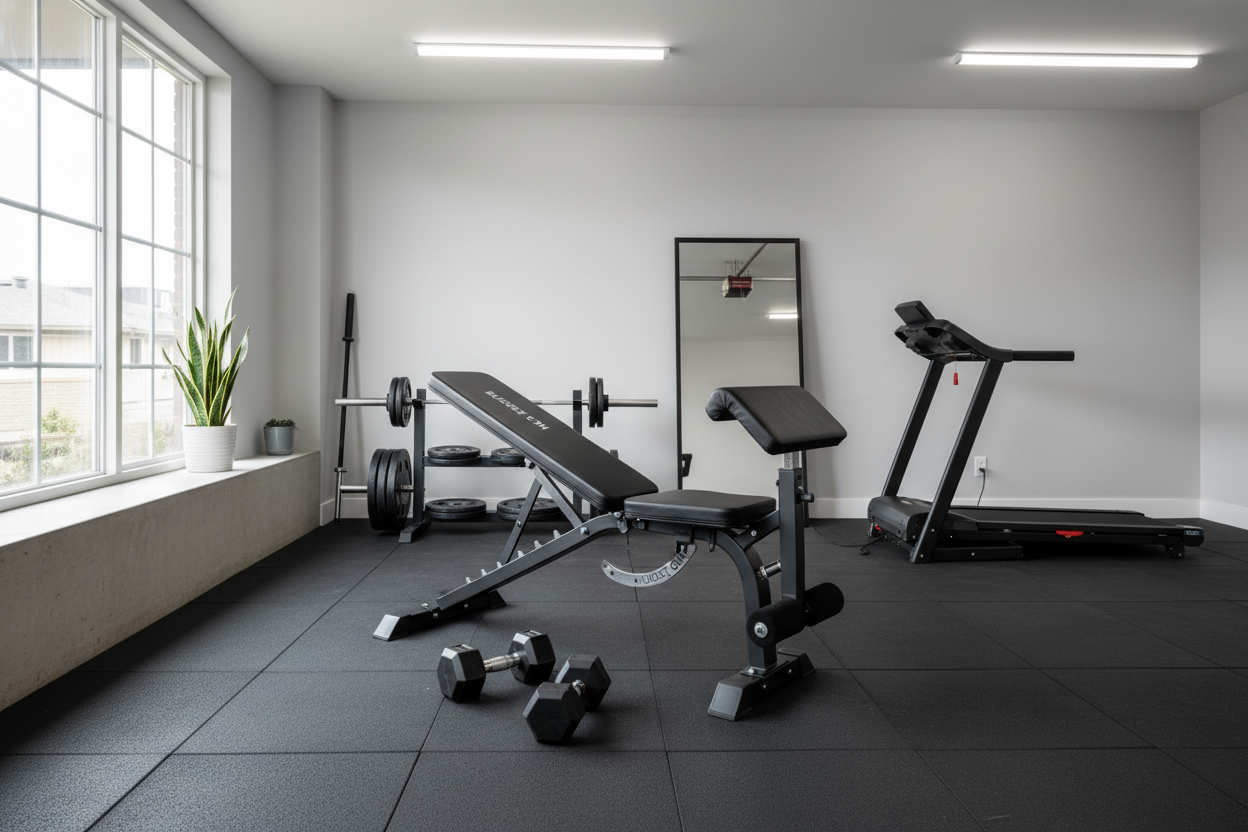
I remember staring at my first 11-gauge power rack and thinking I could fit a whole commercial gym into a 40-square-foot corner. It is a seductive thought. You start scrolling through workout bench accessories at midnight, convinced that a few steel pins and some vinyl pads will replace five dedicated machines. I have spent thousands of dollars trying to make that dream work, and most of it was a waste of steel.
Quick Takeaways
- Leg developers are the only attachments that truly justify their footprint.
- Preacher curl add-ons are almost always ergonomically broken.
- Stability is the first thing you lose when you start bolting on extras.
- Always check your bench's steel gauge before adding offset weight.
The Trap of the 'Swiss Army Knife' Gym
The temptation to buy every modular add-on is real. You see a bench that can do leg extensions, preacher curls, and lat pulldowns, and you think you are winning at the space-saving game. The reality is much grittier. Most gym bench attachments end up compromising the very thing you need most: a rock-solid foundation for heavy pressing.
Every time you add a joint or a pop-pin to a piece of equipment, you introduce a point of failure. I have seen 'all-in-one' setups that shake like a leaf during a simple chest press because the frame is trying to do too much. Before you go down the rabbit hole of modularity, ask yourself: Can One Exercise Workout Bench Actually Replace a Full Gym? In my experience, it usually provides a mediocre version of five exercises instead of a great version of one.
Leg Developers: The One Attachment I Actually Use
If you are going to buy any accessory, make it a leg developer. Isolating the quads and hamstrings in a home gym is notoriously difficult without a massive, $2,000 standalone machine. A leg extension/curl attachment is the one piece that is actually biomechanically sound enough to warrant the floor space.
However, there is a massive caveat. Your weight bench needs a wide enough front stabilizer to act as an anchor. If you load 90 lbs onto a leg developer and your bench has a narrow 'T' base, the whole unit is going to tip forward as soon as you reach peak contraction. I look for attachments that keep the weight horn low to the ground to maintain a decent center of gravity. If it feels like it is going to flip when you stand up, it is a piece of junk.
Preacher Curl Pads: Why You're Better Off With Dumbbells
I have owned three different preacher curl attachments, and I hated all of them. The structural flaws are consistent across almost every brand. First, the chest pad angle is usually set too steep, which puts unnecessary stress on your elbows. Second, because these pads sit on a single vertical post, they inevitably wobble side-to-side during a heavy set.
There is no worse feeling than being mid-rep with a heavy EZ-bar and feeling the entire pad shift two inches to the left. You are much better off sitting backward on an incline bench and performing concentration curls or spider curls with dumbbells. It is more stable, it costs zero extra dollars, and you don't have to find a place to store a bulky vinyl pad when you're done.
Does Bolting on Attachments Actually Save You Money?
Let's do some quick garage gym math. A high-end modular bench frame might cost you $500. Add $150 for a leg developer, $120 for a curl pad, and another $200 for a lat tower attachment. You are now $970 deep into a setup that still feels like a compromise. For that same grand, you could buy a world-class flat bench and a dedicated, used leg extension machine from a local gym liquidation.
The hidden cost isn't just the money; it's the 'setup tax.' If you have to spend five minutes swapping pins and moving pads every time you want to change exercises, you are going to stop doing those exercises. I have seen dozens of these 'Swiss Army' setups gathering dust because the owner got tired of the assembly dance. If an attachment doesn't click into place in under ten seconds, it's a hurdle to your training.
How to Tell if Your Current Frame Can Handle Add-Ons
If you are dead-set on expanding, you need to audit your current gear. Most budget benches are made of 14-gauge steel, which is fine for basic pressing but will twist under the torque of a heavy leg developer. You want at least 11-gauge or 12-gauge steel. Check the pin sizes too—if your bench uses 1/2-inch pins while the industry standard is 1-inch or 5/8-inch, you are going to be locked into one brand's ecosystem forever.
Perform the 'shake test.' Grab the top of your bench and give it a violent shove. If it rattles or moves more than half an inch, do not bolt a 100-lb lever arm to it. You need a foundation like the Adjustable Weight Bench Owb01 that uses heavy-duty steel and wide stabilizers. If the base isn't solid, the accessories are just expensive ways to make your gym more dangerous.
Personal Experience: The Cardboard Shim Incident
Early in my lifting days, I bought a 'universal' leg attachment that was supposed to fit any 2x2-inch tube. My bench was a 2x2, but the tolerances were so sloppy that the attachment would rotate 15 degrees every time I kicked. I ended up shimming it with folded-up protein bar boxes just to finish my workout. It was pathetic. I eventually realized that if the attachment isn't made specifically for the frame—with zero play in the receiver—it is not worth the frustration.
FAQ
Do bench attachments fit all brands?
Almost never. Even if the tube size is the same (e.g., 2x2 inches), the hole spacing and pin diameter usually vary by a fraction of an inch, making them incompatible.
Are leg developers better than lunges?
They aren't 'better,' but they offer isolation that compound movements can't. If you have knee issues, the controlled path of a leg extension is often easier to manage than the shearing force of a lunge.
How much weight can a standard attachment handle?
Most are rated for 150 to 200 lbs. However, the limit is usually the bench's stability, not the attachment's steel. If the bench starts to lift off the floor, you've hit the limit regardless of what the manual says.
Share:
Can One Complete Body Exercise Machine Actually Replace a Gym?
I Tested 50 Pieces of Exercise Equipment for Home. Most Suck.