
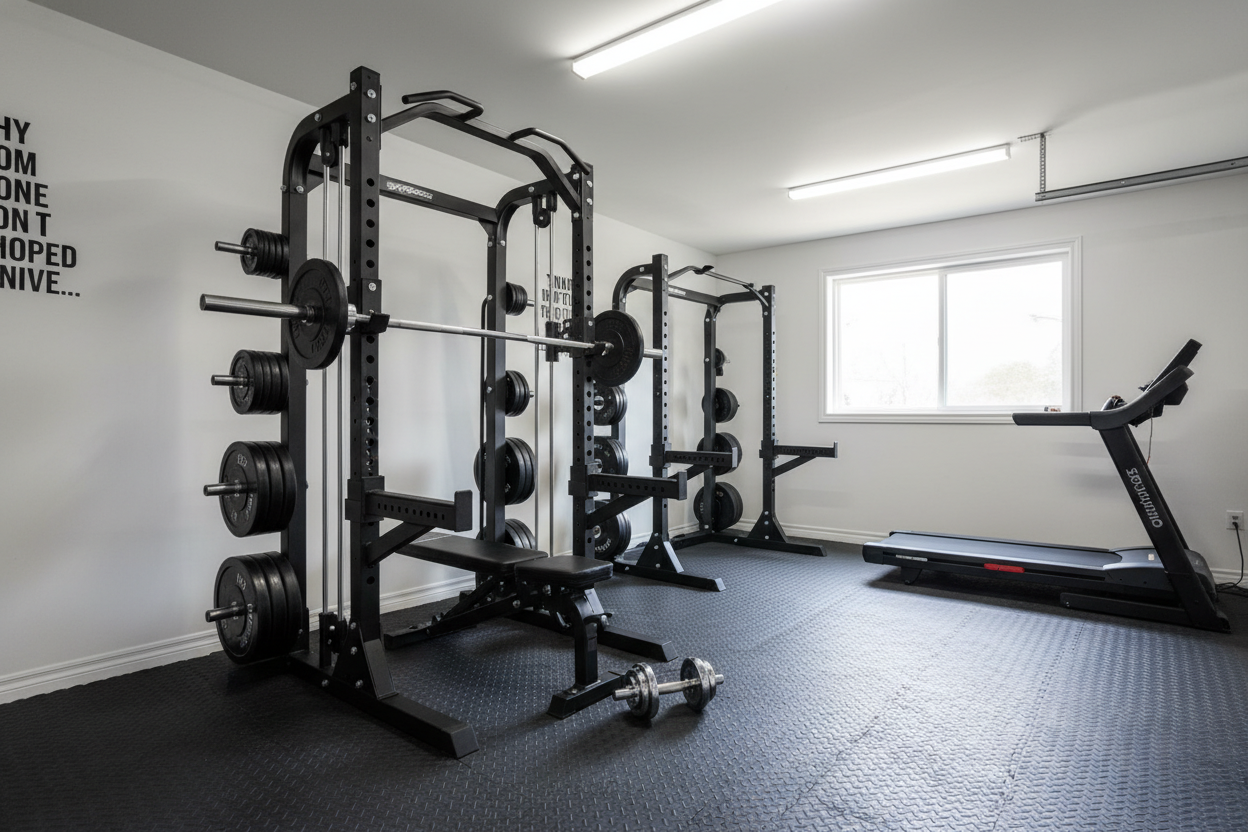
There I was, 11:30 PM in a freezing garage, 225 pounds hovering over my windpipe. I had no spotter, no ego left, and a set of safety pins that I’d set just one notch too low because I wanted that extra bit of 'stretch' on my chest. When my triceps gave out on the fourth rep, the realization hit me like a cold bucket of water: I was stuck. I had to perform a shameful, rib-crushing 'roll of shame' just to get out from under the bar. That night, I stopped being a free-weight purist and started looking for a smith machine at home.
- Safety First: The ability to lock the bar with a flick of the wrist is a literal lifesaver for solo lifters.
- True Failure: You can actually push until your muscles quit, not just until your balance gives out.
- Hypertrophy Focus: Fixed paths mean less stabilization and more direct tension on the target muscle.
- Space Efficiency: Modern units often combine a rack, smith, and cables into one footprint.
The Panic of Getting Pinned in an Empty Garage
When I first started building my home gym, I was a snob. I told myself that if it wasn’t a raw barbell and a power rack, it wasn’t real training. I spent years mocking the 'guillotine' machine. But the reality of training alone is that the fear of injury starts to cap your gains. You stop two reps short of failure because you aren't sure if you can grind out the last one.
That 225-pound fail wasn't just embarrassing; it was dangerous. Rolling a heavy bar over your stomach and hips is a great way to end up in the ER with internal bruising. I realized that my 'hardcore' mindset was actually holding back my intensity. I needed a way to fail safely without needing a neighbor to hear my muffled screams from the garage.
Why Spotter Arms Only Solve Half the Problem
People love to say, 'Just use spotter arms.' Sure, they work, but they are a clunky compromise. If you set them high enough to catch a failed bench press, they often clank against the bar on a full-depth rep. It’s distracting. On incline bench or deep squats, finding that 'sweet spot' for safeties is nearly impossible.
With a smith machine home setup, the safety mechanism is integrated into the movement itself. You aren't aiming for a fixed metal bar at the bottom of the rep. You are the safety. A quick rotation of the bar hooks it into the nearest lockout point. It’s the difference between a parachute and a safety net—one you have to deploy, the other is just there.
The Psychological Edge of a Smith Machine at Home
There is a massive mental shift that happens when you stop worrying about dying under a bar. When I moved to a Smith Machine Home Gym Station, my intensity skyrocketed. I started hitting 12 reps on weights where I used to stop at 8. Why? Because I knew that if I hit a wall, I could just click the bar into place and walk away.
This psychological safety allows for 'beyond failure' techniques. I’m talking about partials, slow negatives, and isometric holds at the bottom of the rep. You can't safely do a 5-second eccentric on a 300-lb squat in a standard rack without a spotter. On a Smith, you can push your nervous system to the limit because the machine has your back.
Chasing True Hypertrophy Without a Spotter
If your goal is purely getting as big as possible, the Smith machine is actually superior to the barbell for several movements. Because you don't have to balance the weight, your brain can focus entirely on the mind-muscle connection. My quads have never grown faster than when I started doing Smith machine sissy squats and narrow-stance presses.
I eventually upgraded to the All In One Smith Machine With Cable Crossover S1 V4. This rig changed everything. I can go from a heavy Smith press straight into cable flyes for a devastating superset. It even lets me do rest-pause sets where I take 15 seconds of 'rack time' between mini-sets to absolutely incinerate the muscle fibers. You just can't do that safely with a raw barbell when you're training solo at 6 AM.
Does It Actually Fit Your Setup?
The biggest hurdle for most people is the footprint. A standard Smith bar is 7 feet wide, and the frame usually needs a 4x6 foot area. You have to be honest about your floor plan. If you're cramped, you might worry about losing your deadlift platform or your open floor space.
Before you pull the trigger, ask yourself if the machine is worth the floor space in your garage. For me, it replaced my squat stand and my old cable tower, actually saving me space in the long run. I’d rather have one machine that lets me train at 100% intensity than three pieces of gear that keep me playing it safe.
FAQ
Is the Smith machine bad for your joints?
No, as long as you position your body correctly. Since the path is fixed, you need to make sure your feet or bench are aligned so your joints move through a natural range. It’s actually easier on my shoulders for pressing than a free barbell.
Does the bar weight the same as a standard barbell?
Usually not. Most Smith bars are counterbalanced or have a starting weight of 15 to 25 lbs, rather than the standard 45 lbs. Always check the specs of your specific machine so you can track your lifts accurately.
Can I still do 'big' lifts like squats on it?
Absolutely. Smith machine squats allow you to place your feet further forward, which targets the quads much harder than a traditional back squat. It’s a different stimulus, but it’s incredibly effective for growth.
Share:
Why Do LA Fitness Machines Feel So Much Better Than Home Gear?
Which Brands of Exercise Equipment Actually Survive 5 Years?