
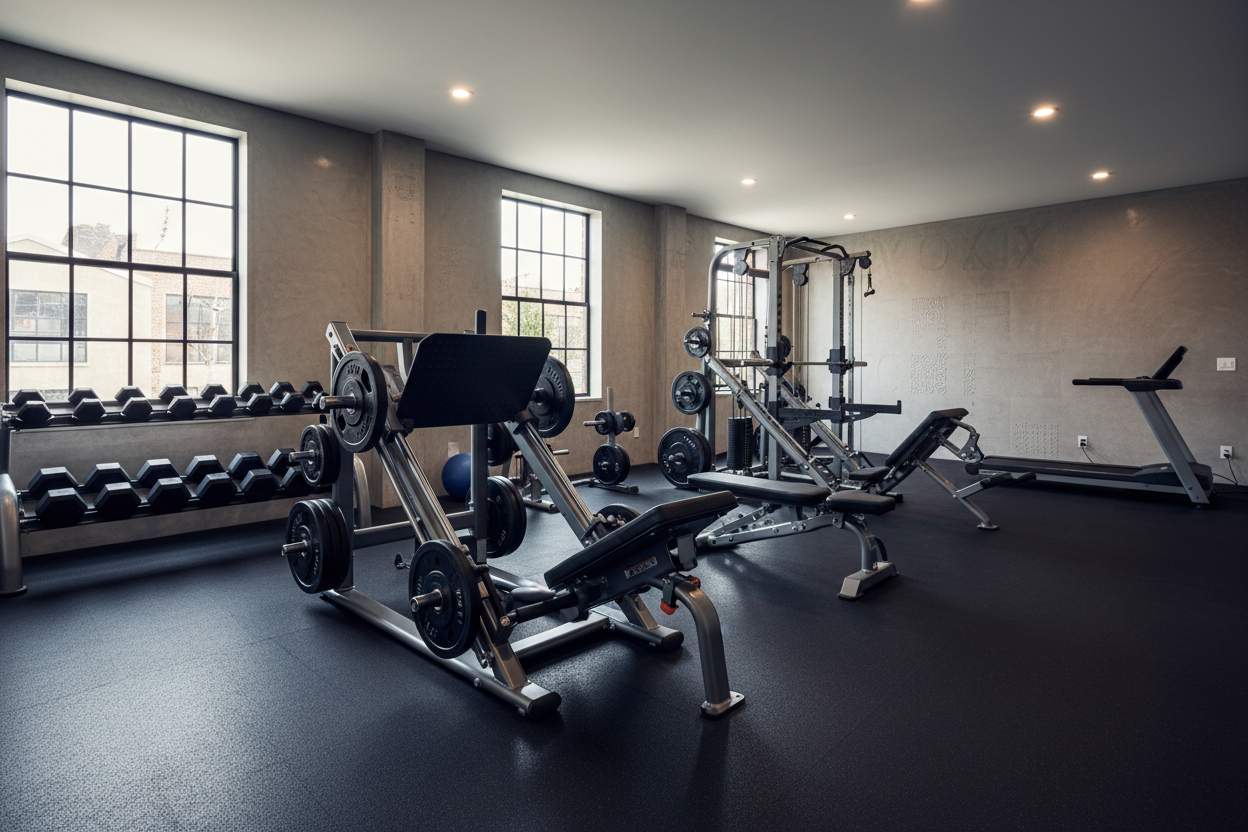
You open your new hypertrophy app, ready to crush a session, and it tells you to hop on the 'Linear Pendulum Squat.' You look around the commercial floor and see forty different contraptions, half of them covered in dust or occupied by someone scrolling TikTok. It is frustrating as hell. Understanding leg machine gym names is the difference between a productive session and standing in the middle of the floor looking like a lost tourist.
I have spent a decade in warehouses and commercial chains, and I still see people stare at a hack squat like it is a piece of alien technology. Most apps use clinical names, while gym rats use slang. We are going to bridge that gap so you can stop guessing and start growing.
- Leg Press: The standard heavy hitter for overall leg mass.
- Hack Squat: A fixed-path beast that targets the quads without the lower back fatigue of a barbell.
- Leg Extension: The ultimate isolation tool for that 'teardrop' muscle look.
- Leg Curl: Essential for hamstring health and thickness.
Why Your New Workout Program Looks Like a Foreign Language
Most fitness apps are written by PhDs or high-level coaches who use the most technical terminology possible. They do not care that your local Planet Fitness calls everything 'the leg thingy.' When you see a term you do not recognize, you end up wandering. I have seen people try to do leg extensions on a seated leg curl machine because they did not have gym equipment pictures and names to guide them.
The nomenclature usually follows the movement. If it says 'extension,' you are straightening your leg. If it says 'curl,' you are bending it. If it says 'press,' you are pushing weight away from you. Simple, right? But the variations are where the confusion starts.
The Big 4: Names of Gym Equipment for Legs That Actually Matter
You do not need to master fifty different machines. To build a set of wheels that actually fill out your jeans, there are only a handful of names of gym equipment for legs you need to memorize. These are the staples of any legitimate program.
The Leg Press (And Why the Angle Changes Everything)
The 45-degree leg press is the king of the commercial gym. You sit low, and you push a sled up an incline. Because of the angle, you can move significantly more weight than you could on a flat, horizontal press. If your program just says 'Leg Press,' this is usually the one they mean.
Then there is the horizontal or 'seated' leg press. These are usually cable-driven. They are great for beginners because the starting weight is lower, but you will eventually max out the stack if you are consistent. I prefer the 45-degree sled because it feels more 'raw' and lets you load up real iron plates.
The Hack Squat (Your Lower Back's Best Friend)
A hack squat machine features a fixed carriage on a track, usually at a steep angle. You stand in it with your back against a pad and your shoulders under the supports. It mimics a barbell squat but removes the stability requirement. This allows you to absolutely torch your quads without your lower back giving out first.
If you have a history of 'tweaking' your back during heavy back squats, the hack squat is your new best friend. It is a staple in bodybuilding for a reason: it allows for deep range of motion and brutal intensity with a much higher safety margin than a free bar.
Leg Extensions & Seated Curls (The Isolation Staples)
These are 'open-chain' movements. Your torso is fixed, and your lower legs move through an arc. The leg extension is the only machine that truly isolates the quadriceps. If you want that 'separation' between your muscles, you cannot skip these. Just watch your knees—don't let the weight slam at the bottom.
Seated or lying leg curls do the same for the hamstrings. Pro tip: if your gym has both, the seated version usually offers a better stretch at the top of the movement. I always pick the seated version if I have the choice.
The Fluff: Lower Body Contraptions You Can Probably Skip
You will see 'inner/outer thigh' machines (the adductor/abductor machines) and those weird glute kickback stations that look like a torture device. For 90% of lifters, these are 'fluff.' They take up a lot of floor space for very little ROI.
If you are hitting your presses and squats hard, your adductors and glutes are already getting plenty of work. Unless you are stepping on a bodybuilding stage next month, do not waste twenty minutes on the 'yes/no' machine when you could be doing another set of heavy presses.
Bringing the Commercial Leg Day into Your Garage
The biggest hurdle when moving to a home gym is the sheer size of leg machines. A commercial leg press takes up half a garage and costs three grand. But you do not need ten different stations to get a pro-level workout at home.
I spent years trying to replicate a leg press with resistance bands and specialized squat shoes. It was 'okay,' but it never felt right. Eventually, I realized that a high-quality combo machine is the way to go. It gives you the leg press and the hack squat in a single footprint. It is the smartest investment I made for my lower body development.
Personal Experience: The 'Wobbly' Mistake
When I first started my home setup, I bought a cheap, bolt-together leg press from a big-box sporting goods store. It was a disaster. The bearings felt like they were full of sand, and the whole unit shook when I loaded more than three plates per side. I ended up selling it for a loss two months later. Lesson learned: when it comes to machines with moving sleds, you get what you pay for. If the steel is thin and the rollers are plastic, stay away.
FAQ
What is the difference between a linear and a rotary leg press?
A linear press moves in a straight line on a track (usually 45 degrees). A rotary press moves in an arc. Linear presses generally feel more consistent through the entire range of motion, whereas rotary presses can feel 'heavier' at the bottom.
Is a Smith Machine squat the same as a hack squat?
Not quite. While both are fixed-path, the hack squat has a back pad that supports your spine at an angle. The Smith Machine requires you to maintain an upright posture yourself, which puts more load on the core and lower back than a true hack squat machine.
Can I just do lunges instead of using these machines?
Lunges are great, but they are limited by your balance. Machines allow you to push your muscles to absolute failure without worrying about falling over. For pure muscle growth, machines are often superior to 'functional' movements.
Share:
Stop Pointing at Stuff: Gym Equipment Pictures and Names Explained
Why One Good Fitness Machine for Home Beats a Room Full of Junk