
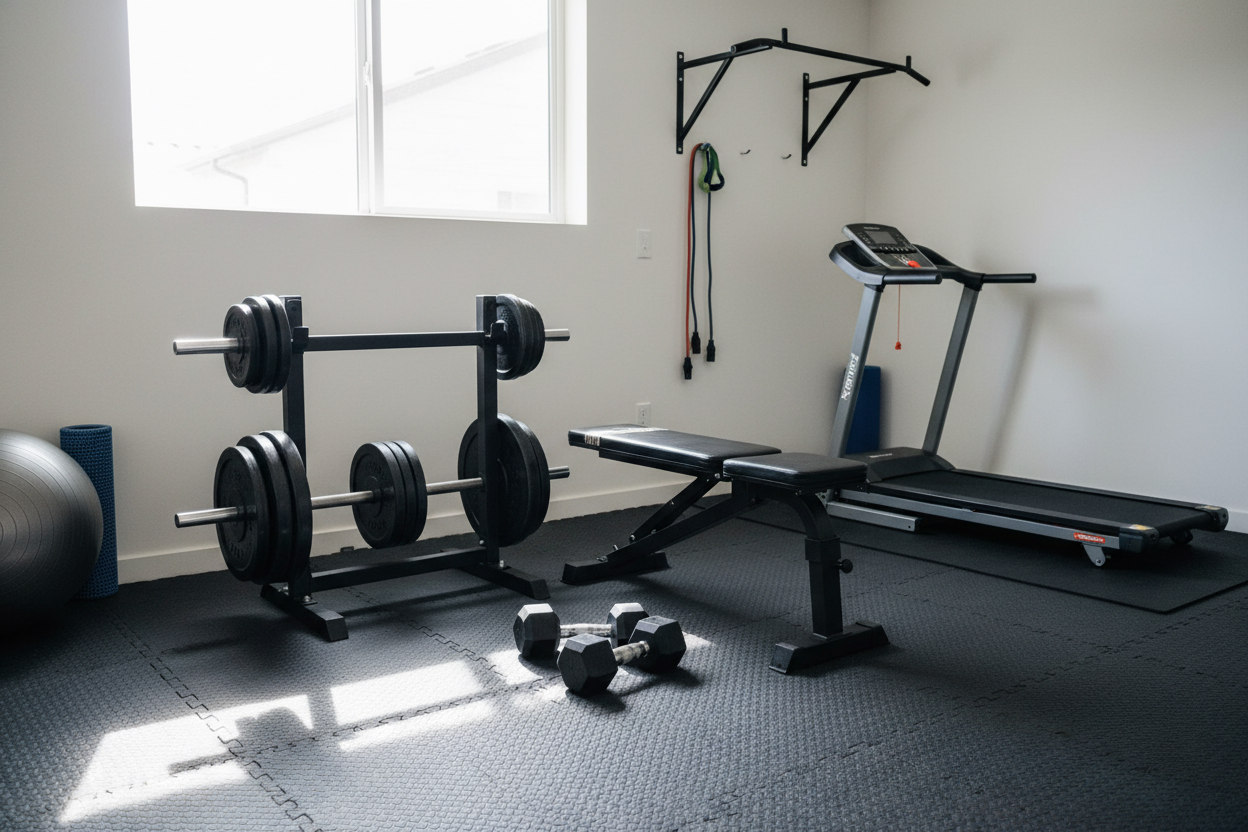
I remember the day I finally quit my $70-a-month commercial gym. I spent three hours scrolling through Amazon at midnight, trying to figure out if a $200 power rack would actually hold my 400-lb squat or if it would fold like a lawn chair the moment I stepped back. Finding inexpensive exercise equipment is a minefield of 'too good to be true' listings and genuine bargains that can save you thousands.
The truth is, you don't need a boutique brand logo to get strong. But you do need to know which pieces of gear are just simple iron and which ones are structural liabilities waiting to happen. I've spent a decade building, breaking, and upgrading my garage setup, and I've learned exactly where you can pinch pennies and where you must pay the 'quality tax.'
Quick Takeaways
- Buy used iron plates and dumbbells; gravity doesn't care about the brand.
- Avoid any budget equipment with cables or pulleys that feel 'crunchy' out of the box.
- Prioritize steel gauge (11 or 12 is the goal) over fancy attachments.
- Manual resistance cardio machines usually outlast cheap motorized ones.
The 'Weight is Weight' Rule for Saving Cash
Gravity works the same regardless of whether your plates are calibrated competition discs or rusty cast iron from a neighbor's yard. This is where affordable at home workout equipment really shines. If you're looking for cheap home workout equipment, start with the 'dumb' stuff: iron plates, standard pull-up bars, and basic flat benches.
A 45-lb plate is a 45-lb plate. Unless you're an Olympic lifter who needs specific diameter tolerances for high-level cleans, basic cast iron is fine. You can often find these for under a dollar a pound if you're patient. The same goes for simple sand-filled kettlebells or hex dumbbells. These items have no moving parts, meaning there is nothing to break. This is the safest place to go for the best cheap fitness equipment because the failure rate is essentially zero.
Moving Parts Mean Multiplying Risks
This is where the 'budget' dream usually turns into a biomechanical nightmare. When you start looking at cheap equipment for home gym setups that involve pulleys, cables, and hinges, you're asking for trouble. Cheap bushings and plastic pulleys create friction that makes a 50-lb stack feel like 30 lbs on the way down and 70 lbs on the way up.
I've tested 50 pieces of exercise equipment for home and the budget functional trainers are consistently the worst offenders. They use thin aircraft cables that fray within months and pulleys that wobble under load. If the movement isn't smooth, you won't use it. Worse, a snapped cable mid-row can result in a handle to the face. If you want cables, save up for something with aluminum pulleys and a high-tensile strength rating.
Stop Buying Cheap Racks (Seriously)
Your rack is the one thing standing between you and a trip to the ER. Many manufacturers sell cheap home exercise equipment using 14-gauge steel—which is essentially thin-walled tubing. If you're moving anything over 200 lbs, that rack is going to sway like a tree in a hurricane. You want 11-gauge or at least 12-gauge steel with 5/8-inch or 1-inch hardware.
If you're a solo lifter, the rack isn't just a holder for the bar; it's your spotter. I've seen cheap J-cups bend under a heavy re-rack, which is terrifying. If you're worried about safety but still on a budget, consider a Smith machine home gym station. These provide a fixed path and built-in safety catches that are far more reliable than a flimsy $150 bolt-together power tower from a big-box store.
Smart Budget Cardio Alternatives
Cheap motorized treadmills are a trap. The motors are underpowered, the decks are short, and the electronics usually fry the moment the warranty expires. If you want cheap workout equipment for home that handles conditioning, go manual or magnetic. Simple is durable.
Look for a magnetic resistance upright bike. Because magnetic resistance doesn't rely on physical friction or complex motors, there's very little that can actually break. You get a consistent workout without the screeching sound of a cheap felt pad or the smell of a burning treadmill motor. Plus, they usually have a much smaller footprint, which is a win for anyone training in a spare bedroom.
How to Actually Appraise Cheap Gear Online
Before you hit 'buy' on that suspiciously affordable bench or rack, check the product weight. If a weight bench only weighs 30 lbs, it’s made of soda cans. A solid, safe flat bench should have some heft to it—usually 50 lbs or more. Also, look at the weight capacity; if it’s rated for 300 lbs total, and you weigh 200 lbs, you only have 100 lbs of 'lifting' room before you're at the limit.
When building a reliable home gym, the goal is to buy things once. It's better to have a high-quality barbell and a pile of ugly, mismatched used plates than a shiny, matching set of low-quality gear that breaks in six months. Check the warranty—if it's only 90 days, the manufacturer doesn't even trust it to last a season.
My Biggest Gear Mistake
Early on, I bought a 'bargain' adjustable bench for $80. It looked great in the photos. The first time I tried to do heavy incline presses, the adjustment pin sheared off. I ended up flat on my back with 185 lbs hovering over my chest. I spent the next week with a strained neck and a bruised ego. I threw that bench in the scrap heap and bought a heavy-duty version the next day. Don't be like me—invest in the parts that hold your body up.
FAQ
Is 14-gauge steel okay for a home rack?
Only if you're doing light accessory work or bodyweight moves. If you plan on squatting or benching heavy, stick to 11 or 12-gauge steel for structural integrity and safety.
Are used weights safe to buy?
Absolutely. As long as they aren't cracked, iron is iron. A little wire brush and a can of 3-in-1 oil or Rust-Oleum will make a 30-year-old plate look and perform like new.
What is the best cardio for a tight budget?
A high-quality jump rope or a used heavy-duty exercise bike. Avoid anything with a cheap motor or a touch-screen console that will be obsolete in two years.
Share:
I Bought the Best At Home Workout Equipment Reddit Swears By
Is a Weight Bench Small Enough for a Closet Actually Safe to Lift On?